






































































































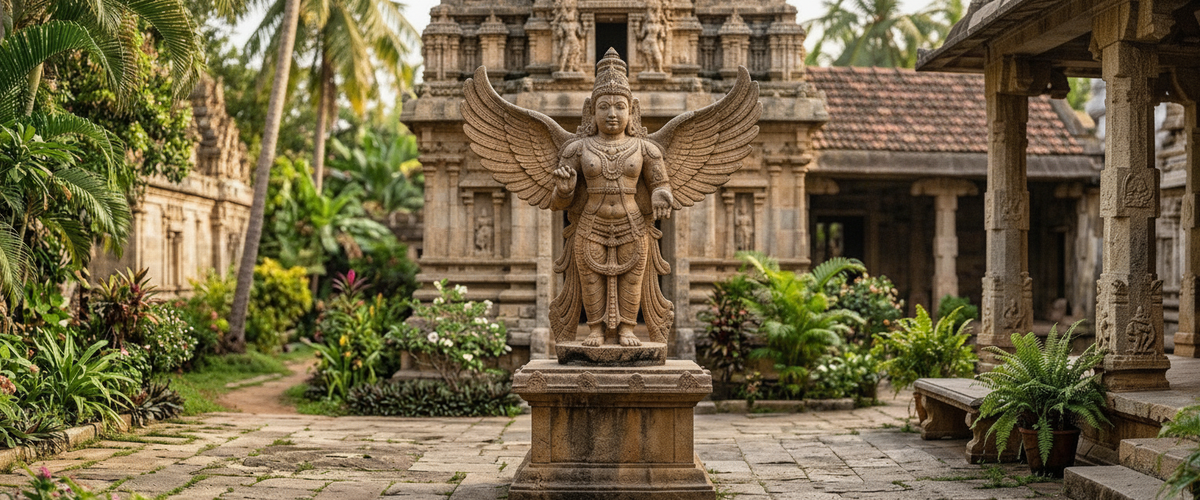

A Garuda parked beside the barbecue looks like a souvenir. Put the same figure at the end of a gravel axis, raise it on a plinth, and set a dark hedge behind it, and it looks as if it has guarded that spot for centuries. Large ancient bird statues carry their meaning in where they stand. In our experience, the costly mistakes rarely happen at the point of purchase. They happen in the first week after the crate is opened.
Garuda, the part-man, part-eagle mount of Vishnu, appears across Hindu and Buddhist art from India to Cambodia and Indonesia. He crowned pillar capitals, flanked temple doorways and knelt on the main axis of a shrine. The mythology behind the figure casts him as a protector and a destroyer of serpents. That is a job description, and it tells you where he wants to be placed.

At a Glance
Origin: Garuda was a guardian of gateways and sacred axes, so place him at thresholds or the end of a long view.
Pose: spread wings need a long axis; a kneeling Garuda suits a niche or a position beside an entrance.
Height: a plinth restores the elevation a temple once gave the figure.
Backdrop: plain, dark or open backgrounds let the wing silhouette read.
Shelter: genuinely old stone or carved wood needs a covered loggia in freezing climates.
Start With the Gateway
Temple builders did not scatter guardian figures around a compound. They put them on the line of approach, where a visitor would meet them before passing into a more important space. The figure marked a change of status: outside to inside, public to sacred.
Your garden has the same transitions, even if they are less dramatic. The gate from the drive into a walled garden. The top of a flight of steps down to a pool terrace. The end of an allée seen from the main living room. Those are the spots where large ancient bird statues make sense, and a buyer who starts there will almost never regret the placement.
Spread Wings or Kneeling Figure? Match the Pose to the Space
The two classic Garuda poses ask for opposite settings. A spread-wing Garuda is a horizontal composition. The wings need air on either side, and the figure reads best from a distance, along a straight path or lawn where the eye travels toward it. Crowd those wings with shrubs or a fence and the silhouette collapses into a confused outline.
A kneeling Garuda, hands pressed together or arms raised as if supporting a lintel, is compact and frontal. It was often made to sit in a niche or against a doorjamb, and it still behaves best that way. Think of a pair flanking the front door of a Texas Hill Country house, or a single figure set into a recess in a stone retaining wall.
We have seen a spread-wing figure sited on a pool deck, competing with loungers and umbrellas. Moved to the far end of a cypress walk, it suddenly held the whole garden together. Same sculpture, entirely different result.

Why Large Ancient Bird Statues Read as Art at a Threshold
Context does most of the work. Large ancient bird statues placed at a threshold borrow some of the ceremony they had in their original setting, and visitors read them as considered, collected objects. Placed casually among outdoor furniture, they lose that authority and start to look themed.
The test we give clients is simple: would the figure make sense if the garden were empty of furniture, planters and lighting? If the answer is yes, the position is probably right. If the sculpture only works as a talking point next to the grill, it is functioning as decoration rather than art.
Plinth Height: Restoring the Temple's Elevation
Like most temple guardians, Garuda figures were usually raised: on a column, a stepped base or a temple platform. At ground level they lose their watchful posture, and visitors end up looking down on a figure designed to look down on them.
As a starting point, a plinth of roughly 2 to 4 feet (60 to 120 cm) brings a life-size kneeling figure close to eye level, while a spread-wing figure at the end of a long view can go higher because it is read from further away. Where a plain block would feel too blunt, a carved column lets the base carry part of the story: on the Clear Guardian Lion on a Gilded Bird Relief Column - 168cm, the bird imagery sits in gilded relief on the shaft while the guardian above is lifted to a commanding height. For heavy stone or bronze, the plinth also needs a proper footing and fixing, which we size during the commission rather than guessing on site.

Clipped Yew, Stone Wall or Open Sky
Wings are only as good as what sits behind them. Three backdrops work reliably for large ancient bird statues:
Clipped yew or dark hedging: the near-black green throws pale stone and gilded or patinated bronze forward. Ideal for a Hamptons or Connecticut garden with formal structure.
A plain stone or rendered wall: warm and architectural, and the best choice for a kneeling Garuda in a niche.
Open sky: dramatic for a spread-wing figure on raised ground, as on an Aspen hillside or a California hilltop, where the silhouette becomes the whole point.
Avoid busy flowering borders and patterned trellis. They fight the feathers.
Old Stone and Carved Wood Need a Roof
Genuinely old examples of large ancient bird statues were usually carved in sandstone, volcanic stone or tropical hardwood, materials suited to warm climates rather than frost. Water gets into the pores, freezes, expands and pushes off the surface. We have seen weathered sandstone shed a layer of detail after a single hard winter outdoors. In a British winter or a New England one, an antique figure belongs under a covered loggia, porch or pavilion, a principle echoed in heritage guidance on stone care.
Not every sheltered space can take a full guardian figure, either. On a loggia console or in an entrance hall, a smaller piece that borrows from ancient forms, such as the Amber Jade Effect Pierced Disc & Brass Birds Resin Sculpture - 40cm, with its echo of the ancient Chinese ceremonial jade disc, can carry the bird motif indoors while the main figure holds the garden axis.
If you want a figure fully exposed to the weather, commission a new piece in bronze or a dense, frost-resistant stone. Bronze in particular holds fine feather detail for generations and can take an aged patina that suits the ancient subject.

Buying Checklist for Large Ancient Indian Garuda Bird Statues
Before you shortlist large ancient Indian Garuda bird statues for sale, work through this list:
Site first: identify the threshold or axis before choosing the figure.
Pose to space: spread wings for long views, kneeling for niches and doorways.
Material to climate: antique stone or wood only with shelter; bronze or hard stone for open ground.
Provenance: ask for documentation on any piece described as old, and know the difference between antique and antique-style.
Weight and access: confirm crane or machinery access and plinth footings.
Budget: it depends on material, scale, carving complexity, engineering, installation and finish, so request a tailored quote rather than comparing headline figures.
Giant Sculptures makes bespoke guardian figures in bronze and carved stone, sized to the axis, niche or gateway they will occupy, and ships them worldwide with installation guidance. Our bird sculptures and statues are a useful place to compare scale, and our bronze animal sculptures show how patina and detail age outdoors. Then tell us where your Garuda will stand. That decision shapes everything else.
For wider placement ideas, Large Eagle Statue in the Garden: Why the Perch Matters More Than the Bird is useful companion reading before finalising the setting and sightlines.