





































































































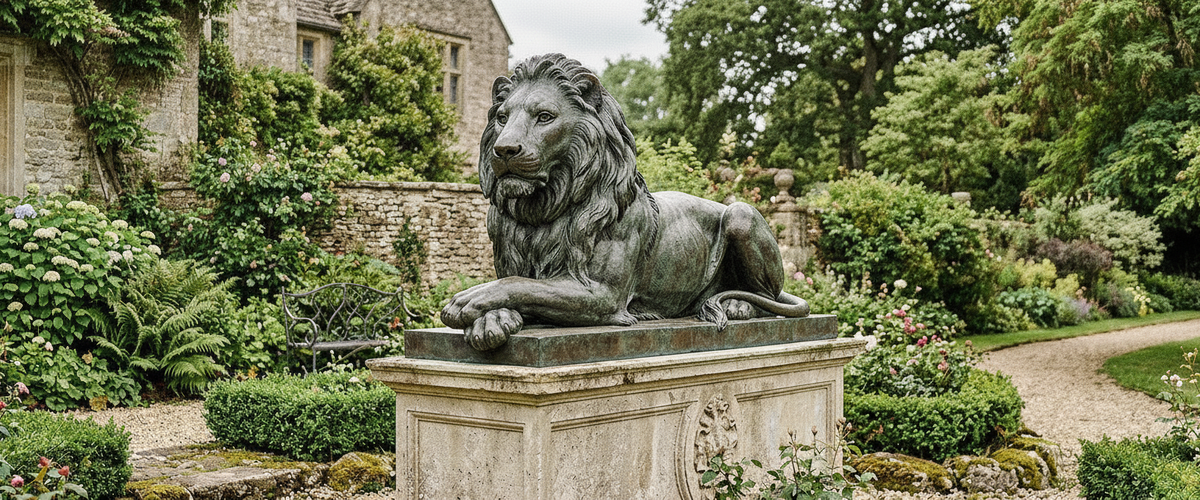

A rampant lion at the gate says something about the owner. A sleeping one says something about the house. That single difference explains why sleeping lion garden statues keep winning commissions on private drives and terrace gardens, while the roaring, clawing versions increasingly look like a hotel entrance. Calm authority ages better than aggression. The catch is that a recumbent animal is a low, horizontal object, and low horizontal objects are the easiest things in a garden to get wrong.
Looking for the full range in this category? Browse our Lion Statues & Sculptures collection for every available finish, size, and configuration.

Key Takeaways
Sleeping lion garden statues read as confidence; upright snarling poses read as signage.
A lying figure loses its silhouette below roughly knee height, so plinth height is not optional.
Gatepost flanks, step returns and terrace edges each demand a different plinth and gap.
Planting should stop below the jaw line, never at it.
Wet ground contact, not weather, is what damages bronze and stone bases over decades.
Budget depends on material, scale, engineering and finish, so ask for a tailored quote rather than assuming a figure.
Recumbent Beats Rampant When You Want Calm Authority
Guardian animals work on implication. A lion lying with its head raised and forepaws crossed is not resting because it is tired; it is resting because nothing in the vicinity worries it. That is a far stronger message than bared teeth, and it survives repetition. You drive past your own gate several thousand times a year. A snarl gets tiring. A sleeping lion does not.
The pose also suits contemporary architecture better. Flat-roofed California builds, long Texas ranch frontages and modern Hamptons shingle houses all favor horizontal lines, and sleeping lion garden statues agree with them. If your house is genuinely classical, a tall seated figure on a pier still holds its own against columns and pediments. Set that same upright figure against a low modern facade and it starts to compete instead of complement. Where the frontage is low but the setting still wants classical weight, a crouching pose sits between the two: Large Classical Crouching Lion Bronze Sculpture, 140cm keeps the long, coiled line of a recumbent animal while carrying enough shoulder mass to read from the drive.
Piers do the elevation work, so the plinth under each animal can stay shallow.

Horizontal Mass Reads Badly at Ground Level
Here is the problem nobody warns buyers about. A sleeping lion is mostly length, and length disappears when you view it from 40 feet (12 m) away at eye level. The mane, the jaw, the shoulder mass: all of it flattens into a gray-brown lump behind the lavender. We have had clients call the studio three weeks after installation convinced the piece looked bigger in the photographs. It did not. It was sitting on grass. That is where most sleeping lion garden statues are lost, not in the casting.
The fix is elevation and background contrast. Raise the piece so its top line sits somewhere between hip and chest height for a standing adult, and put something plain behind it: a clipped hedge, a rendered wall, a stone pier. Bronze against green hedging reads beautifully because the patina is dark and the leaf is matte. Bronze against mixed border planting reads as camouflage.
Plinth Height for a Figure That Is Already Lying Down
Upright statues can tolerate a short plinth. Recumbent ones cannot. As a working rule, a lying lion wants a plinth roughly equal to its own body depth, and often a little more. For a mid-size piece that means something in the range of 18 to 30 inches (45 to 75 cm), enough to lift the jaw into the natural sightline of anyone walking or driving past.
Proportion matters as much as height. Keep the plinth footprint slightly larger than the base of the sculpture, with a consistent reveal of an inch or two (25 to 50 mm) on every side. Chamfer or weather the top edge so water runs off rather than pooling against the metal. And specify the plinth material before the sculpture ships, because bronze on honed limestone and bronze on riven granite are two very different pieces of design. Our commissioning team usually models this with the client before casting is finalized on any bespoke piece.
Gatepost Flanks, Step Returns and Terrace Edges Compared
Three siting habits cover most of what we ship, and they behave differently.
Gatepost flanks. The classic. Piers do the elevation work for you, so the plinth can be shallower. Keep both animals fully outside the swing arc of the gate and clear of vehicle tracking lines; a delivery truck turning tight will find your lion before you do.
Step returns. Placing a recumbent figure on the flanking wall of an entrance stair is the most flattering option, because you meet the sculpture at close range and slightly below its head. This is where a grouped piece such as the Life-Size Traditional Lioness and Cub Bronze Sculpture, 110cm earns its keep, since the secondary figure gives the eye somewhere to travel at arm's length.
Terrace edges. Good for views out, weaker for arrival. A lion on a terrace parapet becomes part of the garden composition rather than a guardian. Works best when it faces the same way the seating does.
A step return brings you close to the head, which is the most flattering viewpoint for a lying figure.

Planting Around a Low Form Without Swallowing the Jaw Line
The instinct is to soften the base with planting. Do it, but set a hard ceiling: nothing should ever grow above the bottom of the plinth reveal. Low box, dwarf hebe, thyme or a tight gravel skirt all flatter sleeping lion garden statues. Grasses do not, because they arch into the face by August. Avoid anything that drops sap, berries or resinous debris directly onto the piece.
One practical note from the studio: keep a clear maintenance band of at least 12 inches (30 cm) around the plinth so a gardener can strim without hitting stone or metal. Strimmer nylon takes the wax layer off a patinated bronze surprisingly fast.
Matched Pairs: Mirrored Poses, Shared Sightline, One Careful Gap
Pairs need three things to work. The poses must be true mirrors rather than two copies of the same casting facing each other, the heads must share a sightline aimed at the arriving visitor, and the gap must be generous. A common mistake is setting the pair too close, which makes an eight-foot opening feel like a checkpoint. Measure the opening, then ask whether the pair still allows two people to walk abreast comfortably. Buying a cast pair such as Large Classical Seated Lion Pair Bronze Sculpture, 130cm settles the mirroring question at source, which is why we often steer clients toward pairs sold as pairs rather than two singles bought separately.
Guardian lions carry real cultural weight in this configuration. The Chinese guardian pair, with a male and female distinguished by ball and cub, follows conventions documented by the Smithsonian's National Museum of Asian Art, and worth respecting if you choose that tradition rather than the European classical one.
Where Sleeping Lion Garden Statues Rot From Below
Weather is rarely the villain. Standing water is. A recumbent figure has a broad, flat underside sitting in direct contact with its base, and in winter that interface stays wet for weeks. Trapped moisture drives bronze disease in cast metal and accelerates spalling in stone. The Getty Conservation Institute's work on outdoor metal conservation is clear that isolating the object from persistent moisture matters more than any surface coating.
Three details to specify at order stage: stainless steel or non-ferrous dowels rather than mild steel, a bedding method that leaves a drainage path rather than sealing the perimeter, and drilled weep holes in any hollow cast form. Then wax patinated bronze annually with a microcrystalline wax before the first hard frost. Marble and limestone bases benefit from a breathable consolidant rather than a film-forming sealer.

Buyer Checklist Before You Commission
Photograph the site from the actual approach distance, not from the front door.
Check the top-line height of the sculpture plus plinth against standing eye level.
Confirm the background: hedge, wall or pier, never mixed border.
Measure vehicle swing paths and gate arcs.
Decide single figure or mirrored pair before you shortlist castings.
Agree fixing hardware, drainage detail and plinth material in writing.
Plan access for delivery; large bronze arrives crated and needs machine handling.
A recumbent lion is a quiet object that only works when the groundwork is right: the correct plinth, a plain background and a base detail that drains. Get those three things settled and the pose does the rest. Continue through the wider range of bronze sculptures and garden sculptures, or talk to Giant Sculptures about bespoke sleeping lion garden statues scaled to your gate opening. Cost depends on material, scale, complexity, engineering and finishing, so the sensible next step is a tailored quote against your site measurements.
For wider placement ideas, Bird Statues for Garden Spaces: Why Height Beats Size Every Time is useful companion reading before finalising the setting and sightlines.