





































































































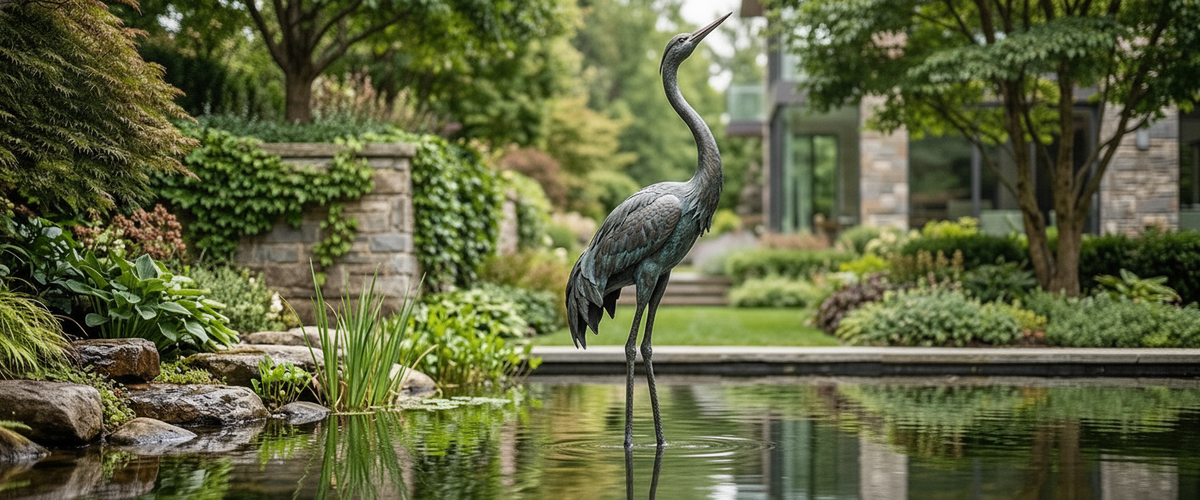

A bronze heron standing flat on the lawn reads as garden ornament. Lift that identical bird onto a 30-inch (76 cm) stone plinth and it reads as sculpture. Nothing about the casting changed. Height did. That single decision, made before you choose the species or the finish, does more for the success of bird statues for garden settings than any other choice you will make, and it is the one most buyers skip.

Quick Answer: What Actually Decides the Outcome
Six decisions do most of the work when you are placing bird statues for garden schemes, and most of them have nothing to do with the bird itself.
Mounting height sets the register. Ground level is decorative, plinth height is sculptural, post or pier height is architectural.
Backdrop beats size. A pale wall or open sky will carry a slender bird that a dark hedge or busy border swallows whole.
Life-size is a trap for small species. A wren at true scale disappears at ten paces; a heron at true scale holds a whole lawn.
Material follows exposure. Bronze and stainless steel handle wind, salt and freeze cycles better than cast stone, so an open site narrows the field for garden bird statues fast.
Groups need uneven spacing. Three birds set at equal intervals read as a shop display, not a flock.
Fixings decide year two. Soft ground and slender legs are the classic combination for a piece that tilts by February.
Ground, Plinth or Post: The Same Bird Reads Three Different Ways
Set a bird directly on grass or gravel and the eye files it with the planting. Plenty of bird statues for garden paths work exactly that way: a quiet find at the end of a route, a crane half-hidden in ornamental grasses, or a pair of ducks at a pond edge. It stops working the moment the piece is meant to anchor a view.
The same heron at ground level reads as ornament; on a 30-inch plinth it reads as sculpture.
A plinth of 24 to 36 inches (61 to 91 cm) lifts the bird into the sightline of someone standing on a terrace, which is where most people will see it from. Go higher, onto a pier or gate post, and the bird becomes part of the architecture. That is the first fork in the road for bird statues for garden positions: decorative, sculptural, or architectural. We shipped a pair of bronze birds to a Napa property last year where the client had planned them for a lawn; the architect moved them onto the flanking piers of the entry court instead, and the whole approach changed character. Same castings, different job.
One warning about high mounting: you are now looking at the bird from below. Garden bird statues on piers and gate posts get read from underneath, so check the underside of the body and the modeling of the feet before you commit, because a piece designed to be viewed from above will show you a flat, unresolved belly.

A Life-Size Heron Holds the Lawn, a Life-Size Wren Vanishes Into It
Great blue herons stand around 4 feet (1.2 m) tall with a wingspan close to 6 feet (1.8 m), which is exactly why they work as garden sculpture at true scale. A house wren is roughly 4.5 inches (11 cm) from bill to tail. The Cornell Lab of Ornithology is a useful sanity check here before you assume a species will read at life size. Life-size is not a default setting for bird statues for garden use; it is one option among several.
Small species need one of two treatments. Either scale them up well beyond life size so the form becomes an object in its own right, or mount them close to the viewer on a wall, a post, or a table-height pier where the detail can be read. That is where most garden bird statues go wrong at the small end. Attempting a true-scale songbird in the middle of a half-acre lawn is money spent on something nobody will notice.
At the other end, tall wading birds carry distance beautifully. Where a lake edge or a long axial view needs presence at fifty paces, a piece like the Monumental Modern Crane Bird Bronze Sculpture - 300cm at 300cm (close to 10 feet) does it on the legs and neck alone, with no plinth involved. That is the honest test for large-scale bird statues for garden use: does the bird carry its own height, or does it need height borrowed from masonry?
Check the Backdrop Before You Choose the Bird
Silhouette is the whole game with bird forms, because bird statues for garden borders are read as outlines long before anyone sees the modeling. Legs, necks and beaks are thin, and thin things need contrast. Dark patinated bronze against a clipped yew or boxwood hedge can vanish; the same bronze against a pale limestone wall, a swimming pool, or open sky is crisp from fifty feet away.
Reverse the logic for polished stainless steel. Mirror finishes want planting and sky around them to reflect, and garden bird statues in polished steel turn muddy against a busy stone facade. Corten is the most forgiving against green, since the orange oxide reads warm at any distance.
Water doubles the outline, which is why pond-edge and fountain positions punch above their size.
Water complicates this again, in a good way. Bird statues for garden pools and rills gain a second silhouette in reflection, which is why a combined bird bath and fountain such as the Classical Bird Bath and Swan Fountain Bronze Fountain - 220cm tends to hold a formal garden so well. You get movement, sound and a doubled outline from one installation.
Cast Stone, Bronze and Steel Judged on an Exposed, Windy Site
For wider placement ideas, Metal Bird Sculptures for the Garden: The Rod Gauge Nobody Checks is useful companion reading before finalizing the setting and sightlines.
On a sheltered courtyard almost anything survives. On a Hamptons dune garden or a Texas ridge with real wind loading, the material ranking for bird statues for garden use changes sharply.
Bronze: the benchmark for slender bird anatomy. It takes fine detail, resists corrosion through its own patina layer, and can be cast with internal armature running through the legs. The V&A's overview of bronze casting sets out how the lost-wax process works, which is why it suits this kind of thin-limbed form.
Stainless steel: excellent for stylized or abstracted birds, and the marine grades handle coastal salt well. Fabricated wings and tails can be engineered thin without becoming fragile.
Corten: strong for flat-profile or cut-plate birds. Be aware the initial oxide run-off can stain pale paving in the first year, so keep it off limestone terraces.
Cast stone and marble: beautiful for perched, compact forms with the body close to the base. Poor for long legs and outstretched wings on an exposed site, since the weak point is always the narrow section.
Freeze-thaw is the quiet killer for stone garden bird statues. Water sits in a wing hollow, freezes, and opens a hairline. If your site drops below freezing regularly, either choose metal or specify a form with no water-trapping pockets.

Two Figures or Three, and the Spacing That Stops Them Reading as a Flock
Grouped bird statues for garden lawns fail in a predictable way: identical spacing, identical facing, identical height. That reads as inventory.
Work in odd numbers where you can, and vary all three factors. Two birds at the same height facing the same direction look posed; the same two, one alert with head raised and one feeding with the neck down, look observed. For three, set two closer together and push the third out at a distance roughly twice the first gap. Turn at least one bird 30 to 45 degrees off the main sightline so the group has depth rather than a front row.
Figurative pieces that include birds work differently from grouped garden bird statues and often need no companions at all. A composition such as the Life-Size Traditional Girl with Bird Trays Bronze Sculpture - 220cm already carries its own narrative and internal spacing, so it suits one strong position: the head of a lawn, or the center of a walled garden, where a flock arrangement would only compete with it. The wider bird sculptures collection covers both approaches if you are still weighing single focal piece against group.
Fixing Into Soft Ground So Nothing Tilts by February
Slender legs concentrate a lot of load onto a very small footprint, and that is where bird statues for garden lawns come unstuck. Grass, mulch and new topsoil all move. Here is the sequence we specify on commissions:
Excavate a concrete pad below the local frost line, sized wider than the sculpture footprint, not just equal to it.
Cast in stainless steel threaded rods or dowels matched to the sculpture's baseplate or leg tubes.
Bed the piece on a non-shrink grout so load spreads evenly rather than sitting on three high points.
Keep the top of the pad slightly proud of grade and slope surrounding soil away, so water does not pool at the fixing.
For tall single-leg poses, agree the internal armature spec at commission stage. Retrofitting structure into a finished casting is not realistic.
One field note from our own installs: irrigation lines are the usual reason a fixing gets moved late in the day. Mark them before excavation, not during.
Before You Buy: A Site Checklist
Work through this before you commit to bird statues for garden positions you cannot easily change later.
Photograph the position from the three places people will actually stand.
Mock the height with a stake and cardboard cutout before ordering a plinth.
Confirm the backdrop tone: dark, pale, or open sky.
Check access for delivery and lifting equipment, including gate widths and soft lawn crossings.
Decide whether the bird is the focal point or a discovery on a route.
Ask for the patina or finish sample against your own stone or paving color.
Confirm foundation and fixing requirements in writing before the piece ships.

Commissioning a Bespoke Bird Sculpture
Stock bird statues for garden projects solve most briefs. Commission work earns its place when the species matters (a client wanting the wading birds they actually see on their property), when the scale has to be unusual, or when engineering demands it, such as a wing span cantilevered over water.
Budget for a bespoke bird depends on material, finished scale, complexity of pose, structural engineering, installation and the finishing specification, so the sensible route is a tailored quote against your site rather than a guess from a catalog. Send us site photos, the viewing distances, and a note on exposure. Our team at Giant Sculptures works through form, patina and fixing detail from there, and the same conversation applies whether you are starting from a stock casting in bronze animal sculptures or from clay.
Get the height and the backdrop right and even modest bird statues for garden settings earn their position for decades. Get them wrong and the finest casting in the world looks like something the garden center left behind.