

























































































Ask a conservator which part of a horse sculpture gives way first and almost nobody says "the legs." They say the base. Horse statues and sculptures concentrate enormous mass onto a footprint the size of a dinner plate, and that geometry finds every shortcut in the foundation years before it finds a fault in the casting. Buyers spend weeks choosing pose and patina, then approve a plinth detail in ninety seconds. That is backwards.

Key Takeaways
Pose dictates engineering. A grazing horse spreads load across four hooves; horse statues and sculptures caught mid-trot or rearing concentrate it onto two or even one.
Standing water at the base is the single most common cause of long-term damage, in bronze and cast stone alike.
De-icing salt from gritted drives is far more corrosive to cast stone and mild-steel armature than sea air alone.
Bronze hides stress, stainless steel shows it at the weld, cast stone cracks openly and early.
Ten minutes of inspection a year, done properly, catches nearly every problem while it is still cheap to fix.
The Three-Point Contact Problem
A standing or grazing horse is a four-legged table. Load paths are short, vertical and forgiving, and the piece will sit happily on a well-poured pad for decades. Lift one hoof for a trot and you remove a quarter of the support while adding a twisting moment to the remaining three. Lift two for a rear and you have a cantilever with a half-ton animal on the end of it.
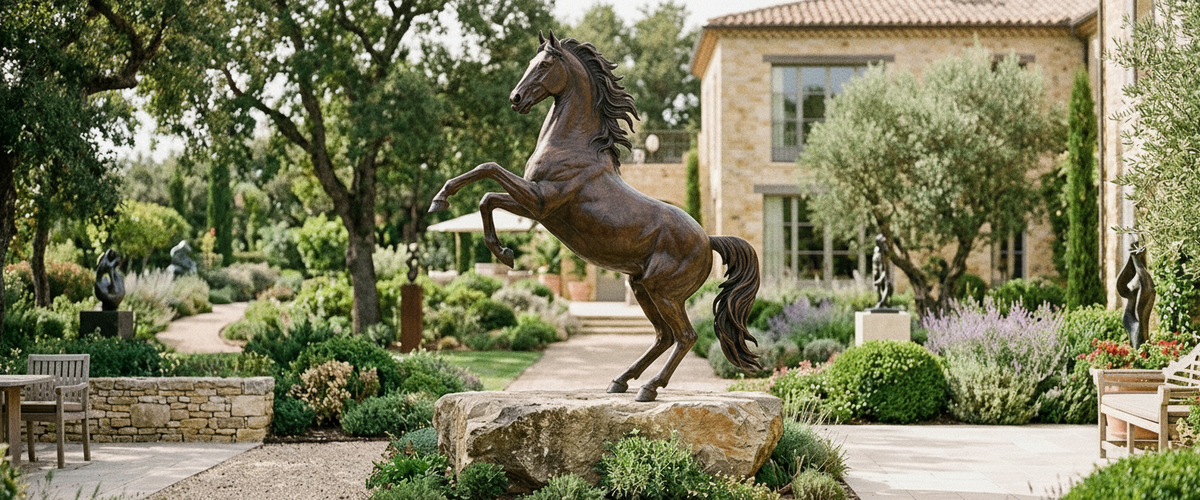
This is why dynamic horse statues and sculptures need a structural conversation before a stylistic one. On a rearing piece at the scale of the Monumental Classical Rearing Winged Horse Bronze Sculpture - 260cm, roughly 8 ft 6 in (260 cm) tall, the hind legs and tail work together as a tripod, and the tail is carrying real structural load rather than decoration. Foundries handle that with internal steel, thickened wall sections at the hocks and anchor bolts sunk into the plinth. Skip any of the three and the piece becomes a lever waiting for a windy night.
A rearing pose turns the hind legs and tail into a tripod, which is why the plinth and anchor design matter more than the patina.

One Shallow Puddle Is All It Takes
We once inspected a bronze horse at a Napa property where the gravel drive had settled over eight years and now drained straight into the plinth bed. The horse looked perfect from ten feet. Up close, the two rear hooves sat in a permanent quarter-inch (6 mm) film of water, and the patina there had gone from warm brown to a chalky green crust that flaked under a thumbnail.
Water that never dries behaves differently from rain. It keeps the metal wet, concentrates minerals as it evaporates, and works into the joint between hoof and mounting plate where nothing can be waxed or inspected. The Canadian Conservation Institute is blunt about this: protective wax coatings on outdoor bronze depend on drainage and regular renewal, not on the metal's own toughness. Drainage, not wall thickness, is what keeps horse statues and sculptures sound at the hoof line. Specify a base that sheds water. Crown the pad, fall it away at a minimum of 1 in per 4 ft, and never let a bedding mortar sit proud of the hoof line.
The hoof-to-plate junction is where staining, silt and moss appear first. It is the cheapest thing on the whole piece to inspect.
Salt Spray, Gritted Drives and Winter Chemistry
Coastal clients expect salt. Inland clients rarely do, and they are the ones who get caught. Rock salt thrown by a plow travels further than people think, and a horse sculpture flanking a driveway in Aspen or Connecticut takes a chloride hit every storm. Cast stone suffers worst: chlorides drive freeze-thaw cycling deeper into the pores, and the Cast Stone Institute flags de-icing chemicals as a leading cause of surface spalling. On bronze, chlorides can trigger active corrosion under the patina, which shows up as bright green powdery spots rather than an even film.
The practical fix is placement, not chemistry. Keep horse statues and sculptures at least 6 ft (1.8 m) back from a salted surface, or accept that you are signing up for a spring rinse with clean water every year.

Bronze, Stainless and Cast Stone: Which Material Warns You First
Each material has a different tell, and knowing it changes what you inspect.
Bronze is the quietest. It flexes, work-hardens and hides fatigue under patina. Look for hairline patina disruption at the fetlocks and where legs meet the plate; that is where movement shows before metal does.
Stainless steel tells the truth at the welds. Discoloration or tea-staining at a joint means the passive layer has been compromised, usually by embedded iron particles from grinding or nearby steelwork.
Cast stone is the most honest and the least forgiving. It cracks visibly, often at a slender leg or a joint line, and once water is in a crack the next freeze widens it.
For long-term outdoor life at scale, bronze remains the default in our studio, which is why most of the pieces in our bronze horse statues collection are cast rather than carved. Cast stone earns its place in sheltered courtyards and warm climates.
The Plinth Is Nearly Always the Part That Gave Way
In failure after failure, the horse survives and the plinth does not. Typical causes: a pad poured too thin for the frost line, anchor bolts set into masonry rather than concrete, a decorative stone cap that carries no load, or bedding that traps water against the mounting plate. Freeze cycles then lift one corner by a few millimetres a year, and the sculpture starts to rock. Rocking is what kills castings.
When we quote a monumental commission, foundation design is part of the engineering conversation from day one. Where the brief adds water to mass, as it does with the Monumental Classical Pegasus Winged Horses Bronze Fountain - 300cm at close to 10 ft (300 cm), the base has to carry structural load and service access at the same time. Budget for horse statues and sculptures at this scale depends on material, size, complexity, engineering and installation, so ask for a tailored quote rather than assuming the sculpture cost is the whole cost.
Rearing Poses and Hidden Armature After Fifteen Wet Years
Internal steel is the part nobody sees and everybody forgets. In a well-made bronze, the armature is stainless or non-ferrous and isolated from the outer skin. In cheaper work, mild steel is bedded directly against bronze, which sets up galvanic corrosion the moment water reaches it. The steel expands as it rusts, and expanding steel inside a fixed bronze wall does exactly what you would expect: it splits it, usually along the inside of a hind leg.
Ask any supplier what the armature is made of, whether it is isolated, and whether internal cavities drain. Scale changes how much is riding on the answer. A terrace-sized piece like the Large Contemporary Winged Horse Bronze Sculpture - 90cm at 3 ft (90 cm) puts modest demands on its internal structure, while monumental horse statues and sculptures live or die by that hidden skeleton.

The Ten-Minute Annual Check
Walk a full circle and look at the hoof line. Any staining, silt or moss means water is sitting.
Press a thumb at each hoof-to-plate junction. Grit or softness underfoot means the bedding has moved.
Push firmly at shoulder height. Any rock, however slight, is a foundation issue, not a sculpture issue.
Inspect fetlocks, hocks and tail contact points for patina breaks or hairline marks.
Check drainage holes are clear; a blocked drain in a hollow leg holds water all winter.
On stainless, wipe a weld with a clean white cloth and look for orange transfer.
Rinse with clean water after the last salt application of the season, then dry and re-wax bronze where the finish looks dull.
Anything you cannot resolve in that ten minutes is worth a photograph and an email. Most of the repairs we see would have cost a fraction if someone had noticed the rock a year earlier.
Choosing Well the First Time
Pick the pose for the site, not just for the room it will photograph in. Open Texas acreage can carry a rearing silhouette; a walled Hamptons garden usually reads better with a grazing or standing horse that lets the planting breathe. Then match material to climate and salt exposure, and insist on foundation drawings for anything above roughly 6 ft (1.8 m). Giant Sculptures builds bespoke horse statues and sculptures to commission in bronze, stainless steel and stone, and the questions above are the ones we ask clients before we ever discuss patina color. Browse the wider horse sculptures and statues range to see how pose and scale change the engineering brief.
For wider placement ideas, A Large Bronze Horse Sculpture Needs Room to Move is useful companion reading before finalising the setting and sightlines.