





































































































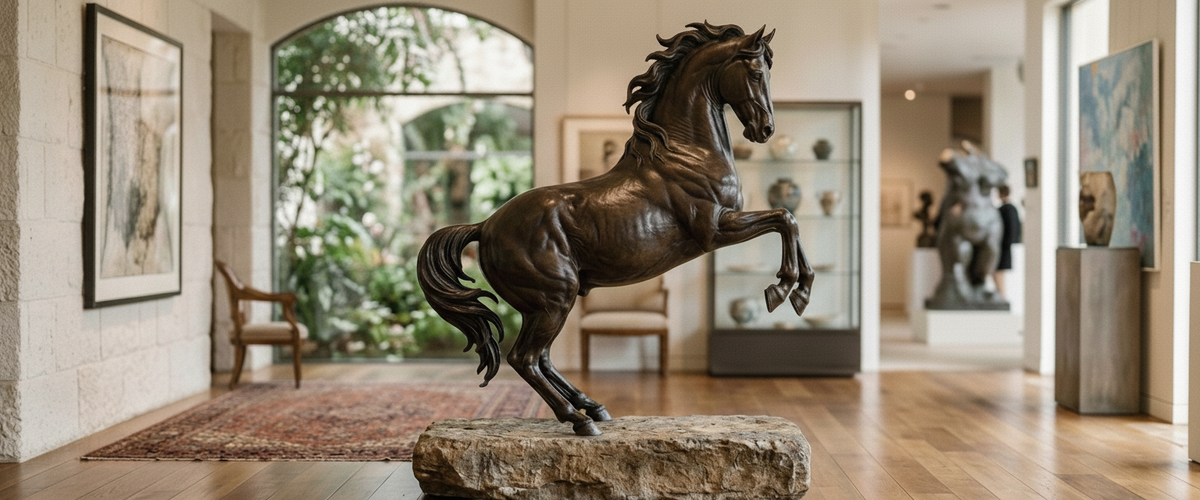

Most large bronze horse sculptures that disappoint were never badly cast. They were badly placed. A rearing stallion set eight feet from a gatepost stops feeling heroic and starts feeling like an obstruction, and no amount of patina work will fix a sightline problem. Horses carry motion in their bodies, and motion needs air around it. Get the distance, the approach angle and the ground right, and a large bronze horse sculpture will hold a drive, forecourt or paddock edge for a hundred years.

At a Glance
Pose sets viewing distance. Every large bronze horse sculpture needs a run-up matched to its pose: rearing forms want the longest, grazing forms want open land behind them.
Head direction is a greeting. Point it across the approach, not straight down the driveway at arriving cars.
Foundation first. Cast bronze at life size is heavy enough to demand a poured pad, dowels and a designed plinth.
Access decides everything. Crane position, gate widths and ground protection are site questions, not delivery-day questions.
Budget varies with scale, wall thickness, finishing, patina, engineering and installation. Ask for a tailored quote rather than working from a guess.
Why a Horse Still Reads as Authority
The equestrian bronze is the oldest power symbol in Western sculpture, and it still works on a residential drive in Texas or a corporate forecourt in Charlotte. The gilded bronze Marcus Aurelius held by the Capitoline Museums survived because a horse and rider read as legitimacy, and that association never really left us. Clients rarely say the word authority out loud. They say they want the entrance to feel finished, or that the paddock fence needs a full stop at the end of it.
Horses also solve a practical problem. A large bronze horse sculpture gives you mass and silhouette without the awkwardness of a figure staring at guests. Browse our bronze horse statues and you will see the range: classical equestrian groups, contemporary winged forms, and studies of stillness that suit a lawn better than a gate.

Pose Decides How Much Distance You Need
A rearing pose only works when the approach is long enough to read the whole diagonal.
Rearing: Give It Distance or It Looms
A rearing large bronze horse sculpture is the most requested and the most misplaced. Vertical drama needs a long approach so the eye can take in the whole diagonal from hind hoof to raised head. Set too close to a wall, a hedge or a windscreen, and the piece stops lifting and starts threatening. At the scale of the Monumental Classical Rearing Winged Horse Bronze Sculpture - 260cm (roughly 8 ft 6 in), the piece wants a clear run of open ground in front of it, ideally an approach where the viewer sees it from thirty paces before they reach it. We once mocked up a rearing piece in plywood for a Napa estate before casting; the client moved it back nearly forty feet from the original mark and never questioned the cost of the mock-up again.
Trotting: Find the Passing Line
A trotting or walking large bronze horse sculpture is a profile piece. It reads best side-on, from a car window, a footpath or a curving approach, and it dies when you park it facing an arriving visitor head-first. Think about the passing line: where does traffic move, and at what speed? Where the drive bends rather than runs straight, a contemporary group such as the Life-Size Contemporary Rotund Rider and Horse Bronze Sculpture - 200cm (about 6 ft 7 in) rewards a slow pass, because the silhouette rotates as you move past it.
Grazing: Land Behind, Not a Wall
Grazing horses are the hardest to place and the most convincing when they land. The pose implies pasture, so it needs depth behind it. Two meters of hedge behind a grazing bronze kills the illusion instantly. On a Hamptons property we sited a lowered-head piece at the far edge of a lawn with meadow beyond it, so the animal appeared to belong to the land rather than the garden design. If you only have a courtyard, a compact form works harder than a full-size large bronze horse sculpture: at roughly 3 ft, the Large Contemporary Winged Horse Bronze Sculpture at 90cm reads as an object rather than an animal in a field, which is the right decision for tight ground.

Which Way the Head Faces
Head direction changes the emotional temperature of an arrival more than any other single decision you make about a large bronze horse sculpture. A head turned across the approach welcomes; a head aimed straight at the gate confronts. On commercial sites we generally angle the horse fifteen to thirty degrees off the main axis so drivers see a three-quarter view rather than a flat frontal. Ears and muzzle also catch the most light, so face them toward the dominant afternoon sun if you want the modeling to show. Where a piece anchors a water feature, the head is what people photograph, which matters even more with a monumental Pegasus fountain group, where two raised heads sit above the basin and set the whole composition.
Ground Bearing, Armature and Plinth
A life-size large bronze horse sculpture is a serious structural load, and rearing poses concentrate that load on two hooves plus a tail or support point. That means an internal stainless armature, engineered anchor points in the casting, and a reinforced concrete pad sized by an engineer to the site's soil and frost depth. Bolt patterns should be set before the pad is poured, not drilled afterward.
Anchor bolts go into the pad before the piece ever reaches site.
Plinth height matters as much as plinth strength. Too tall and the horse floats; too low and the legs disappear into planting. For a rearing form we usually keep the base low so the vertical action stays in the animal, not the stone. Bronze itself will last generations outdoors, but the patina needs modest care: annual washing and a wax coat, following the outdoor sculpture maintenance guidance published in the AIC conservation wiki. Coastal sites in California and the Northeast want that done more often.
Access, Craneage and Commission Lead Times
The most common late-stage problem we see is not the sculpture. It is the gate. Before a large bronze horse sculpture is crated, we want photos of the access route, gate widths, overhead cables, turning circles and the ground the crane will stand on. Lawns need track mats. Some sites need the piece delivered in sections and assembled and welded in place, with the patina blended on site.
Lead times on a bespoke life-size commission are measured in months, not weeks, because clay modeling, mold making, lost-wax casting, chasing, welding and patination each take real time, and each stage carries an approval point. Build in shipping and customs on top. Rush a schedule and something gets skipped at the chasing stage, which is exactly where quality shows.

Buyer Checklist Before You Commission
Walk the site and mark the footprint of the large bronze horse sculpture. Stand where guests will stand.
Confirm the viewing distance suits the pose you want, not the pose you like in photos.
Decide head direction relative to arrival, sun and photography angles.
Get a structural opinion on the pad, drainage and anchor design.
Check bronze wall thickness, armature material and weld quality with your supplier.
Agree the patina color and whether it will be waxed or lacquered.
Photograph the full access route and share it early.
Plan annual cleaning and rewaxing into estate maintenance.
Giant Sculptures works with buyers, landscape designers and venue owners on exactly this sequence, from selecting an existing large bronze horse sculpture in our large bronze sculptures range to modeling a horse from scratch at a scale your site actually supports. Send us site photos and rough dimensions, and we will come back with pose options, plinth thinking and a tailored quote rather than a number pulled from the air.
For wider placement ideas, How to Place a Large Bronze Mermaid Statue so It Reads Like Art is useful companion reading before finalising the setting and sightlines.