












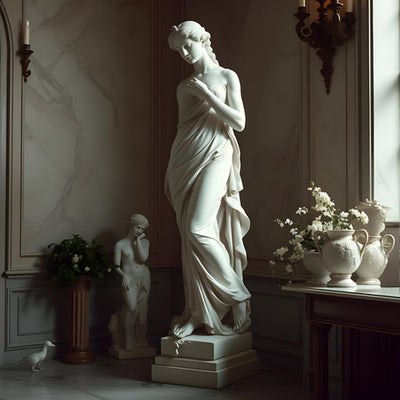

























The white marble Zeus in your head is almost certainly a Roman copy. Fifth-century BCE Greek sculptors cast their gods in bronze, and the pale figures that later filled European galleries were mostly marble versions of bronzes long since melted down, a point the Metropolitan Museum of Art makes plainly in its survey of Greek bronze statuary. That history matters commercially. Bronze Greek gods statues are not a downgrade from marble; they are the original material, and they survive American weather, from Hamptons salt air to Aspen freeze cycles, far better than stone does.

At a Glance
Bronze suits gods. The dark patina on bronze Greek gods statues reads as authority at distance; white stone can look ghostly against green planting.
Match the deity to the space. Zeus and Poseidon need open ground. Apollo, Hermes and Artemis prefer an enclosing hedge, wall or niche.
Attributes are the weak point. Thunderbolts, tridents, lyres and bows bend or snap first, and they should be engineered accordingly.
Plinth height sets the reading. Too tall and you lose the face; too low and a heroic pose looks stranded.
Drainage decides longevity. Water trapped at the feet does more damage over twenty years than rain, frost or sun combined.
An outward, wide-armed pose needs air on all sides to keep the gesture legible.
Why Bronze Greek Gods Statues Beat White Marble Outdoors
Patina is the argument. A dark brown or green-black surface absorbs light instead of bouncing it, so the muscles, drapery and hair stay legible at 40 feet (12 m) rather than flattening into glare. Marble does the opposite in strong sun, washing out at exactly the distance most gardens ask you to view it from. Bronze also carries fine modeling through the lost-wax process, and the surviving Greek and Roman work in the British Museum shows what that buys you: hollow-cast walls, separately cast limbs, and joins that hold for millennia when the alloy is right.
The practical case is maintenance. Stone gods in freeze-thaw climates spall, stain and lose fingers. A well-cast bronze on a properly drained base asks for a wash and a wax coat, not a conservator with a poultice.
Zeus and Poseidon Hold Open Lawn; Apollo Wants an Enclosure
Placing bronze Greek gods statues starts with the pose, because the pose tells you where the figure belongs. Zeus with a raised arm and Poseidon with a trident are wide, outward figures built to be circled, so they need air on all sides: the head of a long lawn, the center of a gravel motor court, the turn of a driveway on a Texas ranch. Crowd them with boxwood and the gesture dies.
Apollo, Hermes and the quieter Olympians are inward figures. A lyre held close, a sandal being fastened, a caduceus at the hip. These want a backdrop that pushes the silhouette forward: a yew hedge, a rendered garden wall, an arched niche in a pool house. We shipped a pair to a Napa courtyard where the client had planned them either side of a 90-foot (27 m) lawn. Moved into two shallow alcoves flanking the loggia, they suddenly looked commissioned for the house.
Group compositions change the calculation. At roughly 11 feet 6 inches (350 cm), a piece such as the Monumental Classical Roman Chariot with Warrior and Horses Bronze Sculpture - 350cm is a processional subject rather than a focal ornament. It needs a long approach so the horses read as movement, which usually means an avenue, a large forecourt or a commercial frontage rather than a residential terrace.

Thunderbolts, Tridents and Lyres: What Snaps First
Nearly every complaint we have fielded about bronze Greek gods statues involved something the god was holding. Trident tines, bowstrings, thunderbolt prongs and outstretched fingers are the thin extremities that catch ladders, hedge trimmers, delivery trucks and curious hands. On bespoke commissions we specify heavier-gauge internal armature at the wrist and elbow, and where a client wants a genuinely slender attribute we cast it as a separate element with a concealed threaded join, so it can be crated apart and replaced later without touching the figure.
Ask the question before you buy, not after. Is the trident cast solid or hollow? Is the lyre a fabricated element or part of the main pour? For public and hospitality sites, we generally advise removable attributes at ground-accessible height and permanent ones above 8 feet (2.4 m).
Dark patinas hold their silhouette against evergreen; warmer tones work harder against brick.
Patina Color Against Planting and Brick
Finish is where bronze Greek gods statues succeed or fail against a backdrop, yet buyers searching bronze Greek Roman gods statues for sale usually pick the figure and treat the surface as an afterthought. Reverse that order. Dark green-black and near-black chocolate patinas are superb against yew, holly and clipped evergreen, where the silhouette carries the whole composition. Against warm red brick, as on a Charleston garden wall or a Dallas colonial, a lighter reddish-brown patina keeps the figure from collapsing into the background; a black one can read as a hole in the wall.
Verdigris highlights work best on water subjects, which is why they sit so comfortably on a piece such as the Classical Bird Bath and Swan Fountain Bronze Fountain - 220cm, where mineral streaking looks intentional rather than neglected. If you are commissioning, ask for a sample plate in your two shortlisted patinas and look at them on site, outdoors, at the hour you actually use the garden.
Plinth Height and Setback
Plinth height decides how bronze Greek gods statues read on approach, and most Greek-Roman statues for sale online are photographed straight on at eye level, which is not how anyone will meet them. A heroic standing god modeled to be seen from below wants a plinth that puts the navel near your eyeline, so the chest and face open up as you walk toward it. A seated or crouching figure usually wants a low block, sometimes barely 12 inches (30 cm), so the pose keeps its intimacy.
Setback follows the pose. As a working rule, allow a viewing distance of roughly two to three times the total height of statue plus plinth for a frontal figure, and more for a wide gesture. Smaller mythological subjects invert the treatment entirely: the Large Contemporary Winged Horse Bronze Sculpture - 90cm at 90 cm (about 3 feet) belongs close to the viewer, on a terrace pedestal or a low wall where the wings can be read at arm's length rather than across a lawn.

Feet, Dowels and Standing Water
Outdoors, bronze Greek gods statues age fastest at the ankles. Feet sitting flush on a stone plinth create a capillary trap; water wicks in, sits, freezes, and over a decade you get staining, sometimes corrosion at the fixing points. Three details fix it. Stainless steel dowels rather than mild steel, because rust jacking cracks stone. Weep holes through the lowest point of the casting. A thin shim or sloped mortar bed so water runs off instead of pooling.
Care after that is genuinely light. Rinse with clean water and a soft brush, dry, and apply a microcrystalline wax once or twice a year depending on exposure. Coastal sites need it more often. Do not pressure wash a patina you paid for.
Buyer Checklist
Confirm wall thickness and internal armature, especially at thin limbs and raised arms.
Ask whether attributes are integral or removable, and whether spares can be cast.
Choose patina against your actual backdrop, not a studio white wall.
Specify stainless fixings, weep holes and a drained plinth detail.
Check access: crane, gate widths and ground protection for anything over about 660 pounds (300 kg).
Get the plinth designed with the sculpture rather than sourced separately afterward.
Request a tailored quote; budget depends on scale, alloy, complexity, engineering, finishing and installation.

Commissioning an Olympian
Catalog work suits many gardens, and our Greek and Roman statues and wider bronze garden statues cover most of the familiar canon. Bespoke earns its keep when the site is unusual: a specific height so the head clears a hedge line, a mirrored pair for a symmetrical facade, or a Roman subject with local meaning, such as a she-wolf nursing the twins for a client with Italian heritage or for a foundation courtyard.
Bring us site photographs, a rough sightline plan and the backdrop material. Bronze Greek gods statues last generations when the engineering under them is right, and that is decided long before the first wax model.
For wider placement ideas, A Large Bronze Horse Sculpture Needs Room to Move is useful companion reading before finalising the setting and sightlines.