





































































































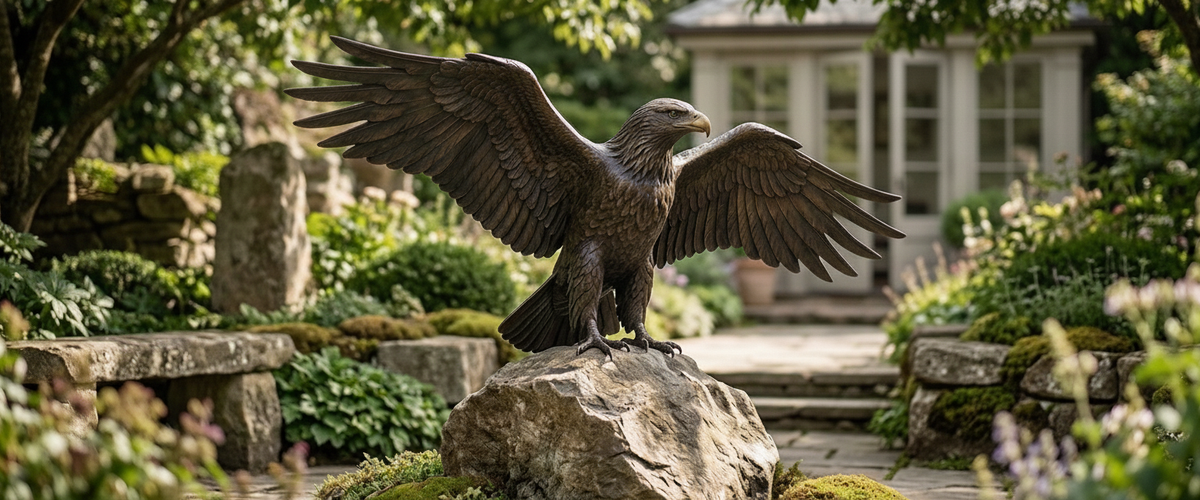

Most indoor eagle sculptures fail for one reason: the buyer measured the floor and forgot the air above it. An eagle statue for home has to earn vertical space, because a raised-wing bird pinned under a low ceiling looks trapped no matter how good the casting is. Get the pose, the clearance and the light right and the same piece anchors a hallway or library for decades without raising its voice.
Looking for the full range in this category? Browse our Eagle Statues & Sculptures collection for every available finish, size, and configuration.

Quick Answer: What Decides Whether an Indoor Eagle Works
Pose before size. Landing poses demand vertical clearance, striking poses demand depth in front. Perched, folded-wing birds sit happily on mantels and shelves.
Wingspan is the critical number. The widest point is usually wingtip to wingtip, and that is what your doorways and stair turns care about.
Headroom rule of thumb. Under an 8 ft (2.4 m) ceiling, save raised wings for a stairwell, atrium or double-height room.
Contrast saves the silhouette. Dark bronze wants a pale wall behind it; pale marble wants a dark one.
Light from the side. Uplighting straight from below flattens feather carving into a gray mass.
Find a perch line. Ledges, newel posts, deep sills and mantels read as natural landing spots. Open floor rarely does.
Landing, Perching or Striking: The Pose Sets Your Headroom Bill
Three broad poses dominate the category, and each one costs you different space. A perched bird with folded or half-open wings is the compact option, roughly as wide as it is tall. For a room with a standard ceiling, a contained casting such as the Life-Size Traditional Bald Eagle Bronze Sculpture at 110cm (about 3 ft 7 in) sits comfortably in a library bay or on a wide window sill. A landing pose throws the wings up and back while the talons reach forward, so it claims another two or three feet of air above the body. A diving strike pushes the mass forward instead of upward and needs depth in front of it, not just above.
A landing pose borrows height from the stairwell void above the half-landing.
Heraldic treatments sit somewhere in between. Wings are held high and symmetrical, the stance is formal, and the piece reads as architecture rather than wildlife. Where the setting already has symmetry built into it, say a broad half-landing or a pair of interior doors that want flanking, something like the Large Heraldic Eagle Bronze Sculpture - 150cm (roughly 4 ft 11 in) is closer to the right design language than a naturalistic wildlife pose. The monumental landing and rock-base castings we make at 220cm and 240cm (7 ft 3 in to 7 ft 10 in) belong in double-height entries, stairwell voids or outdoor terraces; drop one into a standard-ceilinged living room and the wings die against the plaster.

Measure the Wingspan Against the Doorway, Not the Room
Wild bald eagles span roughly 6 to 7.5 ft (1.8 to 2.3 m) from wingtip to wingtip, a figure the Cornell Lab of Ornithology documents in its species guides, and sculptors working at life scale usually respect that proportion. Heraldic castings often exaggerate it. Either way, the wings are the number that decides the delivery route for an eagle statue for home, and crating adds inches on every side.
We learned this the hard way on a commission for a Dallas client with a 30 in interior doorway and a 90-degree turn at the foot of the stairs. The bird fit the landing perfectly; the hallway refused to cooperate. Now we ask for four measurements before a large bronze ships: narrowest doorway width, stair turn diagonal, ceiling height at the final position, and elevator internal depth for apartment deliveries. Where the numbers do not work, we design the piece to arrive in sections and assemble on site, which is standard practice for large bespoke work and far cheaper than discovering the problem on delivery day.
Three Placements That Hold an Eagle Statue for Home
For wider placement ideas, Large Eagle Statue for a Garden: Give It a Perch, Not a Patch of Lawn is useful companion reading before finalising the setting and sightlines.
The Stair Half-Landing
A half-landing gives you the one thing a raised-wing bird needs and most rooms lack: borrowed height from the stairwell above. You also get a natural viewing distance, because people see the piece from below on approach and again at eye level as they pass. This is the single best interior position for an eagle statue for home, and it is where most of our 150cm birds end up.
The Deep Mantel
A mantel over 10 in (25 cm) deep can carry a perched bird or a bust. In period rooms where a full wingspan would crowd the chimney breast, a head study such as the Large Traditional Eagle Head Bronze Bust - 150cm gives you the presence of the whole bird in a fraction of the footprint. Check the mantel's load capacity with your builder before you commit to a bronze of any size.
Folded wings and a dark backdrop keep a mantel piece legible from across the room.

The Study or Library Shelf
Book walls are forgiving backdrops because the vertical rhythm of spines makes the bird's outline pop. Pull the piece forward to the shelf edge by an inch or two so the wingtips are not swallowed by shadow, and leave the shelf above it clear.
Contrast Beats Scale on the Wall Behind It
Silhouette is what registers first, and silhouette depends entirely on the surface behind the sculpture. Dark chocolate or verdigris bronze needs pale plaster, limewash or light stone to read. Reverse it for pale marble: a white bird against a white wall loses its edges from six feet away, while the same carving against walnut paneling or a deep charcoal wall looks carved from the room itself. Polished stainless steel behaves differently again, because it reflects what surrounds it, so keep it away from cluttered backgrounds.
Lighting: Side Light Rescues the Feathers
Lamplight from directly below flattens plumage, fills the undercuts that the sculptor worked hardest on, and turns the head into a blank shape. Feathers are a raking-light subject. Put the source at 30 to 45 degrees off to one side, roughly level with the bird's shoulder, and the layered carving comes back immediately. Two modest side sources beat one bright uplight every time. For a landing pose on a stair, a wall washer above and to the side of the wings will describe the whole gesture.
Material and Long-Term Care Indoors
Indoors, bronze is close to maintenance-free. There is no rain, no chloride spray and no freeze-thaw, so the patina stays where the foundry put it. Dust with a soft dry brush, keep it away from radiators and direct sun, and refresh the microcrystalline wax layer occasionally; the Canadian Conservation Institute's technical notes on metal care are a sound reference for the basics. Marble indoors is stable but porous, so use pads under anything set down near it and keep acidic cleaners well away. Stainless needs only a non-abrasive cloth, wiped in one direction.

Checklist Before You Buy an Eagle Statue for Home
Photograph the intended position and note ceiling height at that exact spot.
Measure the narrowest point on the delivery route, including crate allowance.
Confirm floor, shelf or mantel load capacity for a solid metal or stone piece.
Decide the pose from your available headroom, not from the photo you liked.
Check the wall color behind it and whether contrast works in daylight and at night.
Plan the lighting position before installation, not after.
Ask whether the piece can ship in sections if access is tight.
Commissioning a Bespoke Eagle Statue for Home
Off-the-shelf scale rarely lands exactly where a specific stairwell or loggia wants it, which is why so many of our bird commissions start with a set of site photographs and a ceiling measurement. From there our studio can adjust wingspan, rework the base into a branch or rock form, reangle the head, or match a patina to existing metalwork in the house. Working through the bronze eagle statues range is the quickest way to settle on a pose; scale is the conversation that follows. Budget depends on material, size, complexity of the wing work, engineering, installation and finish, so the sensible next step is a tailored quote rather than a guess.
An eagle statue for home succeeds when the pose, the clearance and the light all agree with each other. Measure the air, pick the wall, and the bird will still look right to you in twenty years. If you are weighing an eagle against other birds, the wider bird sculptures collection shows how much the answer changes with wingspan alone.