

























































































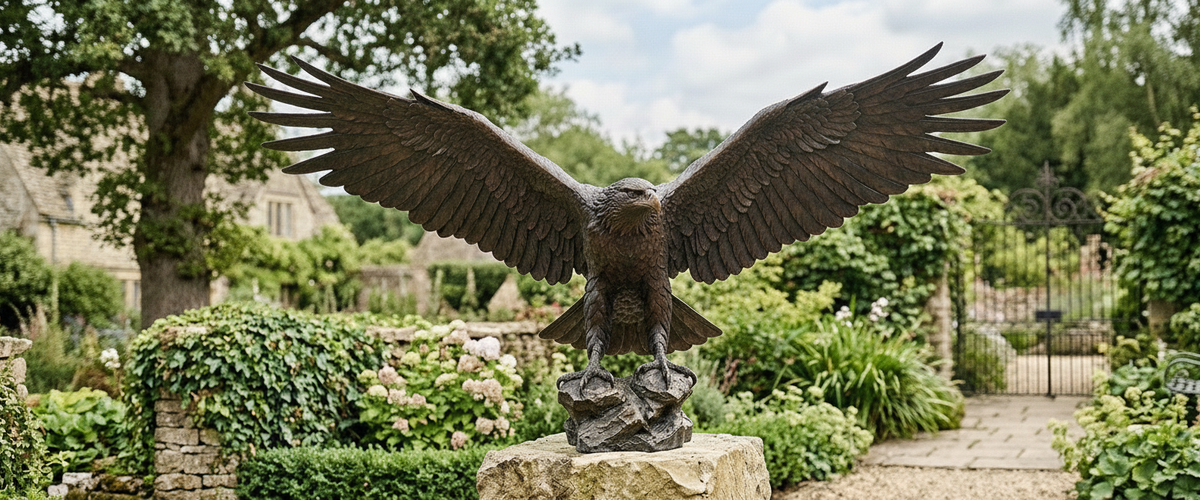

An eagle at knee height reads as a garden ornament, no matter how good the casting is underneath. That is the most common error in a large eagle statue garden scheme: the bird is specified at a generous size, then set down on grass at hip level, where no eagle has ever chosen to stand. Eagles perch. Fix the perch and the sculpture starts doing the work you paid for.

Quick Answer: What Makes a Large Eagle Statue Work Outdoors
Height before detail. A spread-wing bird wants its talons at or above your eye line.
Perch logic. Gate piers, rock outcrops, retaining walls and pillars are perches the eye already believes.
Backdrop rules the silhouette. Open sky or a dark evergreen mass; busy brick kills the outline.
Pose dictates the base. Wings spread need mass and engineering below; wings folded can sit tighter and lower.
Wind is a real load. Raised spread wings act like a sail, so fixings and dowels get specified, not guessed.
Test the site in winter. A large eagle statue garden spot that only reads in July is the wrong spot.
Knee-Level Eagles Read as Ornaments
Scale and elevation are different problems, and buyers planning a large eagle statue garden routinely solve only the first. A six-foot bronze bird on a low stone pad is still something you look down into. You see the top of the head, the flat plane of the wings, the mounting bolts. Everything that makes a raptor compelling, the underside of the primaries, the forward set of the skull, the tension in the tarsi, sits in shadow or out of view.
Raise the same piece four feet and the reading changes completely. Now you look up, the wings catch light from beneath, and the negative space between feather tips becomes part of the composition. Bald eagles carry a wingspan of roughly six to seven and a half feet in life, per the Cornell Lab of Ornithology, which means a faithfully proportioned sculpture is already wider than most plinths people first imagine.
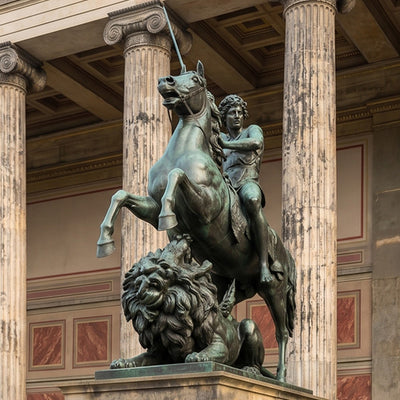
Talons above eye level: the pier does as much work as the casting.
Plinth Math for a Spread-Wing Bird
Our working rule after years of shipping birds: in a large eagle statue garden setting, the base should lift the talons to between 5 and 7 ft (1.5 to 2.1 m) above the ground the viewer stands on. Below that, the piece feels grounded. Push the talons past roughly 9 ft (2.7 m) in a domestic garden and you lose the head modeling entirely; the bird becomes a weathervane silhouette, which can be the right call on an approach drive and the wrong call beside a terrace.
Work the arithmetic backward from the sculpture, because every large eagle statue garden has its own viewing distance. A Large Traditional Eagle Bronze Sculpture - 180cm stands about 6 ft tall, so a 5 ft pier puts the talons at eye level and the head near 11 ft, which suits a wide lawn viewed from 40 to 60 feet away. Compress the viewing distance to 15 feet and the same combination forces an uncomfortable neck-craning angle. Measure the walk-up, not just the wall.

Gate Piers, Rock Outcrops and Boundary Walls
The most convincing large eagle statue garden sites are the ones that already look like perches. Masonry gate piers are the classic answer, and they are why heraldic birds have crowned entrances for centuries; a pair of piers already carries the height, so a compact upright bird such as the Large Heraldic Eagle Bronze Sculpture - 150cm gives an entrance real authority without anything new being built. Beyond gates, look for a granite outcrop, the shoulder of a retaining wall, a dry-stone terrace edge, a bridge abutment over a creek.
We shipped a bird to a Napa property where the client mounted it on a basalt boulder already sitting in the oak line, with a hidden stainless plate epoxied into the stone. No plinth was fabricated at all, and it is the most natural large eagle statue garden placement anyone has sent us photos of. If your yard has geology, use it.
Open Sky, Yew or Brick: The Backdrop Decides the Silhouette
An eagle is read as an outline first, which makes the backdrop the quiet decision in any large eagle statue garden. Set one against a red brick facade and the wing edges dissolve into the mortar joints; the detail you commissioned disappears at 30 feet. Against open sky, ridge line, or a dark evergreen wall (yew, holly, arborvitae), the silhouette snaps into focus and stays legible from the house.
Patina choice follows the same logic. A dark chocolate or near-black patina wants sky or pale stone behind it. A lighter verdigris or a warm brown reads better against a deep green hedge. When clients ask us which patina to choose for a large eagle statue for a garden, our first question has nothing to do with taste. We ask what sits directly behind the bird for the next thirty years. The shortlist gets shorter once the backdrop is settled, so work through the bird sculptures collection with that wall or hedge in mind.
Matte stone against dark planting: the carved edges stay legible where glare would soften them.
Wings Spread or Wings Folded
Spread wings demand air, and that is the tightest constraint in a large eagle statue garden hemmed in by mature planting. Give the piece clear space to each side, ideally more than the wingspan again, or the composition feels boxed in by shrubs and downpipes. Alighting and landing poses, with wings angled back and talons reaching, need to be seen from a specific arc; place them so the main approach hits that three-quarter view rather than the tail.
Folded wings are the underrated option. A perched bird with wings closed is a vertical, compact mass that works on a narrower pier, tolerates a tighter courtyard, and holds up in a walled garden in Charleston or a Manhattan roof terrace where a seven-foot span would be absurd. Material shifts the calculation too: an alighting pose cut in grey marble, such as the 220cm alighting eagle in grey marble, brings heavier, matte presence than bronze and belongs against planting rather than open sky, where glare softens the carved edges.
Wind Load on a Raised Bird
Once a spread-wing eagle is up on a pier, it becomes a small sail on a lever arm. Engineers size this using established wind pressure standards such as ASCE 7, and it is exactly the calculation people skip when they mortar a bird onto a garden wall with two short pins. It is the least glamorous line in any large eagle statue garden specification and the first one to fail when it is guessed.
Practically, in a large eagle statue garden that means stainless threaded dowels rather than mild steel, chemical anchors into sound masonry, and a base plate or internal armature designed around the actual pose. Cast bronze is dense and dimensionally stable, which helps. Aluminum is lighter and expands and contracts more with temperature swings, so fixings need to allow for that movement instead of fighting it; in a Texas or Arizona garden that difference is not academic. Where a piece is going onto an existing structure, send us photos of the pier and its construction before you order, not after.
Would the Spot Still Hold in February?
Deciduous screening is the trap in a large eagle statue garden. A site framed by maples in August can be bare, exposed, and backed by a neighbor's garage in February. Commemorative pieces suffer most, because the visits that matter often happen in the cold months. A monumental eagle, globe and anchor group for a veterans' memorial or a ranch entrance has to hold its ground under a flat gray sky, with low raking sun and no foliage help at all.
Stand in the proposed spot in the worst month you have. Check the sightline from indoors, from the driveway, and from the road. If it still works, build there.

Large Eagle Statue Garden Placement Checklist
For wider placement ideas beyond a large eagle statue garden, The Pose Decides Everything in a Large Rabbit Garden Statue is useful companion reading before finalizing the setting and sightlines.
Mark the footprint and full wingspan on the ground with stakes and string.
Mock the height with a stepladder or scaffold board and photograph it from every main viewpoint.
Confirm the talon height sits above eye level at your shortest viewing distance.
Identify what sits behind the bird at 30, 60 and 100 feet.
Check winter light and bare-branch exposure.
Verify the pier, wall or boulder can take engineered fixings.
Plan crane, forklift or gantry access before delivery day, including gate widths.
Agree drainage at the base so the bird is not standing in a puddle each spring.
Commissioning a Large Eagle Statue for a Garden
Off-the-shelf works when the pose and size suit your site. When they do not, a bespoke commission is usually the shorter route to a piece that actually fits, because you specify wingspan against your pier width, patina against your backdrop, and fixings against your masonry from the start. Most of our large eagle statue garden work begins that way. Giant Sculptures builds large-scale bespoke pieces in bronze, stainless steel and stone, and we regularly adjust a pose, extend a base plate, or re-engineer an armature for a specific perch.
Budget depends on material, scale, complexity of pose, structural engineering, finishing and installation, so the sensible next step for a large eagle statue garden is a tailored quote with your site photos and measurements attached. Send the wall, the wingspan you have room for, and the month you want it standing there. We will tell you honestly whether the spot will carry the bird.