































































































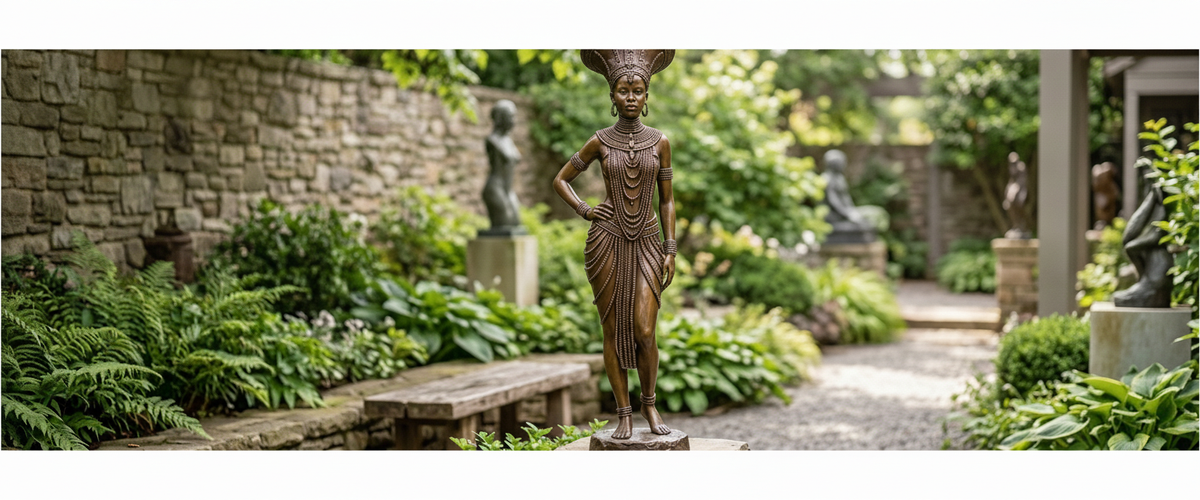

Stand thirty feet back from a bronze tribal figural statue and every decorative detail vanishes. What survives is outline: the pitch of the headdress, the gap between arm and hip, the angle of a staff against a shoulder. That is the test most buyers skip. It explains why a figure that photographed beautifully on a studio turntable can read as a shapeless dark mass in a Dallas entry hall, and why a simpler piece with a sharper profile can hold a 40-foot lobby comfortably.

Quick Answer: Judging a Bronze Tribal Figural Statue in Ten Seconds
Squint at it. If the silhouette collapses into a blob, no amount of surface detail will rescue it.
Check the headdress against the body. Height, flare and negative space around it do more work than any other single element.
Look at the feet, not the face. Weight distribution tells you whether the sculptor understood the pose or copied a photograph.
Ask how it was cast. Lost-wax holds beadwork, braid and textile weave on a bronze tribal figural statue; sand-casting softens all of it.
Decide the patina before the plinth. Warm brown reads approachable; near-black reads formal and graphic.
Get provenance and reference sources in writing before any studio starts modeling.
Silhouette First: Why the Headdress Decides Everything
A headdress is the loudest structural decision in a bronze tribal figural statue. Extend it upward and the figure gains authority but narrows; flare it sideways and the outline suddenly has width, which is what carries a form across an open plan room or a wide lawn. We have seen two versions of the same 8 foot (2.4 m) commission behave completely differently purely because one crown angled back and the other stood vertical. The angled version threw a longer shadow and read from the driveway. The vertical one looked correct only from directly in front.
Flare in the crown gives the outline width, which is what makes a standing figure read from thirty feet away.
Scale amplifies this. At monumental height the outline has to be broken somewhere, which is why a composition like the Monumental Classical Falconer and Bird of Prey Bronze Sculpture - 450cm, at roughly 14 feet 9 inches (450 cm), still resolves from a distance: the raised arm and bird punch a hole of daylight through the mass. Any tall bronze tribal figural statue needs at least one piece of negative space like that. Solid from head to base, it turns into a silhouette of a tree trunk.
Stance and Weight: Presence Versus Posing
The quiet difference between a bronze tribal figural statue that feels alive and one that feels staged sits in the ankles and hips. Real standing weight lands unevenly. One hip lifts, one knee softens, the shoulders counter-rotate a few degrees. Sculptors who skip this produce figures standing to attention, which photographs acceptably and disappoints in person.
For a bronze tribal figural statue holding a spear, vessel or shield, ask where the load goes. If the object is heavy in the narrative, the body should acknowledge it. Our modelers build a small maquette to settle exactly this, because a 12-inch (30 cm) clay study exposes a lazy stance faster than any rendering. Buyers who skip maquette approval on a large commission are the ones who later say the piece looks stiff without being able to say why.
Costume Texture: Where Lost-Wax Keeps the Beadwork
Costume is why most buyers come looking for a bronze tribal figural statue with headdress and costume in the first place: layered cloth, cowrie strings, cuffs, wrapped fiber, incised pattern. How that survives into metal depends almost entirely on casting method. Lost-wax investment casting, practiced in West African workshops for centuries and well represented in collections such as the Smithsonian National Museum of African Art, reproduces the wax surface almost exactly. Individual bead rows stay crisp. Sand-casting is faster and can be right for very large simplified forms, but it rounds off anything finer than a couple of millimeters, and chasers then have to re-cut detail by hand.
The difference is easiest to judge on any piece that depends on fine surface modeling rather than mass. On something like the Classical She-Wolf Nursing Two Infants Bronze Sculpture - 85cm at 85 cm (about 33 inches), the fur and musculature only hold up at arm's length because the wax was worked properly before investment. Apply the same standard to the textiles and body ornament on a bronze tribal figural statue. If a supplier cannot tell you which method they use and how much hand-chasing follows, assume the detail will be soft.

Warm Brown or Near-Black: Patina Sets the Temperament
Patina is chemistry, not paint, and it changes the personality of a bronze tribal figural statue more than most buyers expect. A warm brown liver patina brings out the roundness of shoulders and cheekbones, catches lamplight, and suits interiors with wood, leather and terracotta. It flatters costume detail because the highlights sit on raised edges.
Warm brown lifts raised edges; a near-black finish flattens the same beadwork into pure outline.
A near-black or dark chocolate patina does the opposite. It kills mid-tone detail and pushes the piece toward pure graphic outline, which is exactly what you want against pale limestone or a white gallery wall. One caution from a Napa project: we specified a dark patina for a standing bronze tribal figural statue in full afternoon sun, and the client later planted a shade tree beside it because the surface ran hot to the touch. Dark bronze absorbs heat. Worth knowing before you place one beside a pool deck.
Plinth Height and a Plain Backdrop
A single standing bronze tribal figural statue needs breathing room and a base that lifts the head into a sensible sightline. Too low and visitors look down at it; too high and the face is lost. As a working rule, set the eye line of the figure near the eye line of a standing adult for interiors, and lift it further outdoors where you are competing with planting.
The plinth is also a design object in its own right, and the same sculpture changes register depending on what it stands on. A scalloped base, as on the Large Traditional Chinese Guardian Lion Bronze Sculpture (Scalloped Plinth) - 140cm at 140 cm (about 4 feet 7 inches), reads decorative and traditional; the same lion on a tiered Greek key plinth reads architectural and sits far more comfortably against modern stonework. Behind the figure, keep it plain. A clipped hedge or a rendered wall will do. Busy planting or patterned tile behind a detailed costume turns the whole thing to visual noise.

Commissioning a Bronze Tribal Figural Statue: Reference, Respect and Provenance
This subject carries responsibilities that a garden lion does not. Many historical figural objects were made for ceremonial use, and some were removed from their communities under circumstances museums are still working through. Professional standards bodies including ICOM set out clear expectations around provenance and cultural sensitivity, and private buyers benefit from applying the same discipline.
Before any studio casts for you, get answers on these:
What is the reference? Original design, a documented historical type, or a direct copy of a specific object? Copies of sacred or restituted objects should be off the table.
Who modeled it? Named sculptor, with a portfolio you can see.
Alloy and thickness. Silicon bronze is the workhorse for outdoor casting; wall thickness affects both weight and long-term durability.
Casting and chasing plan. Method, seam placement, how weld lines are dressed out.
Patina specification and warranty of finish. Including whether it is waxed or lacquered on delivery.
Engineering. Internal armature, base plate, fixing detail, wind loading for anything above about 6 feet (1.8 m).
Approval stages. Maquette, full-scale clay photos, patina samples before final finishing.
Budget follows those answers rather than the other way around. Material, finished height, complexity of costume detail, engineering, crating and installation all move the number, so the sensible route is a tailored quote for your bronze tribal figural statue once the brief is settled.
Living with It
An outdoor bronze tribal figural statue wants a wash with clean water and a soft brush a couple of times a year, then a coat of microcrystalline wax before winter. Indoors, dust it and leave the patina alone. Avoid pressure washers, avoid household cleaners, and never let sprinkler overspray hit the same spot on the same side for years; that is how you get a green streak nobody asked for.
If you are weighing a bronze tribal figural statue against other standing figures, browse our wider bronze figures and statues and the bronze garden statues range to calibrate scale and patina in context. Giant Sculptures works on bespoke figural commissions at monumental scale, and the conversation usually starts with a photograph of the space and a hand held at the height you imagine the head.
For wider placement ideas, A Large Bronze Horse Sculpture Needs Room to Move is useful companion reading before finalizing the setting and sightlines.