





































































































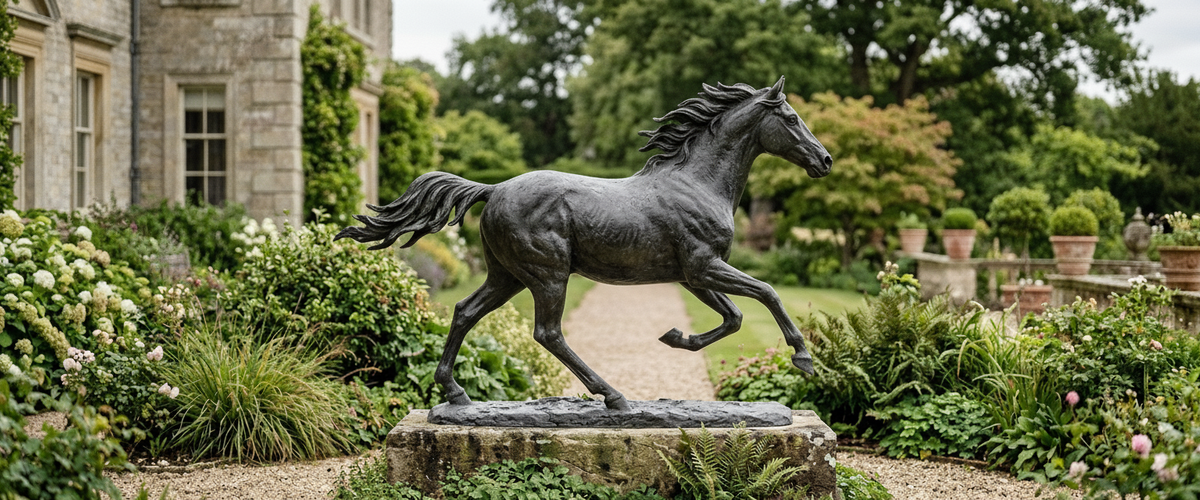

Stand directly in front of a life-size horse sculpture and watch it flatten. The chest swallows the shoulders, the legs stack into one another, and anatomy that took a sculptor months to resolve reads as a shapeless lump. That is why so many large outdoor horse sculptures underwhelm on site despite being beautifully modeled and cleanly cast. The sculpture is fine. The angle is wrong.
Horses are silhouette animals. Their power lives in profile: the arch of the neck, the line from poll to withers to croup, the diagonal of a foreleg reaching. Site a horse so that the main approach hits it broadside and it will do the work you paid for. Site it nose-first to the drive and you have bought an expensive obstruction.

At a Glance: Siting Large Outdoor Horse Sculptures
- Choose the viewing axis before the sculpture. Decide which sightline matters most, then pick a pose that reads from it.
- Profile beats head-on, every time. Aim for a three-quarter to full broadside view from the primary approach.
- Match pose to space. Gallop and canter need open ground; rearing and standing poses want something solid behind them.
- Control the backdrop. Sky behind the withers, dark hedge or masonry behind the legs.
- Setback is roughly two to three times the height of the piece for a comfortable full view.
- Bronze reads mass, stainless steel reads sky. Your local light should decide.
- Check the night view from indoors. It is the one nobody tests and the one owners look at most.

Pick the Viewing Axis First: The Drive, the Terrace or the Kitchen Window
Before any conversation about bronze, size or pose, name the one view that has to work. On a Napa estate we shipped to, the owners assumed the sculpture was for arriving guests. Walking the property told a different story: the drive carried visitors twice a week, while the kitchen window framed the same patch of lawn every morning. We turned the piece about 40 degrees off the drive axis to serve the window, and the drive view improved anyway, because it became a three-quarter approach rather than a flat frontal one.
Write down your top three sightlines in order: the gate or drive, the terrace or pool deck, and the room you actually live in. Most large outdoor horse sculptures can serve two of those well. Chasing all three usually produces a compromise that serves none.

Gallop Wants Open Lawn, Standing Wants a Wall to Push Against
Pose and site are a single decision. Galloping large outdoor horse sculptures carry implied motion across the ground plane, so they need runway: open lawn, a meadow edge, a long gravel court. Crowd one with planting and the extended legs read as clutter. At close to 6 feet at the highest point, an extended pose such as the Large Traditional Galloping Horse Bronze Sculpture, 180cm wants at least a couple of its own body lengths of clear ground in the direction of travel.
Rearing and standing poses behave differently. They are vertical, contained and static, which means they hold their own against architecture. Put a rearing horse in front of a stone wall, a clipped yew block or a barn gable and the mass behind it amplifies the lift rather than competing with it. Where the site offers a courtyard end or a facade to work against, a vertical pose like the Large Classical Rearing Horse Bronze Sculpture, 180cm earns its place by breaking a horizontal line with the raised forelegs.
Groups add a third rule: they have to read as a composition, not a crowd. Pairs and trios should be set so the gaps between the animals stay open from the main view. Line them up badly and the rear horse becomes visual noise behind the front one.

Sky Behind the Withers, Hedge Behind the Legs
Backdrop does more for large outdoor horse sculptures than lighting does. The outline you want to protect runs along the topline, and the easiest way to protect it is to keep sky behind the neck, withers and back. That usually means a slightly raised position or a lower planted foreground.
Legs are the opposite problem. Bright sky behind slender bronze legs makes them thin out and disappear at distance. A dark evergreen hedge, a Corten screen or a stone retaining wall behind the leg zone keeps the whole animal anchored. Storm King Art Center built an entire landscape on that principle, and the way their pieces sit within earthworks and tree lines is a useful reference for anyone siting large work on acreage.
Setback and Plinth Height, or How Far Back the Eye Needs to Stand
Two practical numbers govern how large outdoor horse sculptures settle into the eye. For a full-figure view, allow a setback of roughly two to three times the total height of the sculpture, plinth included. A piece standing around 7 feet (2.1 m) on its base wants 15 to 20 feet (4.5 to 6 m) of viewing distance to sit comfortably.
Plinth height then adjusts where the horse meets the horizon. A low plinth of 12 to 18 inches (30 to 45 cm) keeps the animal grounded and grazing-height, which suits paddock and meadow settings. Raise it to 24 to 36 inches (60 to 90 cm) and the chest climbs toward eye level, which reads as monument rather than livestock. Taller narrative pieces rarely need much plinth at all: at 260cm, the Large Traditional Racehorse and Jockey Bronze Sculpture - 260cm already sits above the viewer, and a tall base only pushes the jockey out of comfortable sight.
Whatever the height, the foundation matters more than the pedestal. Large bronze carries real weight, and wind load on a rearing pose is not trivial. We specify a reinforced pad and stainless anchors sized to the piece, and we would rather see the engineering drawing before the landscaping goes in.
Bronze Reads Mass, Stainless Reads Sky
In flat overcast light, whether that is a Pacific Northwest winter or a gray week in the Hamptons, dark patinated bronze holds its edges and reads as solid weight. It is the safer choice where light is soft and backdrops are green. Bronze also ages into its setting: the patina shifts over years, and faster in coastal air.
Mirror-polished stainless steel does the opposite. It takes on the sky, dissolves into bright conditions, and comes alive under strong directional sun in places like Scottsdale or West Texas. On a dull day it can read as a gray outline. Brushed or satin stainless is the middle path and holds form better in soft light. Within reach of salt air, grade matters as much as polish, and how alloy and surface finish behave near salt exposure should settle the specification early. The full horse sculptures and statues range sits alongside our stainless steel sculptures if you want to compare how large outdoor horse sculptures in the same pose behave in two very different surfaces.
The Second Viewpoint Nobody Checks
Here is the lesson that cost one client a re-dig. Everyone tests the daytime view from outside. Almost nobody tests the nighttime view from inside, looking out through glass at a lit sculpture. After dark, interior reflections fight the window, and an unlit or badly lit horse turns into a dark smudge in the yard.
Fix it at design stage. Two low-level grazing lights set wide of the piece will rake the muscle and keep the profile legible; one central spot flattens everything. Keep the fixtures below sightline from the terrace, and check the aim again once planting matures. A sculpture that performs at 9pm in February earns its keep far more than one that only works in July.
Buyer Checklist Before You Commit
- Walk the site at your three key sightlines and mark the position with stakes and string at full height.
- Photograph the mock-up from each view, including from indoors.
- Confirm the primary approach hits the horse broadside or three-quarter, never nose-on.
- Check what sits behind the topline and behind the legs at the actual viewing distance.
- Measure the delivery route: gate widths, overhead limbs, ground bearing for a crane or telehandler.
- Agree foundation, anchoring and plinth detailing before groundworks.
- Plan lighting positions and power runs at the same time as the base.
- Ask for the maintenance schedule in writing: wash frequency, wax cycle for bronze, inspection points.
Commissioning a Horse That Fits the Site
For wider placement ideas, Choosing a Large Bronze Fountain Statue That Sounds Right is useful companion reading before finalising the setting and sightlines.
Most large outdoor horse sculptures we ship come straight from the catalog, and those pieces solve the majority of situations. When they do not, the usual reasons are scale and axis: the site needs a horse at 12 feet rather than 6, or the pose needs to be mirrored so the head turns toward the house instead of away from it. Both are straightforward bespoke changes at Giant Sculptures, handled with maquettes and scaled elevations before any casting begins.
Budget on a commission depends on material, finished size, pose complexity, structural engineering, plinth work, finishing and installation access, so the honest answer is a tailored quote rather than a headline figure. Send us the site photographs, the sightlines you care about and a rough height, and we will tell you what the horse should be doing before we tell you what it costs.