





































































































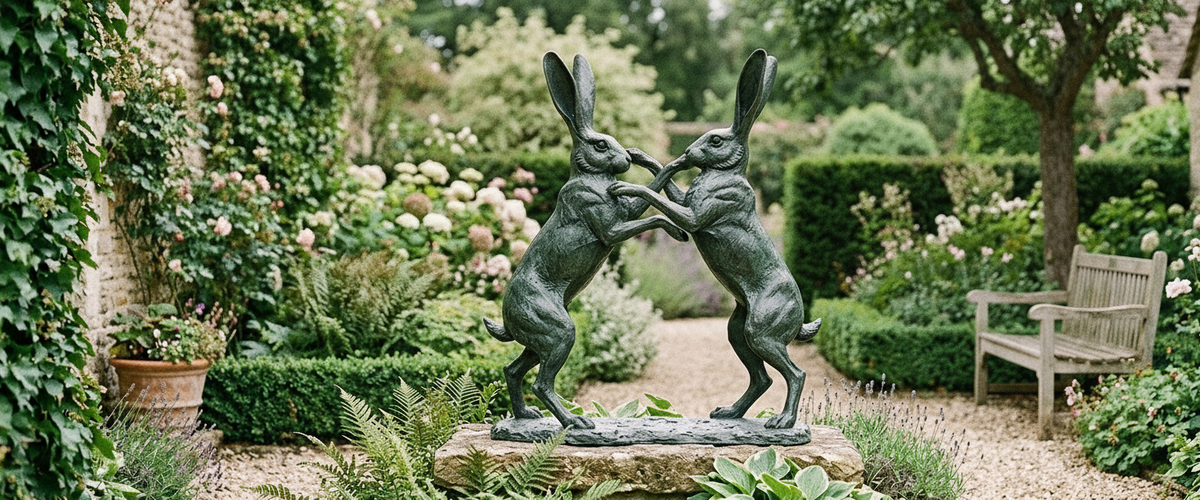

The ears go first. On the rabbit statues garden owners have lived with for a few seasons, the break is nearly always an ear, then a raised paw, then the thin ridge of a haunch where the sculptor got ambitious with the pose. Most people shop by size and price. What actually decides whether the piece is still standing in fifteen years is section thickness, material choice, and how it was fixed to the ground.

At a Glance
Weak points: ear tips, lifted forepaws, undercut haunches. Check them on any garden rabbit statues before you check anything else.
Bronze holds fine detail in thin sections and stays a focal point for decades.
Cast stone softens and colonizes with moss, which suits a planted border but not a formal terrace.
Marble and granite reward mass; avoid delicate carved ears in freeze-thaw climates.
Resin and fiberglass are light and easy to knock over, and the gel coat is the whole story.
Groups of three or five read better in a border than one lone rabbit on a lawn.
Odd-numbered groups sit into planting far better than a single figure stranded on open lawn.
Ears, Haunches and Paws: The Thin Sections That Fail First
A rabbit is a difficult animal to cast well, and the casting is where most garden rabbit statues quietly go wrong. Long ears, a narrow neck, forelegs thinner than a wrist. In bronze, those sections can be walled thin and still take a knock, because cast bronze has tensile strength that stone and cement simply do not. In cast stone, the same ear has to be fattened up or reinforced with a steel armature, and once water finds that armature it rusts, swells and splits the ear off from the inside.
So the first question to ask a supplier is not about height. Ask what the ears are made of, whether there is internal reinforcement, and whether that reinforcement is stainless. That one detail explains most of the failures we see in rabbit statues for the garden. When we quote a bespoke garden rabbit at our studio, ear geometry is usually the first conversation we have with the client, and occasionally we will ask to tilt the ears back a few degrees so they sit within the silhouette rather than spearing out where a wheelbarrow can find them.
Thin-walled bronze ears keep the silhouette sharp without the armature problems of cast stone.

Cast Stone Weathers Into the Border, Bronze Stays the Focal Point
These two materials do opposite jobs. Cast stone is porous, so it takes on lichen and algae fast, greens down within two or three wet seasons, and starts to look like it grew there. That is a genuine virtue in a cottage border or a woodland edge. The trade-off is that porosity plus freezing water is the classic failure mechanism for cementitious and natural stone outdoors, which the Natural Stone Institute covers in its technical guidance on absorption and freeze-thaw performance. It is also why rabbit statues in the garden lose an ear tip after one hard winter.
Bronze goes the other way. It stays legible. Patina shifts over years, but the form stays crisp, so bronze garden rabbit statues remain deliberate objects rather than pieces of scenery. A tumbling, off-balance composition such as the Contemporary Cascading Rabbits Bronze Sculpture - 35cm at 35cm only holds together in metal; the same forms in cast stone would have to be thickened at every contact point until the movement disappeared. Where the priority is mass and pale color rather than movement, the Sitting Rabbit White Marble Statue - 120cm at 120cm (roughly 47 inches) is the honest stone alternative: seated pose, ears close to the body, no cantilevered limbs to snap.
Resin and Fiberglass: Where the Gel Coat Holds and Where It Chalks
The cheapest rabbit statues garden shoppers find online are usually composite, and composites do have a place: indoors, in event work, or on rooftops where load matters. Outdoors, everything depends on the gel coat and the UV package underneath it. A well-made piece with a pigmented, UV-stabilized coat can hold color for years. A thin one goes chalky gray on the south-facing side first, and once the surface has chalked you are into repainting, not conserving. Weight is the second issue: a five-pound (2.3kg) rabbit blows over, gets carried off, or gets picked up by a dog. If the budget points toward composite, put it under a porch and buy metal or stone for the garden proper.
Frost, Mower Strikes and Curious Dogs, Ranked by Actual Damage
From what comes back to us as a repair or replacement query on rabbit statues in the garden, the order is not what people expect.
Mower and strimmer strikes. Far and away the most common. A low rabbit sitting in grass is invisible to a contractor working at speed. Mulch a clear ring around it or set it on a plinth.
Being knocked over. Dogs, deer, kids playing ball, a delivery driver cutting the corner. This is the second biggest killer of garden rabbit statues, and it is almost always a base problem.
Frost. Serious in porous materials, largely irrelevant in bronze and stainless steel. Trapped water inside a hollow cast with a blocked drain hole is the version that catches people out.
Surface chemistry. Sprinkler overspray leaving mineral deposits, fertilizer splash, and bird droppings left on bronze. Rinse and wax annually; the Canadian Conservation Institute notes on outdoor metals are a sound reference for how patinated surfaces behave.

Base, Weight and Pinning: The Lone Lawn Rabbit Gets Knocked Over
Most damage complaints we field come down to a piece that was set on the ground rather than fixed to it. Rabbit statues for the garden need one of three things: enough mass that a shove does nothing, stainless dowels grouted into a stone or concrete pad, or an integral base plate bolted down. Two pins beat one, because a single pin lets the piece rotate and work the joint loose.
Scale changes the math. Anything above about 3 feet (0.9m) in bronze usually has enough weight to sit stably on a prepared pad, and a monumental reclining figure at 180cm is effectively self-anchoring once it is on a level footing. Small garden rabbit statues are the risky ones. They are light, they sit in mowing lines, and they are portable enough to be worth stealing.
Odd Numbers Beat a Single Sentry
A single small rabbit centered on a lawn looks like an ornament. Three or five, staggered through planting at different heights and facing different directions, read as a composition and give the eye somewhere to travel. That is the point at which rabbit statues in the garden stop decorating and start shaping a view. Grouping also ages better, because when one piece darkens faster under a tree the variation looks intentional. Multi-figure casts do this work for you: the Contemporary Five Rabbit Bronze Sculpture - 80cm at 80cm arrives as a resolved group rather than five separate decisions you have to make on site with a spade. Browse the full Rabbit & Hare Statues range to see how poses pair up, and the bronze rabbit and fox statues if you want a mixed-species narrative through a border.
Commission Notes from Garden Rabbits We Have Shipped
Two lessons from recent garden rabbit statues are worth passing on. A Napa client wanted a pair of sparring hares at the head of a gravel path; we raised both figures onto a shared low plinth so the irrigation heads could not throw hard water directly onto the patina every morning. A Hamptons project asked for oversized ears on a seated rabbit, and we cast a stainless internal spine into each ear rather than relying on bronze section alone, because the site is exposed and the piece sits within reach of a driveway.
Bespoke rabbit statues for the garden usually start with a photograph of the spot, a rough height, and a sense of whether you want the animal to disappear into planting or hold a sightline. Cost depends on material, scale, complexity of pose, engineering, finishing and installation, so we quote each piece individually rather than working from a list.

Buyer's Checklist Before You Order
Are the ears solid, and if reinforced, is the armature stainless?
Does a hollow cast have drainage at the lowest point?
Is there an integral base plate or provision for stainless pins?
Will the piece sit inside a mowing line, and can you mulch a ring around it?
Do you want it to green down over time, or stay crisp and legible?
One rabbit or three? Decide before you buy, not after.
Can two people lift and place it, or does the site need machine access?
Get those seven answers right and rabbit statues for the garden become one of the lowest-maintenance things you will own. Get the base wrong and you will be gluing an ear back on by spring.
For wider placement ideas on garden rabbit statues, The Pose Decides Everything in a Large Rabbit Garden Statue is useful companion reading before finalising the setting and sightlines.