





































































































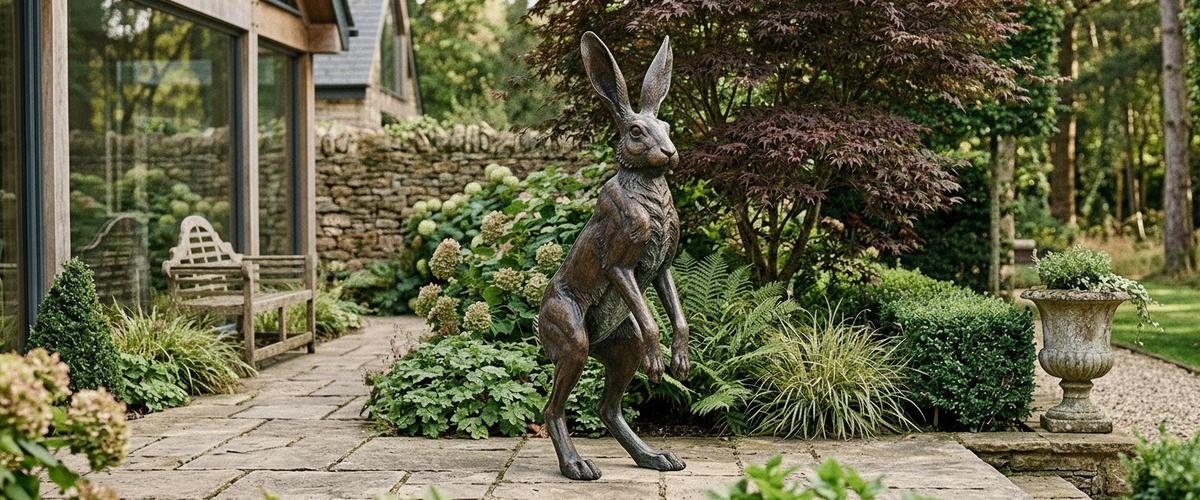

Most people choose a large rabbit garden statue from a photograph taken on a plain white background, then wonder why it looks wrong once it is standing on real grass. The sculpture did not change. The context did. Pose is the single biggest variable in whether a hare or rabbit figure reads as a living animal caught mid-thought or as a piece of garden furniture that happens to have ears.

Key Takeaways Before You Choose a Pose
Six things worth settling before you commit to a large rabbit garden statue:
Sitting and compact reads decorative and calm. Good for terraces, thresholds and formal beds.
Alert and upright reads alive. It needs a sightline worth looking down.
Mid-leap needs empty ground in front of it or the movement stalls.
Ear angle is a pointing device. Aim it at something.
Viewing distance beats absolute size. A pose that works at 10 feet (3 m) can vanish at 65 feet (20 m).
Leaping hares carry real load through thin bronze. Ask how the ankle and base are engineered.
Sitting Reads as Ornament, Alert Reads as Animal
A crouched, settled rabbit is a closed shape. The silhouette is a soft dome, the weight sits low, and the eye passes over it the way it passes over a well-placed urn. That is not a flaw. Where the setting calls for stillness rather than incident, a seated large rabbit garden statue behaves more like architecture than wildlife. A pale form such as the Sitting Rabbit White Marble Statue - 120cm (roughly 4 ft) holds the end of a gravel path or flanks steps without asking the eye to follow it anywhere.
An alert pose does the opposite. Head lifted, forelegs braced, ears up, muscle tension implied through the shoulder. The shape opens out and the brain fills in the next second of movement. If you want visitors to stop walking, buy alert. If you want the garden to feel composed and settled, buy seated.
A seated marble figure closes a sightline without competing with the planting around it.

Mid-Leap Needs a Run-Up
Jumping figures are the most misplaced sculptures we ship. A leaping large rabbit garden statue implies a trajectory, and that trajectory has to land somewhere the eye can follow. Put one 3 feet from a wall and the animal reads as though it is about to hit the brickwork. Give it 20 or 30 feet of open lawn, meadow or water in the direction of travel and the same casting suddenly has speed.
Direction matters as much as clearance. We had a commission for a Hudson Valley property where the client wanted a leaping hare on the approach drive. The first staked position pointed the animal back toward the house; it looked like it was fleeing the visitor. Rotating it about 140 degrees so it launched across the meadow fixed the whole composition without moving the plinth more than a foot.
Ear Angle Sets the Sightline
Ears are the most directional feature in animal sculpture. Human eyes follow them the way they follow a pointing finger. So decide what you want people to notice, then buy or commission a piece whose ears aim there: a pond, a gate, a specimen tree, the view over a Napa vineyard.
Two ears swept back read as speed and wariness. Ears splayed sideways read relaxed and grazing. Ears vertical and slightly forward read as listening, which is the pose that makes a large rabbit garden statue feel most uncanny at dusk. Hares behave this way in life. The tall black-tipped ears and spring boxing of the brown hare are why sparring and listening compositions read as observed rather than invented.
Crouched Forms Disappear, Upright Forms Fight Hedging
Planting will edit a large rabbit garden statue whether you want it to or not. A crouched or feeding figure set into ornamental grasses or long meadow turf is swallowed by July. That can be charming if it is meant to be a discovery. It is a waste of money if it is meant to be the focal point.
Upright poses have the opposite problem. Stand a tall alert hare directly in front of clipped box or yew and the two shapes argue: geometry versus anatomy, both wanting the same visual space. Either pull the sculpture forward so it stands clear against sky or lawn, or set it against the hedge deliberately as a dark ground so the bronze silhouette is crisp. Hedge as backdrop works. Hedge as neighbor does not.

Viewing Distance Changes Which Pose Wins
At close range, detail carries the piece. Fur texture, the crease of a haunch, the modeled interior of an ear. A study of around 24 in (60 cm) belongs on a terrace or in a courtyard where people pass within a few feet of it and can read the surface.
At 65 feet (20 m), detail is gone and only outline survives. Mass and negative space have to do the work instead, which is why something on the scale of the Monumental Reclining Rabbit and Child Reading Bronze Sculpture at 180cm (about 6 ft) still holds a long lawn: the gap between the figures reads as clearly at distance as the bodies do. Before committing to a large rabbit garden statue at that scale, cut a plywood silhouette to the intended height, stake it in position, and walk your actual approach route. Ten minutes of that saves an expensive relocation later.
A leaping bronze needs open ground ahead of it before the movement reads at distance.
The Fragile Geometry of Leaping Hares
Dynamic poses concentrate a lot of weight into very little metal. Cast bronze is strong, but a hare balanced on one hind foot pushes bending load through the ankle, the tail root and the point where the leg meets the base. Those are the three places where poor casting gives way, usually after a few freeze cycles or one careless mower strike.
Ask the supplier how the load path is handled. In our studio work, a leaping figure typically gets a stainless steel armature running through the supporting limb into a hidden anchor in the plinth, with wall thickness increased locally at the joint rather than kept uniform for looks. Good foundries also weld and chase interior seams so water cannot collect inside the body. Conservation guidance for outdoor metalwork, including Historic England's technical advice, is consistent on the point: trapped water and failed drainage do more damage than surface weathering.
Pairing Poses: One Alert, One Feeding
A single figure states. Two figures narrate. Place one animal alert with ears up and a second grazing head-down a few feet away, and viewers instinctively read a relationship: one keeping watch while the other eats. Grouped work such as the Contemporary Five Rabbit Bronze Sculpture - 80cm applies the same logic inside a single casting, varying posture across the group so the arrangement has rhythm rather than repetition. It also saves you setting out and leveling several separate bases.
Keep pairs unequal. Two identical poses facing each other look like bookends. Vary height, angle and attention, and leave enough gap that a person can walk between them; that empty ground is what makes the group feel observed rather than arranged. Browse more configurations across our rabbit and hare statues before locking a layout.

Buying Checklist for a Large Rabbit Garden Statue
Mark the footprint on site and check clearance in the direction the animal faces.
Confirm your primary viewing distance and the season you use that view most.
Decide backdrop before pose: sky, hedge, wall or water.
Ask about wall thickness, internal armature and drainage on any dynamic pose.
Confirm fixing method: dowels, resin anchors or a poured concrete pad below frost depth.
Ask for patina options; a mid-brown patina can vanish against bare soil in fall, while a lighter finish holds against dark planting.
Get a tailored quote. Budget depends on material, scale, complexity, engineering, finishing and installation, so a specification-led quote is the only honest number.
Commissioning a Pose That Fits Your Ground
Where a catalog pose almost works, changing it is usually straightforward at the modeling stage: raising a head, opening an ear angle, lengthening a stride, scaling a 50cm study up into a large rabbit garden statue you can read from the house. Giant Sculptures works this way regularly, developing bespoke bronze, stainless steel, Corten and stone animal commissions from client photographs, site plans and sightline notes. Our bronze rabbit and fox statues are a useful starting point for judging modeling quality and patina before you brief a custom piece.
Buy for the ground you actually have, not the photograph. Get that right and a large rabbit garden statue stops being an object in a garden and starts being an animal that happens to live there.
For wider placement ideas, Why Large Deer Garden Statues Vanish Into the Hedge is useful companion reading before finalising the setting and sightlines.