






































































































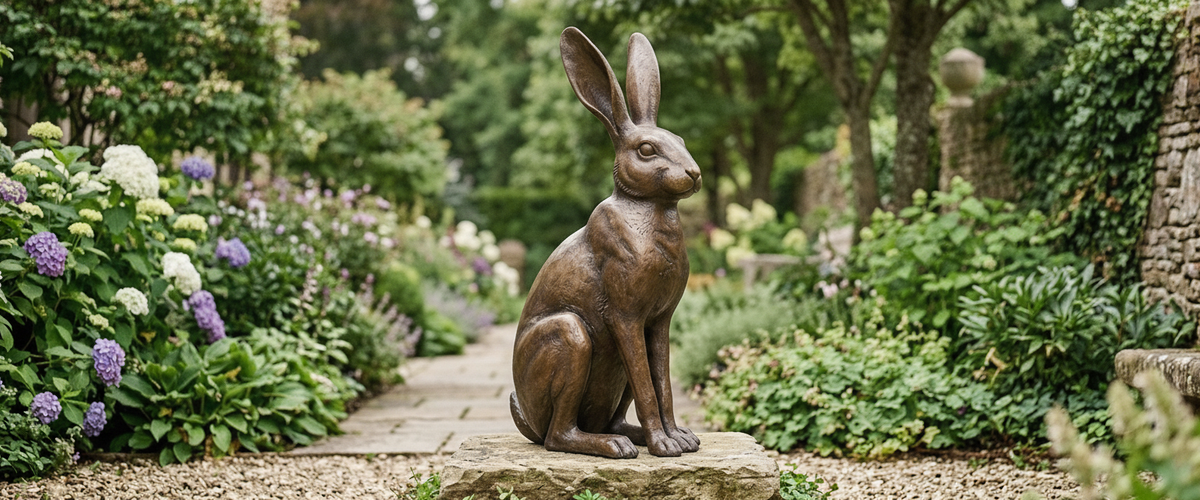

Most garden rabbit statues fail for one reason: they are bought at the size of a real rabbit and then asked to hold a space designed around people. Tucked under a hosta, a 12-inch bunny is charming. Set it in the middle of a 40-foot lawn in Napa and it simply vanishes. If you are shopping for rabbit statues for the garden, scale is the first decision, and it is the one buyers most often get wrong.

At a glance
Under about 20 inches (50 cm), a rabbit reads as ornament. Use it on steps, in borders and beside paths.
From roughly 3 feet (90 cm) upward, it starts to hold a lawn or terrace as sculpture.
When sizing up, check the ears. They decide whether an enlarged rabbit looks right.
Bronze is the safest long-term choice through freeze-thaw winters; Corten suits simplified, graphic forms.
Above about 6.5 feet (2 m), commission a new design rather than enlarging a catalog piece.
Garden Rabbit Statues: Ornament Below the Knee, Sculpture at Waist Height
Height relative to the viewer changes how a piece is read. Anything below the knee is something you glance down at, like a planter or a lantern. Once a rabbit reaches waist height or above, you meet it more directly, and the garden starts organizing itself around it. That shift is what separates decorative garden rabbit statues from a true focal point.
Grouping smaller garden rabbit statues is the shortcut if you want presence without monumental scale. At the turn of a path or the edge of a terrace, a clustered composition such as the Contemporary Five Rabbit Bronze Sculpture, about 31 inches (80 cm) tall, can carry as far as a much taller single rabbit, because five bodies together read with the visual mass of a larger animal.
A group of five bronze rabbits carries across a lawn better than a single taller figure.

Ears Are the Scale Trap
In our studio we have watched enlargements go wrong in the same place again and again. A rabbit modeled at hand size has ears that look fine at 10 inches. Scale that same model four times and the ears become long, thin blades that read like antennae against the sky and catch wind like sails. A good sculptor adjusts them as the animal grows: slightly thicker at the root, a touch shorter in proportion, angled so the silhouette stays compact.
Stylized designs dodge some of this. Where the setting calls for a graphic silhouette rather than realistic fur, a steel form such as the Coco Rabbit Steel Outdoor Sculpture, about 24 inches (61 cm), points toward the design language that survives enlargement, where the ears are treated as simple planes. Realistic fur and fine ear veining are much harder to stretch.
Big Rabbits Need Open Lawn
Put a 5-foot rabbit in a crowded perennial border and it looks lost, as if it wandered in. Large rabbit statues for the garden need negative space: a clear stretch of lawn, a gravel court, or the end of an axis seen from the house. A useful rule is to leave clear ground around the piece at least equal to its height, more if it is viewed mainly from a distance.
Smaller garden rabbit statues work the opposite way. On a low wall or beside a terrace step, a close-range pose such as the Contemporary Sparring Rabbits Bronze Sculpture, about 24 inches (60 cm), makes more sense than a single tall figure, because people pass near enough to read the movement between the two animals.

Bronze, Corten or Armatured Resin at Five Feet
For rabbit statues in the garden at around 5 feet (1.5 m), material choice becomes a question of winters, not looks. Cast bronze is dense metal with no porous body for water to soak into, so freeze-thaw cycles do it little harm, provided hollow casts are sealed or drained so water cannot pool inside. Its patina deepens with age rather than failing. The finishes we cast most often are gathered in our bronze rabbit and fox statues.
Corten forms a protective rust layer, but it needs repeated wet and dry cycles to stabilize, a point stressed by corrosion specialists at AMPP. It suits faceted, graphic rabbits, though it will stain pale paving as runoff carries rust, so set it on gravel or dark stone.
Armatured resin is lighter to ship and install, which matters on rooftop gardens. The trade-off is long-term: UV exposure dulls surfaces, and any trapped moisture inside can expand in a hard freeze. If a client in Colorado or upstate New York wants a permanent piece, we steer them to bronze.
The Plinth Detail That Survives Mowers, Leaning Visitors and Frost Heave
The most common damage we see on lawn-set bronzes is a fine patina scuffed bare at the base by a ride-on mower, sometimes within a single summer. We now specify a stone or gravel collar about 12 inches (30 cm) wide around every lawn-set piece, so blades and strimmers never touch metal.
A gravel collar keeps mower blades and strimmers away from the patina.
Beneath that, the footing should go below your local frost line (check regional building guidance), or frost heave will tilt the sculpture a little further each spring. Stainless steel studs set into the footing and fixed into the base resist the lateral push of guests leaning in for a photo. A plinth around knee height also keeps the rabbit clear of splash and lawn debris.
Past Two Meters: Why Catalog Rabbits Stop Scaling Gracefully
Catalog designs are modeled for their catalog size. Push one past about 6.5 feet (2 m) and you meet engineering limits: the ears need internal steel, the casting must be sectioned and welded, and the crate may need a crane at delivery. At that point Giant Sculptures starts from a new maquette, approved by you, with proportions resolved for the final height. Budget depends on material, scale, complexity, engineering, installation and finishing, so request a tailored quote once you know the site.

Buyer Checklist for Rabbit Statues for the Garden
Measure the viewing distance from the house or main path, then choose height to suit it.
Look at the ears in profile at the final size before you approve anything.
Pick bronze for harsh winters and permanence, Corten for graphic forms on gravel.
Plan a mowing collar and a footing below the frost line.
Leave clear ground around the piece at least equal to its height.
Commission rather than enlarge above roughly 6.5 feet (2 m).
Start with our full rabbit and hare statues to compare poses and sizes, then talk to us about scale if your lawn asks for something bigger.
For wider placement ideas, Garden Bronze Keeps a Calendar: How to Clean Outdoor Bronze Sculptures is useful companion reading before finalising the setting and sightlines.