


























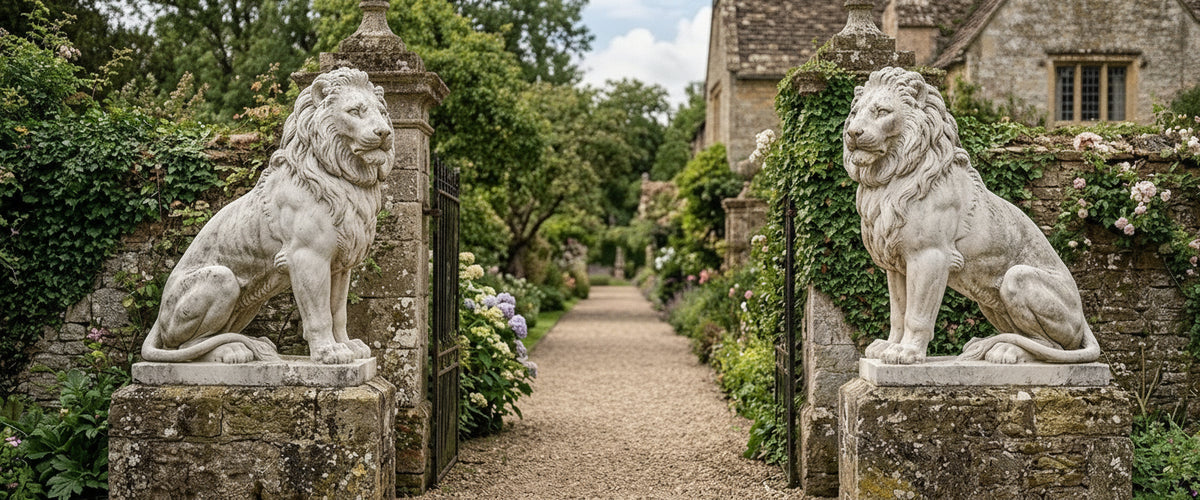

A lion with nothing to guard looks lost. Put the same animal on a gatepost, at the foot of a flight of steps or beside a front door, and it suddenly has a job. That is the real secret of lion garden statues: placement decides whether the piece reads as heraldic or as an impulse buy from a garden center. After years of shipping lions to estates, ranches and city courtyards, our studio has learned that choosing the sculpture is only half the decision. Choosing its post is the other half.
Looking for the full range in this category? Browse our Lion Statues & Sculptures collection for every available finish, size, and configuration.

At a glance
Pairs belong at thresholds: gates, drives and front steps.
A single lion works when it guards something specific, such as a step, a bench or a bend in the path.
Gatepost proportions matter more than the size of the lion alone.
Recumbent lions tolerate imperfect symmetry. Standing lions do not.
Bronze and marble age at their own pace, so plan for that rather than fighting it.
Why a Matched Pair Reads Grand on One House and Civic on Another
A pair at the gate borrows an old vocabulary of authority: palace forecourts, library steps, bank entrances. At the end of a long gravel drive in Aspen or in front of a shingle-and-stone house in the Hamptons, that vocabulary feels earned. On a modest suburban frontage, the same pair can tip into municipal, like the entrance to a county courthouse.
The fix is proportion and restraint. Smaller frontages usually suit a pair scaled to the piers, set on plain bases and pulled back slightly from the sidewalk, so the lions greet the house rather than the street.
The Case for a Single Lion
A single lion statue for garden settings needs a specific post. Set one at the bottom of a terrace step, at the end of a stone bench, or where a path turns, and the lion becomes the reason the eye pauses there. Without that anchor, one lion looks like the survivor of a pair.
A single is also the easier way to buy big. In a Napa courtyard, one carved marble lion at around 150cm (roughly 4 ft 11 in), such as the Giant Lion Marble Outdoor Sculpture, can hold the space on its own, where a pair at the same scale would crowd a narrow entrance.
Mirrored Poses or a Mismatched Pair That Feels Collected
Mirrored pairs, one head turned left and one right, are the classical default. They read as formal and deliberate. A mismatched pair, perhaps one alert and one at rest, feels collected, as though the lions arrived across generations. Chinese guardian lions offer a long precedent here: traditionally the male rests a paw on a ball and the female on a cub, so the pair is matched without being identical.
A mismatched pair still needs a binding thread. Keep the same material, the same scale and the same plinth design, and the difference in pose will look intentional.

Gatepost Height Decides Whether a Pair Looks Proud or Apologetic
The most common gatepost problem we are asked to solve starts with masonry piers built before anyone chose the sculpture. Tall, slender piers make a pair of lion garden statues look as if they are clinging on. A wider cap or one less course of stone usually fixes it, but measuring first is far cheaper.
Our working rule: the lion should fill most of the cap, with a few inches of stone showing on every side. Tall piers want an upright lion with presence. Low piers or garden walls suit a lying pose. Before ordering, cut a cardboard silhouette to size, tape it to the pier, and look at it from the street and from the front door.
Recumbent Lions Forgive Asymmetry; Standing Lions Punish It
A lying lion has a long, low silhouette, and small differences in pier height or angle disappear into it. On uneven ground, an old wall or a sloping bank, a long resting form such as the Giant Sleeping Lion Marble Outdoor Sculpture, at 200cm (about 6 ft 7 in), settles into the site instead of drawing attention to its flaws.
Standing and seated lions are less forgiving. If one pier sits two inches lower or one plinth leans slightly, the vertical line of the chest and head exaggerates it, and visitors notice it from the car before they can say what is off.

Stone, Bronze or Resin: Why Uneven Weathering Can Be a Gift
Marble softens over decades. Bronze darkens and can turn green or streaked depending on rain, irrigation and pollution, a process the Getty Conservation Institute has studied extensively in outdoor sculpture. The lion nearest the sprinklers will change first. We encourage clients to accept that: a pair that ages slightly differently looks as if it has stood there for a century.
Resin is lighter and simpler to place, but it never really weathers into character; it holds its factory finish until sunlight fades it. That is why we steer outdoor pairs toward bronze and stone.
Anyone shopping for lion garden statues for sale in MI faces a harder test. Michigan's freeze-thaw cycles punish porous stone and poorly sealed joints, a risk well documented in Historic England's technical guidance on stone decay. In cold states, dense marble or bronze, sound fixings and good drainage under the base matter far more than they do in Southern California.
Lions Stranded on Open Lawn
The mistake we see most often in client photos is a lion placed dead center on an open lawn. With nothing behind it and nothing to protect, it floats. Give it a backdrop (a clipped hedge, a wall, a planting bed) or a job: a gate, a pond, a seat.
Water is an underrated job. Where a blank garden wall needs a focal point more than another freestanding figure, a bronze lion-head spout such as the Classical Lion Head Wall Fountain Bronze Sculpture, at 110cm (about 3 ft 7 in), makes the lion the source of the water rather than a spectator beside it.

Buying Lion Garden Statues: A Placement Checklist
For wider placement ideas, Adam and Eve Garden Statue: How to Stage the Story Outdoors is useful companion reading before finalising the setting and sightlines.
Name the threshold first. Decide what the lion guards before choosing the lion.
Measure the cap and the view. Record pier height, cap width and viewing distance from the street and the house.
Match pose to symmetry. If your piers or ground are uneven, favor recumbent poses.
Choose material for climate. Ask about fixings, drainage and frost resistance in cold regions.
Check access. Stone and bronze lions at this scale usually need lifting equipment, so confirm gate widths and ground conditions.
Ask for a full quote. Budget depends on material, scale, complexity, engineering, installation and finishing.
Because Giant Sculptures carves and casts lions to order, a pair can be scaled to your piers instead of the piers being rebuilt around the lions. Send us photos and measurements of the spot, and we will advise on pose, size and material before anything is quarried or poured.