






































































































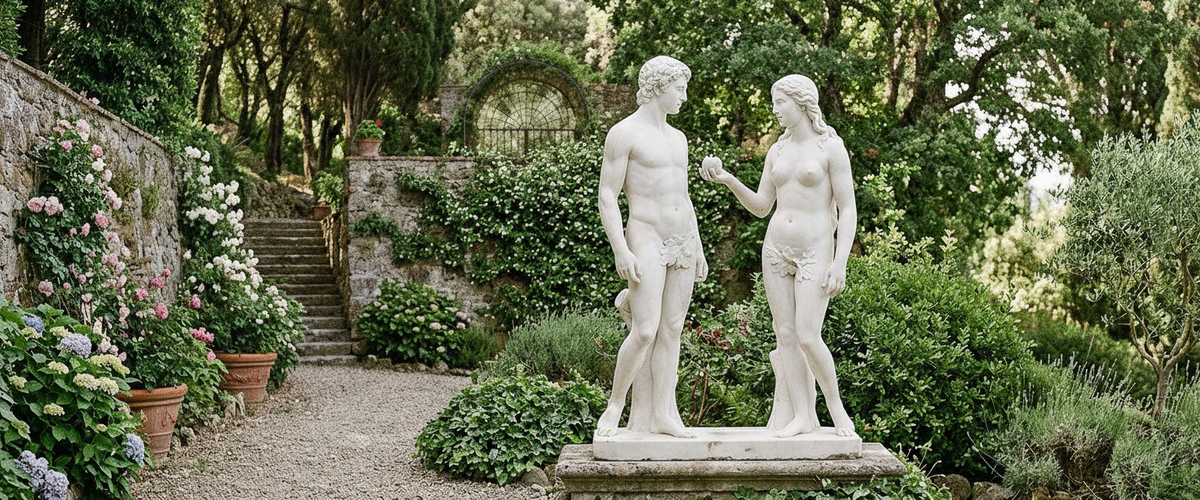

An Adam Eve garden statue, the shorthand most buyers search for when they want the first couple from the Book of Genesis outdoors, works best staged as one scene rather than placed as two separate figures. Choose the moment you want to show: innocence, temptation or the expulsion from the Garden of Eden. Set the pair against a hedge, wall or orchard edge. Add a carved or living tree, and plan the path so visitors meet the story in order. For a permanent outdoor pair, marble, stone or bronze outlasts fiberglass resin.
Most Adam Eve garden statues go wrong before anyone looks closely at the carving. They get bought as two attractive figures, set down in the middle of a lawn, and left to explain themselves. They can't. The story needs staging, and when it gets it, a modest pair carries a whole garden. Get it wrong and even fine marble looks like stock statuary.
At a Glance
One scene, two figures: spacing and gaze decide which moment of the story you are showing.
The tree completes it: a living apple or fig can stand in for the carved tree.
Setting beats size: orchard edges and enclosed corners suit an Adam Eve garden statue; open lawns strand it.
Plan the walk-up: visitors should meet the story in sequence.
Material matters more for nudes: stone weathers into the skin, while fiberglass resin depends on a surface coating that needs watching outdoors.

One Scene, Two Figures: How Sculptors Have Read the Pair
From the Renaissance onward, sculptors usually conceived Adam and Eve to be read together. Even when carved as individual figures, each depends on the other: a glance, a reaching hand, a turned shoulder that only makes sense with the partner in view. Rodin pushed the idea further. He modeled his Adam and Eve as companion figures intended to flank The Gates of Hell, their heavy, downcast poses answering each other across the gap between them (the Musée Rodin holds both). For anyone buying an Adam Eve garden statue, the lesson is simple. Choose the pair as one composition, from one maker, in one material and finish. A reclaimed Eve beside a newly carved Adam almost never works; proportion and surface give each other away within a season.
Facing, Side by Side or Apart: What Each Arrangement Says
Spacing is the plot of any Adam Eve garden statue. Figures turned toward each other, close enough to pass the fruit, show the temptation. It is the most narrative choice and the one that most needs a tree between or behind them.
Side by side, both facing the viewer, reads as innocence before the fall. It is calmer and more formal, and it suits a symmetrical axis or a pair of plinths flanking a gate. Set the figures apart, turned away with heads lowered, and you are showing the expulsion. That version carries the most drama and is the hardest to place, because the gap between them has to look deliberate rather than accidental. As a working rule, we keep a facing pair within roughly one figure's height of each other so the exchange still reads from the path.
A facing pair reads as the temptation; a planted fig completes the scene.
The Tree as a Third Figure
Classical treatments almost always include the tree, often with the serpent wound through its branches. Outdoors, an Adam Eve garden statue has a better option: plant one. Apple is the popular reading, though some early traditions and painters, Michelangelo in the Sistine Chapel among them, favored the fig, which also gives broad leaves at a useful height beside a nude pair. A living tree turns the scene with the seasons: blossom in spring, fruit in late summer, bare limbs in winter that suddenly make the expulsion feel right.
A young fig planted between a facing pair can grow out to frame both heads within a few summers. Same carving, different scene. One practical warning: fallen fruit stains pale stone. Set the figures just outside the heaviest drop zone, or plan on a rinse after harvest.
Plan the Approach So the Story Unfolds in Order
Think about the first thing a visitor sees on the way to your Adam Eve garden statue. Ideally they meet the gesture or the tree before the full figures, then both faces, then step back to take in the group. For a temptation scene, bring the path in from Eve's side so the offered fruit is the opening detail. For an expulsion, approach head-on, so the figures walk out of the garden as you walk in. A bend in the path, a hedge return or a low wall controls that reveal better than any plinth height.
Where an Adam Eve Garden Statue Belongs
Open lawns leave the pair stranded, two pale shapes with nothing to stand in or against. The figures want a setting with edges: the margin of an orchard, a walled kitchen garden in the Hamptons, an enclosed courtyard corner in the Texas Hill Country, the end of a pleached walk. Dark yew or boxwood behind white marble makes the figures read from a distance, as it does for most figurative garden sculpture; bronze or darker stone prefers a lighter wall.
Where ground is short, a carved relief such as the Adam and Eve in Eden Marble Relief Wall Panel, roughly 47 inches (120 cm) across, makes more sense than a freestanding Adam Eve garden statue pair. It flattens the whole scene, tree included, into a single plane, so on a courtyard wall in Santa Barbara or inside a loggia it tells the full story without crowding the circulation.

Fiberglass Resin or Stone for Nude Figures Outdoors
Nude figures are unforgiving because skin is the subject. Weathering on drapery reads as character; weathering on a cheek or shoulder reads as blemish. That is the lens to use when comparing a carved stone Adam Eve garden statue with the typical retail listing, usually titled something like 'Adam Eve fiberglass resin indoor outdoor garden statue sculpture'.
Fiberglass resin is light, takes cast detail well and is easy to reposition, which makes it reasonable indoors or under cover. Outdoors, everything depends on the gelcoat or painted skin. UV fades flesh and faux-stone tones, and once the coating chalks or chips, the hollow shell shows. On resin pieces that reach our studio for refinishing, the fading almost always starts on the tops of heads and shoulders, the surfaces facing the sky.
Marble softens and warms outdoors, where a resin coating would fade.
Stone ages the other way. Marble softens and warms, and limestone gathers a gentle bloom in shade; the Getty Conservation Institute publishes useful research on how outdoor stone weathers. For a permanent outdoor Adam Eve garden statue, we recommend carved marble or stone on an engineered footing, or bronze if you want a darker skin that develops patina. Expect real weight and plan for access.
Buyer Checklist Before You Commission an Adam Eve Garden Statue
Choose the moment: innocence, temptation or expulsion.
Fix the setting first, then scale the figures to the hedge, wall and tree around them.
Decide whether the tree is carved, planted or both.
Walk the approach and mark where the first view happens.
Match material to exposure: full sun, frost cycles, coastal salt, sprinkler spray.
Check foundations and delivery access for a crane or pallet truck.
Agree on the finish and a simple yearly care routine before carving begins.
Giant Sculptures makes bespoke figurative work in marble, stone and bronze for gardens and venues worldwide. Most inquiries for an Adam Eve garden statue arrive with a catalog image, but the most useful ones arrive with photographs of the site and the path leading to it, so start there if you are weighing a commission. Budget depends on material, scale, complexity, engineering, installation and finishing, so every commission is quoted individually.
For wider placement ideas beyond the Adam Eve garden statue, Placing Large Chinese Garden Statues: Every Figure Has a Station is useful companion reading before finalizing the setting and sightlines.