
























































































Most garden hares fail because someone bought a rabbit. The ears are right and the color is right, but the body is round and tucked, and once it sits in a border it reads as a lawn ornament rather than a wild animal caught mid-thought. Good hare statues for garden settings do the opposite. They show the lean flank, the long hind leg folded like a loaded hinge, and the alert head of an animal that could be gone in a second. Get that anatomy right, set it at the height where a real hare would sit, and the piece starts doing the job you bought it for.

Quick Answer
Height: place hare statues for the garden at ground or meadow level, because a plinth shrinks them.
Pose: use moon-gazing figures on open lawn, crouched figures in borders and boxing pairs in clearings.
Material: choose cast bronze for anything that will live near mowers, frost or wet soil.
Scale: life size suits most gardens. Go oversized only when the space is large and the sculptor has simplified the form to carry it.
A Hare Is Not a Rabbit
Look at a hare side-on and the differences are obvious. The hind legs are far longer, the ears are longer than the head and often tipped dark, and the body rides higher off the ground. American buyers already know the type: the jackrabbit is a hare, not a rabbit. The best garden hare statues keep that rangy, athletic outline, and your planting has to protect it.
Sink a hare in hostas up to the shoulder and you lose the one feature that separates it from a rabbit. Keep the planting around the hindquarters low or airy (fine grasses, creeping thyme, low sedges) so the leg reads clearly from your main viewpoint. Let taller planting rise behind the figure instead of in front of it.

Why Hare Statues for Garden Lawns Look Lost on Plinths
A hare lives at grass height. Lift it three feet into the air and it becomes a trophy on a mantel. Set a pair of boxing hares on a limestone pier beside a pool terrace and the result looks like a hotel lobby. Move the same pair into an unmown strip at the edge of a vineyard or meadow, bases settled into gravel, and the whole garden changes. That is why we raise the ground-level option at quote stage.
There are sensible exceptions. A flush stone pad stops a heavy garden hare statue from tilting in soft lawn, and a small hare viewed mostly from a terrace can sit well on the edge of a low wall. Keep any lift below knee height and the animal still feels wild.
Matching Pose to Planting
Moon-Gazing in Open Lawn
Of all hare statues for the garden, the upright, seated moon-gazer with its head tipped skyward needs the most sky behind it. Put it on an open lawn, a rise in the ground or the far end of a view in an Aspen garden where the mountains do the framing. Crowd it with shrubs and the upward gaze has nowhere to go.
Crouched in Borders
A low, lying hare is meant to be found rather than displayed. At the front of a border, a small crouched casting such as the Traditional Lying Hare Bronze Sculpture - 25cm, about 10 inches (25 cm), sits best under the loose edge of lavender or nepeta, where a guest spots it halfway along the path.
Boxing in Clearings
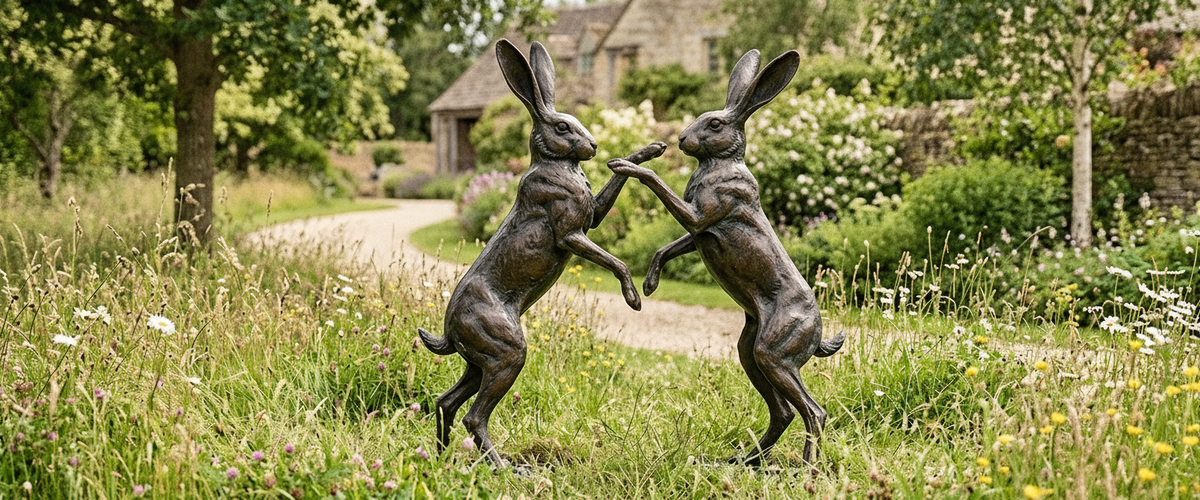
Boxing hares need air on every side. A clearing in long grass, or a close-mown circle within a meadow, gives the raised forepaws a clean silhouette. Tight planting reads as clutter around a pose that is already full of movement.
Seasonal Cover: Summer Grass Versus Winter Beds
In July a crouched hare in long grass can vanish entirely. In January the same hare in a cut-back bed can look stranded. Plan for both when siting hare statues in the garden. A dark bronze patina reads well against pale winter straw, while in summer green growth tends to swallow brown metal unless the ears break the grass line. Two fixes work: mow a close halo around the base in high summer, and leave seedheads standing through winter. A Hamptons meadow of little bluestem, left uncut until spring, gives a hare copper-colored cover that flatters bronze for months.

Thin Bronze Ankles Against Brittle Resin
Hares break at the ankles and ears. Those thin sections are exactly where resin and composite hare statues for the garden fail: frost opens hairline cracks, sun chalks the surface, and one glancing mower strike snaps an ear clean off. Cast bronze handles thin sections far better, and its surface darkens and mellows outdoors rather than flaking, a process the Copper Development Association describes in its guidance on copper alloy finishes.
In our studio the ankles get more attention in the wax and chasing stages than any other part of a hare. When installing hare statues for garden lawns, we pin castings with stainless steel into a concrete footing set below soil level, with gravel beneath for drainage so wet ground never sits against the base. Leave a 12-inch (30 cm) buffer your mowing crew can respect, or hand-trim around the figure.
Pairs and Trios: When Boxing Hares Earn a Second Figure
Spring boxing is usually a female fending off an overeager male, as the Woodland Trust notes in its brown hare profile, so a pair carries a built-in story that a single hare statue for the garden cannot tell. For most private gardens, a life-size pair such as the Life-Size Traditional Boxing Hares Bronze Sculpture - 80cm, about 31 inches (80 cm), tells that story without overwhelming a clearing, and because both figures share one sightline, the tension between them reads from a single viewpoint.
A third hare rarely helps if it joins the fight. It earns its place when it watches from a distance, set 20 or 30 feet away at the edge of the grass, so the eye travels between scenes instead of landing on a cluster.
Oversized Hares: When a Single Figure Can Hold a Large Meadow
Oversized hare statues for garden meadows work on estates, hotel lawns and commercial venues where a life-size figure would disappear. The test is stylization. A realistic hare scaled up with every tuft of fur modeled turns cartoonish fast. Where a meadow needs something that reads as sculpture first and animal second, a simplified, elongated form such as the Monumental Contemporary Contemplative Hare Bronze Sculpture - 340cm, just over 11 feet (340 cm), is closer to the right design language. The bigger the hare, the smoother the surface should be. Before committing, stake a plywood silhouette at the proposed height and look at it from the house for a week.

Buyer Checklist: Choosing Hare Statues for Your Garden
Does the model show a long hind leg and lean flank, or a rounded rabbit body?
Where is the main viewpoint, and will planting hide the legs from it?
Does the pose suit the spot: open lawn, border edge or clearing?
How will the figure read in both summer growth and winter cutback?
Will it sit near mowers, frost or poorly drained soil? If so, specify bronze and a proper footing.
Is a pair telling a clear story, or would one figure be stronger?
For oversized pieces, has the surface been simplified enough for the scale?
Our rabbit and hare statues cover poses ready to ship, and the wider bronze rabbit and fox statues are worth a look if you are planning a woodland edge with several species. Giant Sculptures also commissions bespoke hare statues for garden sites, adjusting pose, patina and scale to a specific location. Budget depends on material, scale, complexity, engineering, installation and finishing, so send us photos of the spot and we will prepare a tailored quote.
For wider placement ideas, Choose Your Outdoor Large Garden Sculpture for February, Not July is useful companion reading before finalizing the setting and sightlines.