






























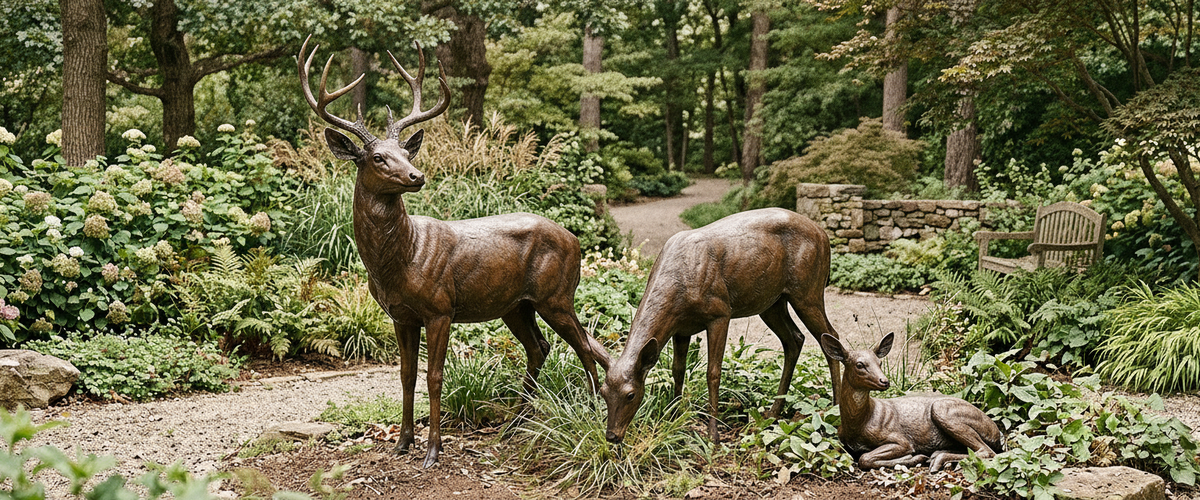

A single bronze stag planted in the middle of a lawn almost always reads as an ornament. Put two more figures around it, one with its head down and one half-lost in grasses, and the whole scene changes: your eye reads a moment rather than an object. That difference is why the best deer statues for garden settings are bought as a cast of characters, not as a single hero piece. We have shipped enough deer commissions to know that the number of figures, their poses and the gaps between them do more work than the sculpting detail ever will.
Looking for the full range in this category? Browse our Deer Statues & Sculptures collection for every available finish, size, and configuration.
Real deer are social and they space themselves. Herds break into small family groups and browse at irregular intervals rather than standing shoulder to shoulder, which is exactly why an evenly spaced pair on a manicured lawn looks staged. Wildlife accounts of white-tailed deer describe small maternal groups and loose feeding formations rather than tidy lines, which is a useful mental model when you are laying out figures on grass with marker stakes (the Smithsonian's National Zoo and Conservation Biology Institute has good background on deer behavior and grouping).

At a Glance: The Short Version
Groups beat singles. Three figures usually beat two; two beat one. A lone stag needs a strong architectural reason to stand alone.
Cast roles, not copies. One alert standing stag, one grazing doe, one resting fawn. Repeated poses kill the illusion instantly.
Space at browsing distance. Uneven gaps of roughly 8 to 20 feet (2.5 to 6 m) beat a neat row.
Rank your sightlines. The kitchen window usually matters more than the path.
Hide part of the group. A half-screened figure implies more deer beyond the planting.
Get the ground contact right. Hooves that float ruin an otherwise excellent bronze.
Herd Math: Why Deer Statues for Garden Lawns Work in Groups
One figure is a statement. Two figures create a relationship. Three create a scene, because the brain stops counting and starts reading behavior. That is the practical case for buying deer statues for garden schemes in groups: each extra figure lowers the chance that a viewer reads the piece as furniture.
There is a budget consequence, and it is worth being honest about it. Three modest figures often land better than one oversized stag at the same total investment, because the composition carries the drama instead of the height. If you do want a solitary piece, give it a job: terminate an axis, mark the turn of a drive, or sit as a reflected form beside water. Motion helps carry that weight, which is why a courtyard with room for only one animal is usually better served by something like the monumental running deer bronze fountain at around 5 ft 7 in (170 cm) than by a static stag on a plinth; the implied movement supplies the narrative a single standing figure lacks.

Standing Stag, Grazing Doe, Resting Fawn: Cast the Roles First
Decide the story before you decide the sculptures. A workable classic trio is one stag with head up and antlers reading against the sky, one doe with her neck dropped into the grass, and one fawn folded down at rest. Each pose sits at a different height, which gives the group a natural rise and fall instead of a flat silhouette line.
Buyers comparing deer statues for garden planting usually skip the recumbent figure, and usually regret it. A lying deer breaks up the vertical rhythm and reads as calm rather than alert, which is what makes the rest of the group feel unobserved. If that low, settled note is what your scheme is missing, a piece such as the Large Traditional Recumbent Deer and Dharma Wheel Bronze Sculpture - 180cm at roughly 5 ft 11 in (180 cm) holds presence close to the ground without competing with the standing figures. Look through the wider bronze deer statues range with roles in mind rather than picking three pieces you happen to like individually.

Spacing That Mimics Browsing, Not a Shop Window
Stake out the positions of your deer statues for garden lawns before anything ships. Bamboo canes, a bedsheet, whatever you have. Then walk the garden and adjust. The rule we give clients: never place three figures at equal spacing on a straight line, and never place them all at the same distance from the viewer. Push one figure noticeably further back, closer to a hedge or tree line, so the group has depth. Uneven gaps of roughly 8 to 20 feet (2.5 to 6 m) work well on a lawn of typical suburban depth; a large Hamptons or Napa property can stretch that considerably.
Turn the figures too. Deer rarely all face the same way. Angle the stag slightly across the main view, put the doe at three-quarters, and let the fawn face somewhere entirely different.
Rank Your Sightlines Before You Fix Anything
Most gardens have four or five real viewing positions and only two that matter daily. For one Northern California commission, the client had planned the group for the terrace. We asked how often they actually sat there in winter. The group moved 30 feet left so it read perfectly from the kitchen sink, and it became the view they mention every time we speak.
Rank sightlines in this order: the window you look through most, the approach along the main path, then the far boundary view. Optimize for the first, check it does not collapse from the second, accept compromise on the third. Backlighting matters here as well. A stag placed against morning sky from the breakfast room will do more for you than one lost against a dark yew hedge.
Half-Hidden Beats Fully Framed
The strongest trick in this whole exercise costs nothing: let planting eat part of the herd. Set one figure so ornamental grasses cover its legs and another so a shrub obscures its hindquarters. The mind fills in the missing volume and assumes more animals sit beyond the border. Deer statues for garden borders that are fully exposed on cut grass have nowhere to hide, and every proportion is judged instantly.
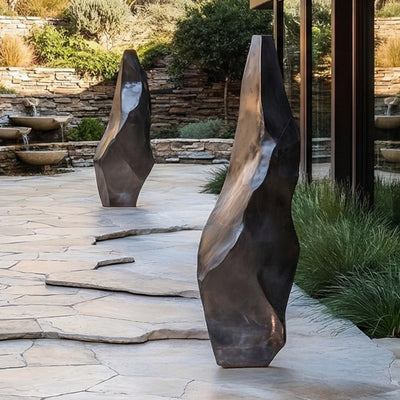
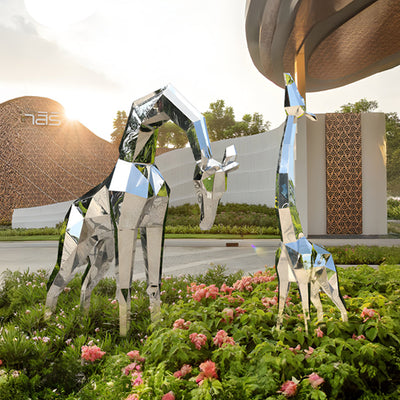
This works for contemporary pieces too. In stainless steel or Corten, an open framework reads as a drawing in space rather than a solid mass, which suits modern gardens where a naturalistic bronze might feel too traditional. Where the setting calls for line rather than modeled weight, the Deer Silver Geometric Wireframe Outdoor Sculpture - 180/280cm, offered at roughly 5 ft 11 in and 9 ft 2 in (180 cm and 280 cm), speaks the right design language: its faceted planes reveal the animal gradually as you move past the planting.
Ground Contact: The Detail That Sells the Illusion
Hooves are where credible groups fail. A deer sitting on a visible slab plinth reads as sculpture; a deer whose hooves disappear into turf reads as a deer. The engineering answer is usually a concealed base: a buried concrete pad with stainless steel pins rising into the legs, set so the finished ground level covers the mounting plate by an inch or two. Grass or low planting closes over the joint within a season.
Two things to specify at order stage. First, the fixing detail must suit your ground; heavy clay, sandy soil and sloping sites all need different pad depths and drainage. Second, ask about drainage inside hollow-cast figures so water cannot sit and freeze in a cold winter. The US National Park Service technical preservation guidance is worth reading for context, and the Henry Moore Foundation, which cares for a large collection of outdoor bronzes, is a useful reference on why drainage and regular waxing matter for long-term surface stability.
Scale the Group So the Fawn Is Not a Shrunken Adult
This is the mistake we see most in mixed-source groups. Buyers assemble three deer statues for garden use from different makers, and the fawn turns out to be an adult model scaled down. Adult and juvenile deer have different proportions: fawns have shorter muzzles, proportionally longer legs, and a rounder body relative to head size. Shrink an adult and the eye registers something wrong even if it cannot name it.
Buy the group from one range where the anatomy has been modeled at each life stage, or commission the set together. If you are mixing sources anyway, compare the head-to-body ratio and leg length of every figure against photographs of real deer at that age before you commit to anything.

Buyer's Checklist
Decide herd size first, then pose combination, then material.
Mock up positions with stakes and view them for a full week.
Confirm every figure comes from a range with consistent anatomy and finish.
Check the mature height of surrounding planting; grasses that swallow a fawn in August are a problem, not a feature.
Agree base and fixing details, including ground conditions and drainage, before manufacture.
Plan access for delivery and lifting. Bronze at life size is heavy and rear gardens are rarely easy.
Book an annual wash and wax for bronze; inspect welds and fixings on steel pieces at the same time.
Commissioning a Herd
Most groups we make are bespoke, because stock combinations rarely match a specific garden's depth, planting and viewing angles. At Giant Sculptures we work from site photographs and rough plan dimensions, then agree poses, heights and finish before casting begins. Patina choice matters more than people expect; a warm brown reads naturalistic against green planting, while darker patinas hold up better against pale gravel and stone.
Cost depends on material, scale, complexity of the modeling, structural engineering, installation and finishing, so we quote deer statues for garden commissions individually rather than working from a list. Send us the site views and how many figures you have in mind, and we will tell you honestly whether three smaller deer or one larger piece will serve the garden better. If you want to see how animal groups behave at different scales first, the wider bronze animal sculptures collection is a good place to calibrate your eye.
For wider placement ideas, Large Stainless Garden Sculptures: Place Them by Sightline, Not by Gap is useful companion reading before finalising the setting and sightlines.