





































































































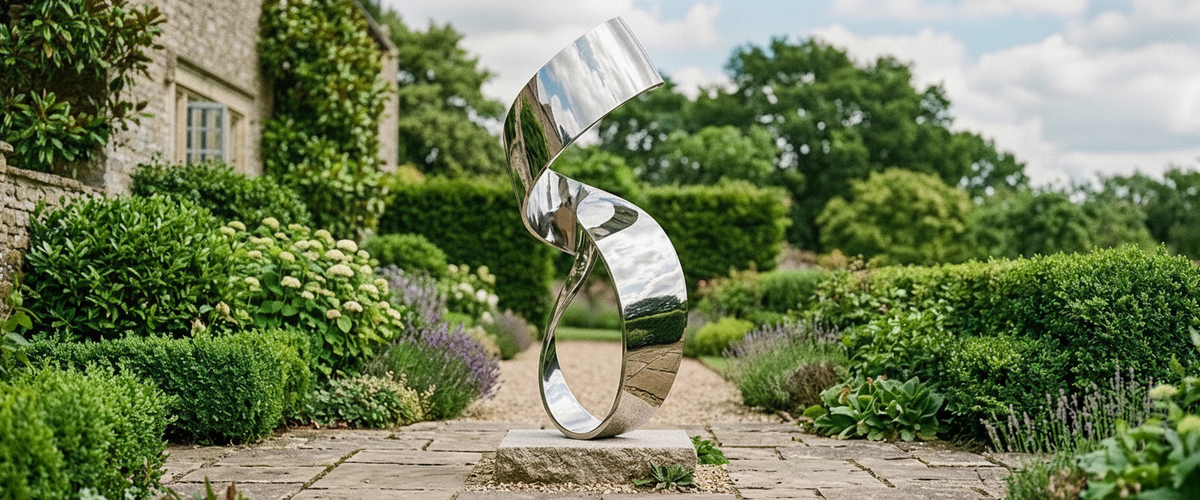

A mirror-polished form seven feet tall (2.1 m) can disappear into a yew hedge at 9am and throw a hard white flare across the terrace at 4pm. That is the whole problem with large stainless garden sculptures in one sentence. The metal has almost no color of its own, so the garden decides what the piece looks like hour by hour, and most siting mistakes come from choosing a gap in the planting rather than a sightline through it.

Key Takeaways
Steel takes its color from the setting. Test the spot at three times of day before large stainless garden sculptures are fixed in place.
Walk the approach, not the plan. The first fifteen paces of arrival matter more than a tidy view from above.
Mirror finish wants a dark backdrop; brushed and satin finishes hold their form against pale stone and rendered walls.
Past about 6 ft 6 in (2 m), the plinth becomes engineering, not decoration. Footing depth follows soil type, wind exposure and mass.
Water doubles everything, including glare and any error in level.
Budget for large stainless garden sculptures depends on scale, grade, fabrication complexity, finishing and install access. Ask for a tailored quote rather than working from a guess.
A Polished Form Borrows Its Color from Sky, Hedge and Planting
Stand a satin-finished abstract in a Napa garden and it reads as soft gray against olive foliage. Move the same piece to a Hamptons lawn with an open sky and it turns pale silver, almost white, for most of the afternoon. Mirror-finished large stainless garden sculptures go further: they collect the hedge line, the pool, the clouds and the guest walking toward them, and they compress all of it into a curved image that shifts with every step.
That behavior is the reason large stainless steel garden sculptures work so well in planted schemes. A bronze figure asserts a fixed tone. Steel negotiates. It gets warmer as the beech turns copper in October and cooler when frost flattens the borders. Our studio has had clients call in November convinced the finish had changed; the garden had.

The Fifteen-Pace Test: Walk the Sightlines Before the Plinth Is Poured
Before we agree a position for large stainless garden sculptures, we ask for one thing: walk it. Start where guests actually arrive, whether that is a gravel turning circle, a side gate or a set of sliders off the kitchen. Count fifteen paces toward the proposed spot and stop three times on the way.
What you are checking is simple. Does the piece hold its silhouette against the background at each stop, or does it collapse into a fence panel? Does it stay visible as you move, or does a magnolia eat it at pace eight? Curators at outdoor institutions like Storm King Art Center site work around long approaches for exactly this reason: the walk toward a piece is part of the piece.
The second half of the test is the view from indoors, and it is where large stainless garden sculptures earn their keep. In a Texas project we shipped last year, the client's preferred lawn position looked perfect on a site plan and was completely invisible from the two rooms they use every evening. We moved it nine feet (2.7 m) left, onto the axis of the dining room glazing, and the sculpture became the thing they actually see.
Mirror Finish Against Dark Yew, Brushed Finish Against Pale Stone
Finish is a placement decision on large stainless garden sculptures, not a taste decision.
Mirror polish: needs a dark, dense backdrop. Yew, holly, clipped box, a dark rendered wall. Against pale limestone or a white render, a mirror piece loses its edges and reads as a smear of light.
Brushed or satin: the safer choice for open positions, pale paving, sunny courtyards and anywhere glare could reach a seating area or a neighbor's window.
Bead-blasted or matte: holds form beautifully in flat light and gray weather, which matters more in the Pacific Northwest or coastal New England than people expect.
Grade matters too. Within a mile of the coast, 316 stainless with its molybdenum content resists chloride pitting far better than 304, though large stainless garden sculptures still want regular fresh-water rinsing to stay clean. Guidance from the Australian Stainless Steel Development Association on grade selection in marine environments is worth reading before you commit to a coastal position. If you are comparing finishes side by side, our stainless steel sculptures collection is a useful way to see how differently polish and satin behave.

Plinth Height and Footing Depth Above Six Feet Six
Under about 6 ft 6 in (2 m), a stainless piece can often sit on a dressed stone pad or a shallow reinforced base. Above that, wind load and mass turn the plinth into structure. Tall polished forms are effectively sails on a windy Aspen ridge or an exposed Long Island lawn, and the footing has to answer for that.
Three things drive the design for large stainless garden sculptures: total weight and where the mass sits, soil type and drainage, and the height of the visual center above ground. Clay that moves seasonally needs a different solution than free-draining sand. We supply fixing details with commissioned work, and we would always rather over-engineer a footing than repair a leaning sculpture two winters later.
Plinth height itself is an aesthetic call with a rule of thumb behind it: raise the piece until its visual center lands near eye level from the main viewing point, then stop. Over-tall plinths make sculptures look nervous.
Pools and Courtyards: The Doubled Reflection Nobody Plans For
Water is the most rewarding and most punishing setting for large stainless garden sculptures. A still pool gives you a second sculpture for free, and on calm mornings the two read as one continuous form. That is the reward.
The punishment is glare. Sun bouncing off water onto a mirror surface and back at a lounger is genuinely uncomfortable, and it happens at predictable hours. Check the low-sun angles in late afternoon before you fix a mirror finish near a pool; a satin surface solves it without losing the reflection in the water. Enclosed courtyards behave the same way, with rendered walls acting as a second bounce surface.
Level is the other trap. Beside water, any deviation from plumb is doubled by the reflection and instantly obvious.

Placements We Talk Clients Out Of
For wider placement ideas on large stainless garden sculptures, Large Abstract Garden Sculptures: A Buyer's Guide to Scale, Metal, and Placement is useful companion reading before finalizing the setting and sightlines.
Side returns. A narrow strip beside the house gives no viewing distance. A large piece there is a squeeze, never a moment.
Sunken corners. Cold air and leaf litter collect, drainage is usually poor, and the sculpture is seen from above rather than across.
Tight boundaries. Set a tall polished form against a shared fence and you have made a decision on your neighbor's behalf about reflections and sightlines.
Under mature trees. Constant sap, bird traffic and dripping tannins mean far more cleaning than anyone signs up for.
Dead center of a small lawn. Symmetry without a strong axis usually reads as accident, not intent.
Commissioning Large Stainless Garden Sculptures
Bring us three things and a commission moves quickly: photographs from the main viewing points, a rough sense of the backdrop planting or masonry, and the exposure conditions (coastal, high altitude, deep shade, poolside). From there we can advise on grade, finish, wall thickness, internal armature and the fixing method, then produce visuals of the sculpture scaled into your setting.
Cost for large stainless garden sculptures tracks scale, material grade, geometry, engineering, finishing time and site access rather than any fixed list, so a tailored quote is the only honest answer. Access is the item buyers underestimate most: a piece that clears a gate on paper may still need a crane over the roof. Clients weighing steel against a warmer material often look at our bronze sculptures alongside stainless proposals, and browsing the wider garden sculptures range helps clarify what scale actually suits the space. Get the sightline right and large stainless garden sculptures will still look deliberate in twenty years.