




























































































A tiger is one of the few sculpture subjects that can be technically perfect and still look wrong. The casting is crisp, the patina is deep, the anatomy holds up under close inspection, and the animal still sits there inert because somebody centered it on a formal plinth in the middle of a lawn. An outdoor tiger statue is a study in stored movement, and stored movement needs somewhere to go. Get that part right and a bronze cat can hold a whole garden. Get it wrong and you have an expensive ornament.
Looking for the full range in this category? Browse our Tiger Statues & Sculptures collection for every available finish, size, and configuration.
Most of the outdoor tiger statue inquiries we take are really placement calls in disguise. Buyers know they want the animal. What they have not settled is where a visitor first sees it, from what angle, and against what ground.

Quick Answer: Where an Outdoor Tiger Statue Belongs
Off-axis, not centered. Symmetry reads as ceremony. Tigers read as intent.
At a turn or a gap in planting, so the viewer meets it side-on and slightly late.
On gravel, stone or a low stone apron, never in long grass that eats the legs.
Within about 40 feet (12 m) of the main viewing point, or the surface detail stops reading.
With the base bedded down, so the belly line sits where a real animal's would.
In dappled or raking light rather than flat midday glare.
Predators Read as Movement, so a Formal Plinth Stalls Them
Classical plinths were designed for figures at rest and for heraldic animals that are meant to look ceremonial. A lion couchant on a pedestal gains dignity. A prowling cat loses momentum, because the moment you lift it clear of the ground and square it to an axis, you have told the eye that this is a monument rather than an animal. The shoulders stop pushing forward. The paws stop gripping anything.
The fix is usually subtraction. Lower the base, break the axis, and let the ground do the framing. An outdoor tiger statue at 220 cm, roughly 7 ft 2 in nose to tail across the casting, works best on a shallow stone pad that reads as terrain rather than as furniture. Save the tall plinth for a bust or a heraldic pairing.
Head-On or in Profile: Two Different Sightlines
Decide early which one you are buying, because they are not interchangeable. A head-on tiger, facing a terrace or the end of a pool, is confrontational. It works when there is real distance to absorb it and when the viewer is seated. Guests eating dinner 50 feet away with a tiger staring back at them will talk about nothing else, which is either the point or a problem.
Profile is the more forgiving orientation for an outdoor tiger statue in a garden. Seen side-on, the long line of the spine, the drop of the head and the coil in the hind legs all become legible at once, and the animal appears to be passing through rather than confronting you. Interlocked compositions are the clearest case: something like Large Contemporary Fighting Tigers Bronze Sculpture, 220cm only works from a broadside view, because the negative space between the two bodies is the drawing, and head-on it collapses into a single mass.

Ambush Angles: Site the Tiger Where Visitors Turn a Corner
For wider placement ideas, A Tiger Garden Statue Needs Cover, Not a Lawn is useful companion reading before finalising the setting and sightlines.
The best outdoor tiger statue placements we have shipped share one trait. The animal is not visible from the house. It waits at a gap in planting, at the pivot of a path, behind a hedge line, and the viewer meets it on the turn at a distance of 15 to 20 feet (about 5 to 6 m). That short delay does the work no lighting scheme can.
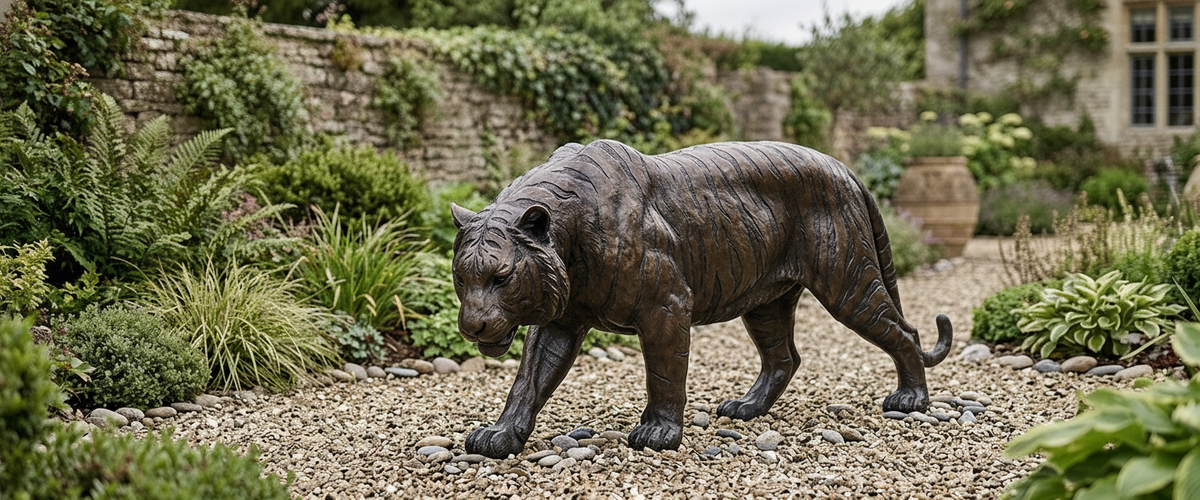
Met side-on at a bend in the path, a low stalking pose lands before the viewer expects it.
A Napa client originally wanted a life-size tiger dead-center on a lawn panel opposite the terrace doors. We suggested a trial run instead: mark the footprint, walk the approach, and try a second position at the olive-hedge gap where the gravel path bends. The gap won outright. For that kind of close-range reveal, a low-slung pose such as Life-Size Traditional Stalking Tiger Bronze Sculpture, 150cm is startling in the right way, because the dropped head and forward shoulders are exactly what a cat about to move looks like. We field the misspelled "outdoor tigar statue" searches too, and the answer behind them never changes: the corner beats the center.

Lawn Swallows a Life-Size Tiger, Gravel Gives It Back Its Legs
Turf is the single most common placement mistake with a life-size outdoor tiger statue. Grass grows up around the paws, the mower cannot get close, the lower legs disappear into green, and a life-size animal starts to look like a half-buried one. Fine gravel, decomposed granite, flagstone, or a bedded stone apron all keep the full leg length visible and give the tiger something to grip.
Water is the other setting that works. Bronze against a still surface doubles the animal for free, which is why a walking pose reads well at the head of a rill or on the edge of a formal pool, with the reflection carrying the striping down into the water.
The Forty Feet Where Stripes Still Read
Tiger striping is disruptive patterning; it exists to break an outline up rather than to decorate it, and the Smithsonian's National Zoo notes how effectively it hides a very large cat in tall grass. Sculptors work with that. Chased or textured stripes and a two-tone patina give you the pattern at close range and a strong silhouette further out.
Past 40 feet, texture flattens and posture carries the piece, so raised heads and open strides win.
In practice there is a window of roughly 40 feet (12 m) where a large outdoor tiger statue still reads as a tiger in surface detail. Beyond that, texture flattens and you are relying entirely on posture, so the pose has to be unambiguous. Long views want a raised head, an open mouth or a clear stride, which is why a piece like Large Classical Roaring Tiger Bronze Sculpture, 220cm carries across a paddock or a long drive where a subtler stalking pose would simply disappear. Keep the quieter poses for the places people walk past at arm's length.
Dappled Shade Flatters the Pattern, Midday Sun Flattens It
Position an outdoor tiger statue where broken light falls across it for part of the day. Shade patterns from a live oak, a pergola, or bamboo behave like extra striping and the animal seems to shift as clouds move. Flat overhead sun does the opposite: it kills the shadow in the modeling and turns a well-chased coat into a smooth brown shape. For evening use, cross-light it low from one side at 20 to 30 degrees rather than uplighting it from directly beneath, which gives every large cat the same startled, over-theatrical face.
Set the Base into the Ground so the Belly Does Not Float
Every bronze animal arrives with a mounting plate or base tabs, and that plate has thickness. Leave it sitting proud on paving and the belly line rides an inch or two higher than the anatomy intends, which is exactly the detail that makes visitors say something is off without being able to name it. Bed the plate into the gravel, recess it into a stone pad, or set it into a concrete pad below finished level and dress the surface back up to it.
Anchoring is not optional at this scale. A large bronze cat is heavy enough to need machinery to place, and it still needs stainless fixings into a properly sized footing, especially in wind-exposed or public settings. We size pads and fixings around the specific casting rather than a rule of thumb, and we would rather talk it through before shipping than after.

Placement Checklist for a Large Outdoor Tiger Statue
Walk the approach route and mark the footprint with cardboard or stakes before committing.
Pick your primary sightline: head-on for confrontation, profile for narrative.
Check the main viewing distance against the 40 foot (12 m) legibility window.
Choose a ground surface that keeps the lower legs fully visible.
Confirm access for delivery and lifting equipment, including gate widths and soft ground.
Plan the footing and stainless anchor points, not just the position.
Test the light at morning, noon and dusk before finalizing the orientation.
Agree the patina tone against your local stone and planting, not against a screen.
Commissioning an Outdoor Tiger Statue with Giant Sculptures
Cast bronze remains the default for this subject, and for good reason: it holds fine surface chasing, it takes a patina that can separate stripe from coat, and it survives decades outdoors with modest care. Conservation bodies including the Getty Conservation Institute publish guidance on maintaining protective coatings on outdoor metalwork; in practice, an annual wash and a wax refresh keeps a garden tiger looking deliberate rather than neglected. Stainless steel and Corten are worth discussing if you want the animal abstracted, though neither gives you readable striping in the way a patinated bronze does.
Bespoke work is where placement problems get solved properly. We adjust pose, head direction, tail line and overall scale so the piece suits the actual sightline rather than a catalog photograph, and we can mirror a stance so a matched pair flanks an entrance correctly. Budget depends on material, finished size, complexity of the modeling, engineering and base work, and installation, so the sensible next step is a tailored quote. The wider bronze sculpture collection is useful for scale and patina comparisons; after that, send us the site photos and the approach angle. That is the information that actually shapes the commission.