





































































































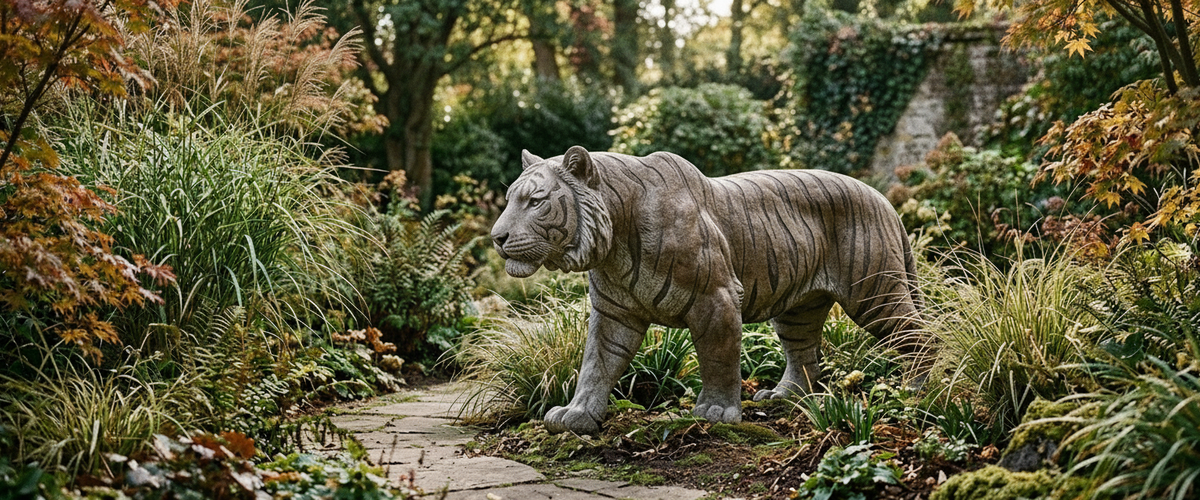

A tiger on an open lawn is just a big cat with nowhere to go. Set the same piece three feet off a curving path, half-screened by grasses, and the moment you round the corner it stops you cold. That difference has nothing to do with carving quality and everything to do with staging. A tiger garden statue is one of the few animal subjects that depends on concealment to work, and it is the single thing most buyers get wrong before the crate has even been opened.
Key Takeaways
Cover beats prominence. Partial screening reads as ambush; full exposure reads as ornament.
Shoulder height is the make-or-break dimension. Under roughly 3 ft (90 cm) at the shoulder, a tiger starts reading as a large domestic cat.
Stance must answer the approach. A prowling tiger wants to cross your path, not face it head-on.
Mascot tigers are the exception. A Clemson or LSU tiger garden statue belongs on a plinth in the open, not in the shrubs.
Concealed still means engineered. Slopes, base plates and a hard footing matter even when nobody sees the base.

The Ambush Rule: Why a Tiger Garden Statue Dies in the Open
Lions are throne animals. They sit at gates, flank steps, hold the center of a formal axis, and they look right doing it because that is how the subject has been used for centuries. Tigers are not throne animals. Everything about the anatomy, the low carriage, the long spine, the shoulder blades riding above the line of the back, says stalking cover. Put that body language on a mown lawn with clear sightlines in every direction and the sculpture contradicts itself.
The fix is cheap and it is spatial. Give the tiger a reason to be where it is: the edge of a planted bed, the base of a slope, a gap between two mature shrubs, the shaded side of a boulder group. A client outside Austin set a 150 cm descending piece into a limestone outcrop on a hillside so the animal appears to be coming down the rock face. From the terrace you see stone. From the lower path you see the tiger, and you see it late. That is the whole trick.
Staging the First Glimpse: Low, Off-Axis, Partly Screened
Work backward from where people walk, and do it long before the tiger garden statue leaves the crate. Stand at the point of approach and decide exactly how much of the animal you want visible at twenty paces: usually a shoulder, a haunch, or the line of the head. Then plant or place so the rest is withheld until the viewer is close.
Partial screening at the path edge: shoulder and head visible, hindquarters withheld until the viewer is close.
Three rules hold up in almost every garden we have shipped to. Keep the piece low, ideally with the base at or slightly below path level, so the eye meets the animal rather than looking up at a monument. Set it off-axis, angled fifteen to thirty degrees away from the walking line, because a tiger squared up to the path looks posed and a tiger crossing it looks caught mid-move. And keep the screening partial, not total, so there is a reveal rather than a hide-and-seek game. Stone tone does half the work here: dark material such as the Prowling Tiger Black Marble Statue, 150cm sinks into planting shadow and gives up its outline only at close range, where a pale marble keeps catching light through every gap in the foliage.
Grasses, Bamboo and the One Sightline You Never Plant Over
Miscanthus, panicum, clumping bamboo and low evergreen mounds all work as camouflage because they move. A static sculpture behind moving foliage picks up an illusion of motion that no amount of carving detail can fake. Deciduous grasses also change the reveal across the year, which keeps the piece interesting in February as well as August.
One sightline stays clear on any tiger garden statue, always: the head and the front shoulder from the main approach. Lose the face behind a shrub and the sculpture becomes an expensive lump of stone in a bed. Everything else, hindquarters, tail, back line, can be swallowed by planting without harm. Mark that sightline with a cane before anything goes in the ground, then prune to protect it for the life of the piece. Grasses will double in three seasons and buyers routinely forget that.

Shoulder Height: Where Big Cat Becomes House Cat
A wild Bengal tiger stands somewhere around 3 ft (90 cm) at the shoulder and runs 9 to 10 ft (2.7 to 3 m) nose to tail tip. Below that shoulder line, the brain quietly reclassifies what it is seeing, and the sculpture starts to read as a large tabby. It is a hard threshold, not a gradual one.
Body length carries a low 120 cm piece at close quarters; open ground and long approaches need 150 cm and up.
Practically, that means a 120 cm reclining or lying tiger needs to be genuinely long in the body to hold authority, and it works best at close quarters where you cannot compare it to a doorway or a car. Beside pool coping or at the turn of a terrace, where the viewer is within a few strides, a low-slung piece like the Majestic Lying Tiger Marble Outdoor Sculpture, 120cm carries its weight through body length rather than height. For open ground, mid-lawn islands or long approaches, go to 150 cm and beyond. Scale reads relative to what surrounds it, so measure the tallest planting and the nearest built edge before you commit.
Prowling, Seated or Mid-Stride: Match the Stance to the Approach
Stance is a placement decision disguised as a style choice, and it settles how your tiger garden statue meets the viewer.
Prowling or descending: best on slopes, rockwork and path edges where the animal appears to be traveling through, not stationed.
Lying or reclining: best in tight, intimate spaces, courtyards, poolside, the base of a wall. Low mass, high calm.
Seated or upright: the most formal option, and the one that tolerates open ground. Use it when you want presence rather than surprise.
Roaring or lunging: high drama, and the only stance that genuinely wants a frontal approach. At 200 cm in sandstone, a roaring pose works as a terminating feature at the end of a long walk, where the open mouth stays legible from distance.
One warning on roaring poses: the open jaw collects water and debris outdoors. In freeze-thaw climates like Aspen or upstate New York, that matters. Porous stone absorbs water, and standing moisture in carved recesses accelerates surface loss, a pattern well documented in USGS work on stone weathering and acidic rainfall. Check drainage in the carving, not only in the ground.
Mascot Tigers Want a Plinth, Not Undergrowth
Everything above reverses for a mascot piece. A Clemson tiger garden statue or an LSU tiger garden statue is not doing ambush work; it is doing heraldic work. Hiding it in grasses reads as an accident. These belong on a plinth, centered, frontal, at or above eye level, with clear ground around them so the silhouette is unbroken from the street or the driveway. Think entrance court, gate pier, alumni terrace. Color and finish carry weight too, so agree on stone tone or bronze patina against school color before fabrication starts rather than after.
Heraldic placement: plinth, clear ground and an unbroken silhouette from the driveway.
The Tasmanian tiger sits in its own category again. The thylacine was a striped marsupial predator with a stiff tail and a canine profile, declared extinct in the twentieth century and still one of the most requested memorial subjects from Australian collectors, as the Australian Museum's thylacine record sets out. A Tasmanian tiger garden statue works best at close viewing range in naturalistic planting, where the stripe pattern and the odd gait can actually be read. Screen it like a big cat and you lose the very details that make it worth commissioning.

Sloping Ground, Base Plates and Footings
A concealed tiger garden statue still needs a hard, level, load-rated footing. Stone tigers of this scale carry serious weight, and soft ground plus a wet winter equals a slow tilt that nobody notices until the piece is visibly leaning.
Pour a reinforced concrete pad sized to the base plate and the bearing capacity of your soil, not to the visible footprint.
On slopes, cut and level a bench rather than packing fill under the downhill edge. Fill settles.
Set the pad slightly proud of grade and fall the surrounding soil away so the base is never sitting in standing water.
Plan the crane or gantry line before planting goes in. Mature bamboo makes a lift far harder than an open bed does.
Confirm dowel or pin fixings with your supplier, especially in high-wind or seismic regions.
Check the frost line locally and take footings below it in cold climates.
Commissioning a Tiger That Fits Your Site
For wider placement ideas, A Giraffe Garden Sculpture Needs Sky Behind It, Not a Hedge is useful companion reading before finalising the setting and sightlines.
Stock pieces solve most gardens. Sites with an awkward slope, a specific sightline, or a mascot brief usually do not. Bespoke work at Giant Sculptures starts with the approach photograph and the measured drop across the site, then moves to stance, shoulder height and material: granite for durability and a matte, weather-tolerant surface, marble for detail and tonal range, bronze where you want a patina that shifts over decades. For an exposed hillside or a boulder group, a granite descending pose such as the Descending Tiger Grey Granite Statue, 150cm is the usual starting point, scaled up or reworked in pose to suit the angle of the rockwork.
Cost depends on material, finished scale, carving complexity, any engineering or base work, installation access and finish specification, so ask for a tailored quote against your actual site rather than working from a generic figure. Send the site photos with a person standing where the tiger garden statue will go. That one image answers more questions than a page of measurements.