



























































































Most large bear statues fail at the shoulder hump, and the anatomy is rarely to blame. The fur is. From ten feet (3 m) away a weak coat reads like a bath mat; from two feet it looks like melted wax. This guide shows you how to grade large bear statues sculpture by its surface: how bronze, stainless steel, fiberglass and stone each handle fur, and which bear species suits which material. If you are shortlisting large bear statues and sculpture for a ranch entrance in Montana or a hotel forecourt in Aspen, judge the coat before you judge the pose. That single surface tells you more about the maker and the material than any spec sheet.

At a Glance
Bronze holds the finest fur detail at full scale and ages the most gracefully outdoors.
Stainless steel drops literal fur and uses facets or mirror polish to catch light instead.
Fiberglass saves real weight, but molded fur looks soft at arm's length.
Species matters: grizzlies suit bronze, polar bears suit polished steel or pale stone, black bears work in most dark materials.
Always ask for close-up photos of the coat at actual size before you commit to any large bear statues sculpture order.
Why Fur Texture Makes or Breaks a Large Bear Sculpture
A bear is mostly coat. Long guard hairs lie over dense underfur, and the whole mass shifts direction at the ruff, the shoulder hump and the haunches. A large bear sculpture standing 6 feet (1.8 m) tall forces the sculptor into a choice: model every strand and the surface turns to noise, or smooth it over and you have a plush toy. The good ones group hair into locks, vary their depth and let light do the rest. That one decision separates convincing large bear statues sculpture from the forgettable kind.
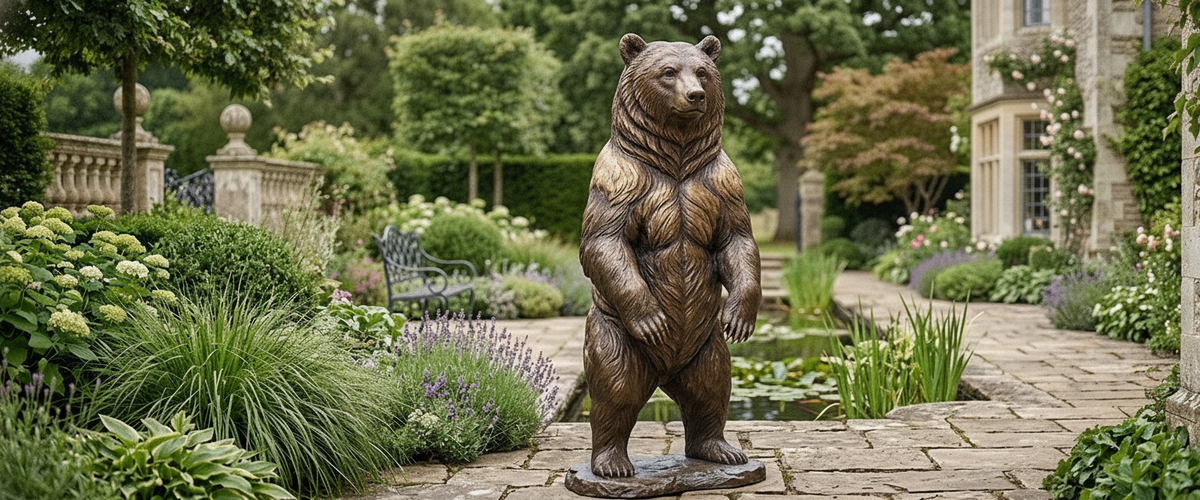
Hand-chased guard hairs on a bronze grizzly, grouped into locks that change direction at the hump.
In our studio, when we review large bear statues sculpture proofs from the foundry, quality is judged first by stroke direction. Lazy modeling combs the fur one way from head to tail. A sculptor who has studied real bears will swirl it at the neck, part it along the spine and let it hang heavier on the belly. Look for that before anything else.
Bronze: Lost-Wax Casting Keeps Guard Hairs Crisp
Lost-wax casting is still the best way to carry fine texture into metal. The sculptor's clay is molded in rubber, a wax copy is pulled, coated in ceramic shell, then melted out and replaced with molten bronze. Every generation of that process can soften detail slightly, which is why the real work happens afterward. Skilled chasers recut the guard hairs by hand across every welded panel so the joins disappear into the coat. On large bear statues sculpture pieces, that hand finishing is where most of the hours go.
Patina then does something no other material can. It pools in the grooves and leaves the tips a shade lighter, so the fur reads with depth even on an overcast day. That is why so many clients browsing our bronze bear statues end up choosing a grizzly or brown bear pose. One hard lesson: a ranch client near Bozeman asked us for a very dark patina on a standing grizzly. The recesses went nearly black and the coat flattened out at dusk. We now recommend lifting the highlights on shaggy species in any large bear statues sculpture commission, even when the brief says "dark." For outdoor care, the Getty Conservation Institute has published widely on protective wax coatings for exposed bronze.

Stainless Steel: Faceted and Mirrored Bears Trade Fur for Light
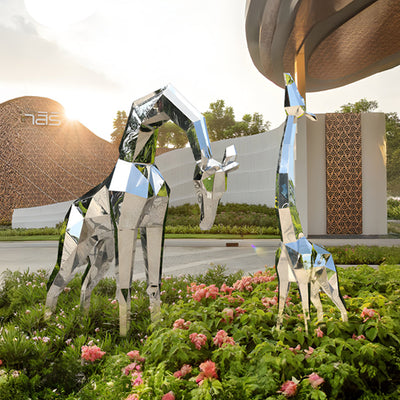
No sensible fabricator tries to carve fur in steel. Instead, stainless bears are built as faceted, low-poly forms or polished to a mirror, and the animal becomes a reflection of its surroundings. In a Hamptons garden, a mirrored bear picks up hedges and sky and changes with the weather. It is a contemporary take on large bear statues sculpture rather than a naturalistic portrait.
A mirrored stainless bear swaps fur for reflection, shifting with the light and weather.
If you are unsure whether a reflective bear suits your taste, living with a tabletop-scale piece such as the Mystic Chrome Bear Sculpture - 50cm, at about 20 inches (50 cm), is a low-risk way to test the look indoors before commissioning a monumental large bear statues sculpture piece. For coastal sites, specify marine-grade 316 steel; the Nickel Institute explains why its molybdenum content resists salt far better than standard grades.
Fiberglass: Real Weight Savings, but Soft Molded Fur
Fiberglass weighs a fraction of cast bronze, which matters on rooftop terraces, touring displays and structures with strict load limits. The trade-off is surface. Fur is molded from a master, gel-coated and painted, and each layer fills the grooves a little more. Across a lawn it looks fine. Up close, guard hairs become rounded ridges. We suggest fiberglass for temporary installations or weight-restricted sites, and bronze or stone for any large bear statues sculpture meant to stay put.
Where a lighter material is non-negotiable, it often makes more sense to drop naturalistic fur altogether. A smooth, graphic figure such as the Gacko Porsche Love Bear Sculpture - 160cm, standing about 5 feet 3 inches (160 cm), reads cleanly because there is no coat for layers of gelcoat and paint to blur.
Grizzly, Black Bear or Polar Bear: Matching Species to Material
Grizzly: the shaggiest coat and the famous hump. For grizzly large bear statues sculpture, bronze wins because chasing and patina handle long, layered fur better than anything else.
Black bear: a shorter, sleeker coat that tolerates stylization. Carved stone reduces fur to broad planes, which suits the species. For a black bear at near-life height, a dark stone figure such as the Black Stone Bear Sculpture - 165cm, at roughly 5 feet 5 inches (165 cm), suggests the coat through mass and silhouette rather than chasing every hair.
Polar bear: at a distance its fur reads smooth and pale. Polished stainless steel or white marble captures that better than bronze, which tends to look oddly heavy unless the design is strongly stylized.
How Each Fur Surface Ages After Ten Winters Outdoors
Bronze: patina deepens and warms. Unwaxed, green verdigris collects in fur grooves; an annual wax keeps the contrast even.
Stainless steel: 316 stays bright but can tea-stain near salt spray. A gentle wash two or three times a year handles it.
Fiberglass: paint chalks under UV, and freeze-thaw cycles can craze the gelcoat. Budget for repainting.
Stone: lichen settles into carved texture. Fine grooves that hold water are vulnerable to frost, so good drainage at the base matters.

Buyer Checklist for Large Bear Statues and Sculpture
See the coat at actual size. Request close-up photos of the fur, not only full-figure shots.
Match species to material using the pairings above.
Check viewing distance. A driveway piece seen from a car needs bolder fur than a patio piece seen at arm's length, where one of our medium bear sculptures may suit the space better.
Confirm the site. Ground conditions, anchoring and access for lifting equipment all shape the engineering.
Be honest about maintenance. Bronze wants an annual wax; fiberglass wants periodic repainting.
Ask for a tailored quote. Large bear statues sculpture cost depends on material, scale, sculptural complexity, engineering, installation and finishing.
Giant Sculptures makes and ships large bear statues and sculpture worldwide, from stock pieces to fully bespoke commissions built around a specific site. Start with our large bear sculptures, compare finishes across the full bear statues and sculptures range, and if nothing fits your setting exactly, send us the site photos. The coat is where we start the conversation.
For wider placement ideas, Bull Versus Bear: How to Choose a Bronze Bull Fight Sculpture That Holds up is useful companion reading before finalizing the setting and sightlines for your large bear statues sculpture.