





























Two animals caught mid-collision is one of the hardest things to cast well, and one of the easiest things to buy badly. A bronze bull fight sculpture has to work as anatomy, as engineering and as a story, all at once, and when one of those three slips the whole group reads as a novelty. Get it right and you have a piece that people circle, photograph and argue about. Get it wrong and you have two animals standing near each other in an expensive way.

At a Glance
The pairing carries meaning. Bull and bear reads as markets in a lobby and as raw animal power in a garden. Same bronze, different sentence.
Contact points are structure. Every hoof, paw and locked horn is both drama and load path. Count them early.
The gap is the composition. Negative space between the two bodies does more work than either animal alone.
One patina, one batch. Two figures finished separately will not sit as a group.
Plan a circle, not a wall. A fight scene needs walk-around clearance or half of it disappears.
What a Bronze Bull Fight Sculpture Announces in a Lobby Versus a Private Study
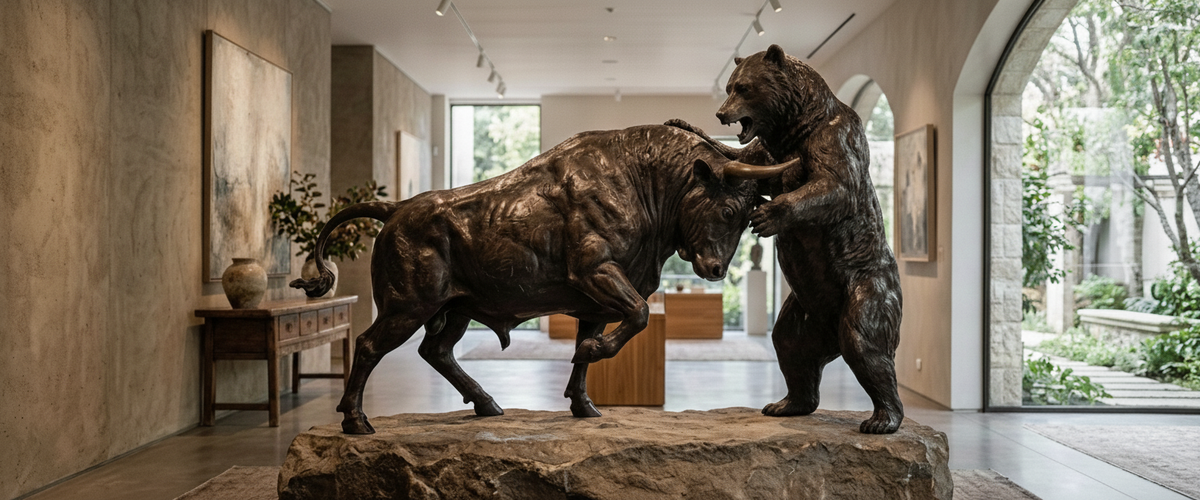
Context rewrites the subject. In a financial services lobby in Manhattan or Charlotte, a bull and bear sculpture locked mid-clash is instantly legible: optimism against caution, and the building's opinion about which one is winning. That legibility is the point. Visitors decode it in two seconds and remember it for years.
Put the same group in a private study or a Napa hillside garden and the market reference falls away. What remains is muscle, torsion and confrontation. Collectors buying for a home tend to want the abstraction dialed up and the symbolism dialed down. Where the room needs form rather than narrative, a stylized piece such as the Large Modern Abstract Bull Bronze Sculpture - 120cm at 120cm (roughly 3 ft 11 in) is closer to the right design language than a photorealistic Wall Street homage. Decide which room the piece is speaking in before you pick a style.
Locked Horns or Raised Paw: The Three Moments Sculptors Freeze
Every bronze bull fight sculpture begins with a choice of moment, and fight scenes almost always land on one of three beats. The approach shows both animals braced, weight back, no contact yet. It is the calmest option and it ages well because nothing about it feels staged. The clash puts horns into the bear's chest or shoulder, bodies interlocked, maximum mass in the middle. The dominance moment raises one animal over the other, usually the bear rearing, and it is the most dramatic and the most likely to look dated in a decade.
Our honest bias, after years of shipping animal groups: the approach and the clash outlive the dominance pose. A raised paw at nine feet of height reads as theatre, and theatre has a shelf life. A locked stance reads as tension, and tension does not wear out. A fully engaged clash also needs real physical volume before it convinces from a distance, which is what a piece at the scale of the Monumental Fighting Bears Bronze Sculpture - 350cm at 350cm (about 11 ft 6 in) is buying you: enough interlocked mass that the collision still reads from across a plaza.
The clash: interlocked mass through the center keeps the collision legible from a distance.

Count the Contact Points Before You Fall for the Pose
Here is the practical test we run in the studio on every bronze bull fight sculpture before it leaves the workshop. Trace how the weight travels from the highest point of the piece to the base. A bull with all four hooves down and a bear with two paws grounded gives you six load paths and a straightforward install. A rearing bear supported only by the bull's horns gives you one, and that single junction has to carry hundreds of pounds of bronze through wind load, thermal movement and the occasional shoulder-lean from a curious visitor.
That does not rule out ambitious poses. It means the internal armature, wall thickness and welded joins have to be specified for it, and that engineering is part of what you are buying in a bespoke bronze bull fight sculpture. Ask any supplier how the piece is internally reinforced and how it fixes to its base. If the answer is vague, keep asking. A well-built group should be liftable, boltable and repairable years later.
The Gap Between the Two Animals Is the Composition
For wider placement ideas, Choosing a Large Bronze Fountain Statue That Sounds Right is useful companion reading before finalizing the setting and sightlines.
Amateur groups treat the space between the bodies as leftover. In a well-composed bronze bull fight sculpture the void is the subject. The space under a rearing chest, the wedge of daylight between a lowered head and a raised shoulder, the triangle formed by four braced legs: those shapes are what your eye actually reads from thirty feet away, long before you register a single detail of fur or hide.
This matters most outdoors, where sky fills every gap and turns the group into a silhouette. Walk the intended viewing line before you approve a maquette. If the two animals collapse into one blob from the driveway approach, the gaps are too tight. If they read as two separate sculptures, they are too generous. Somewhere in between the fight becomes one object with a hole in it, and that is where it should sit.

One Patina, Two Bodies
The quickest way to break a group is to finish the animals separately. A bronze bull fight sculpture is two castings pretending to be one event, and the surface is what sells that illusion. A bronze patina is a chemical reaction applied hot to the metal, and it varies with alloy batch, temperature, timing and the hand of the person holding the brush. Two identical recipes applied a month apart will not match. We insist on patinating both figures in the same session for exactly this reason, and we photograph them together under daylight before crating.
You have a genuine choice here. A single unified patina, typically a dark chocolate or a warm mid-brown, makes the group read as one event. A deliberate two-tone treatment, lighter bull against darker bear, separates the combatants and sharpens the narrative. Both are legitimate; drifting into two-tone by accident is not. Bronze itself is forgiving over decades, which is why the lost-wax tradition documented by the Metropolitan Museum of Art still underpins modern casting, but the surface film does need periodic waxing outdoors. The National Park Service guidance on outdoor bronze maintenance is a sensible baseline for owners.
Give the Fight a Circle
A single charging bull sculpture can live against a wall: a piece like the Large Traditional Charging Bull Bronze Sculpture - 120cm at 120cm has one dominant profile and loses almost nothing when its back is to a stair core. A bronze bull fight sculpture does not work that way. Push a two-animal group into a niche and you permanently hide one of the two things you paid for. We shipped a bull and bear group to a Dallas office atrium where the original plan had it tucked against a stair core; moving it eight feet into the floor plate cost nothing and transformed the piece, because visitors could finally walk the aggressor's side.
Open floor plate, not a niche: clearance on all sides is what makes a fighting group work.
Setback: allow a clear route all the way around, ideally wide enough for two people to pass.
Approach view: identify the primary sightline and orient the clash across it, not end-on.
Base and footing: confirm slab loading, drainage and fixing detail before delivery, not after.
Access: check door widths, crane or forklift routes, and whether the group ships assembled or in sections.
Lighting: low cross-light from two sides keeps the gaps readable after dark.
Care: rinse, dry and wax on a set schedule; note any pooling water at the contact points.

Tabletop Clash to Over-Life-Size Commission
Scale changes more than the invoice on a bronze bull fight sculpture. A tabletop group is a detail object, read from two feet, where hide texture and horn tips carry the piece. At life size the anatomy has to survive being seen from below. Over life size, wind load, foundation design, transport engineering and site access all enter the conversation, and the work becomes a construction project with an artistic brief attached.
A bronze bull & bear fight sculpture large enough to hold a corporate plaza is a bespoke bronze commission in almost every case, because stock pieces rarely match a specific site's sightlines. Our process runs from reference imagery and a scaled maquette through clay development, mold making, casting, chasing and patina, with client sign-off at the clay stage. Budget depends on material, scale, complexity, engineering, installation and finishing, so the sensible next step is a tailored quote rather than a guessed figure.
If you are still shaping the idea, look at the bronze bull statues and bronze bear statues collections side by side to see how the two animals behave as forms, then at the large bronze sculptures range for a sense of what monumental scale does to presence. Send us the site photographs, the sightlines and the mood you are after, and we will tell you honestly whether the pose you love is the pose that will still look right in twenty years.