



























































































Most of the pieces listed online as a 1900 bronze tiger statue were poured a good deal later than 1900. That is not always a problem. It becomes one when you are paying for age you cannot verify, or when a hall bronze that spent a century indoors gets planted in a Connecticut garden and starts weeping green down its shoulders by the second winter. Reading a tiger properly takes ten minutes, a flashlight and a willingness to lie on the ground and look at the underside.

Key Takeaways
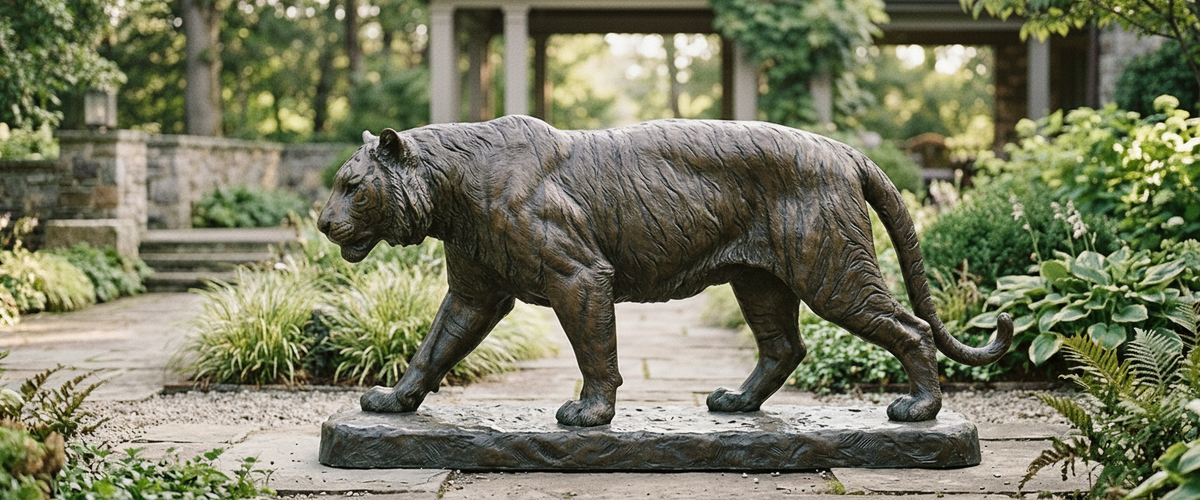
Period animalier cats, including anything sold as a 1900 bronze tiger statue, were cast low, long and heavy on purpose. Height was never the point; mass and reach were.
Sand casting leaves evidence: seam ridges, punch-chased fur, file marks and plug repairs that nobody polished away.
An interior tiger and an outdoor tiger statue of the same model age into visibly different animals. Judge the patina against the life it has had.
The base is the fastest tell. Integral cast bronze, married marble and 1970s replacements each leave a different underside.
Signatures are cheap to copy. Wall thickness, crispness of detail and shrinkage are much harder to fake.
A new cast in the 1900 idiom, engineered for outdoors, often beats three years of hunting an original that was never built for weather.
Why a 1900 Bronze Tiger Statue Was Cast Low and Long
The animalier tradition that produced these tigers was obsessed with observed anatomy, and observed tigers are horizontal creatures. Foundries of the period pushed the body out rather than up: shoulder blades riding high, spine dipping, tail sweeping down to meet the plinth so it worked as a third anchor point rather than a snappable ornament. Antoine-Louis Barye set that grammar decades earlier and every foundry within reach of it borrowed the vocabulary. The Walters Art Museum holds one of the deepest Barye collections anywhere; study those proportions before you shop.
That low, long build is also structural sense. A prowling cat with four feet on a continuous bronze base spreads its load and resists a shoulder shove. A rearing figure on two contact points does not. It also explains why buyers are often surprised by how much ground a horizontal cat needs: a piece in the period silhouette such as the Life-Size Traditional Stalking Tiger Bronze Sculpture, 150cm reads heavier and occupies more space than an upright figure of the same nominal height, because the mass sits where the eye expects weight.

Sand-Cast Tells: Seams, Chased Fur and File Marks
Run raking light along the belly, the inside of the legs and the underside of the tail. A genuine 1900 bronze tiger statue was sand cast in multiple sections, so faint ridges survive where mold halves met, and the chaser tidied what would be seen and left what would not. You want to find punch work in the fur, small crescent tool marks running with the coat direction rather than a uniform stippled texture. You also want file marks in awkward places, plugged core-pin holes, and the occasional square repair patch a hair off in color from the surrounding metal.
Then get the flashlight inside, through the drainage hole or an opening in the base plate. Original casts often show gritty core sand residue, iron core pins and irregular wall thickness. A surmoulage, meaning a cast taken from a finished bronze rather than a model, shrinks slightly and comes out soft: fur reads mushy, whisker channels blur, claws lose their edges. Once you have handled a crisp cast and a third-generation copy in the same week, the difference stops being subtle.
A Hall Tiger and a Garden Tiger Age Into Two Different Animals
Indoor bronzes keep their applied patina and wax. Look for warm liver-brown tones, rubbed high points on the ears and shoulder where a century of hands went, and dust in the deep fur. A 1900 bronze tiger statue of the same model that lived on a terrace tells another story: dark cuprite under pale green sulfate, vertical streaking off the jaw and elbows, and pooling stains where water sat in the hollow of the chest. Neither is wrong. Buying a hall bronze for an exposed terrace without checking its drainage, though, is a genuine mistake, because a sealed interior fills, freezes and splits along the weakest seam.
Original Base, Married Base or 1970s Replacement
For wider placement ideas, A Tiger Garden Statue Needs Cover, Not a Lawn is useful companion reading before finalising the setting and sightlines.
Sellers use the phrase "1900 bronze outdoor large tiger statue with bronze base" freely, and on a 1900 bronze tiger statue the plinth is often the youngest part of the piece. Turn it over. An integral cast bronze plinth shares the sculpture's alloy color, its casting texture and its corrosion history. A married base shows mismatched aging, fresh drill holes through the feet, and hardware that never existed in period: zinc-plated hex bolts and Phillips heads are modern giveaways. Marble and slate socles were sometimes original and sometimes swapped in the 1970s, and a stone plinth that has weathered less than the bronze standing on it did not spend the same decades outside.
Where a plinth is designed as part of the composition rather than added later, as on the Large Traditional Seated Tiger Bronze Sculpture, 150cm, the base carries the silhouette down to the ground instead of reading as a plate the cat is bolted to. That is the effect a married base almost never achieves.

Foundry Marks, Barye Derivatives and Japanese Exports Sold as French
Most of the fakery in the 1900 bronze tiger statue market happens at the signature. Cast-in marks sit under the surface with fur flowing around them; stamped or engraved ones cut through the patina and often sit oddly flat. Foundry cachets are worth photographing and researching, but treat them as one data point among several, because a mark takes minutes to copy and a wall thickness does not. The other common misattribution is geographic. Meiji-period Japanese export bronzes, superb pieces in their own right, are regularly relabeled as French animalier work; the Khalili Collections Meiji holdings make the stylistic differences clear, from inlay and mixed-metal detailing to the treatment of eyes and claws. Buy the object, not the story attached to it.
Siting a Large Outdoor Tiger Statue So It Holds Its Position
We shipped a pair of cats to a client outside Austin who set them straight onto compacted decomposed granite. Inside two years one had settled off true and the pair looked drunk. A 1900 bronze tiger statue in this weight class needs a real footing.
Footing: reinforced concrete pad below the local frost line, sized wider than the plinth on all sides.
Anchors: stainless steel studs and isolation washers so no ferrous fixing bleeds rust down the bronze.
Drainage: confirm the interior can shed water and that the pad sheds it too. Trapped water does more damage to outdoor bronze than anything else.
Setback: allow a viewing distance of roughly two to three times the sculpture's length so the prowl reads.
Backdrop: dark evergreens, a clipped hedge or weathered stone. Patina disappears against pale render.
Orientation: point the head toward the arrival route, not the property line.
One aside on searching: listings spelled "outdoor tigar statue" turn up regularly and are worth clicking, because misspellings attract fewer bidders.

When a Fresh Cast in the 1900 Idiom Beats Years of Hunting
If you want the language of a 1900 bronze tiger statue and a piece engineered for a Hamptons lawn or a Texas forecourt, commissioning is usually the better route. Lost-wax casting with controlled wall thickness, an internal stainless armature, designed drainage and a patina specified for your light and climate gives you the period look without inheriting a century of unknown repairs. Scale can be set to the site rather than to whatever survived, which is the real argument against hunting: a forecourt that swallows a single 150 cm cat may need a two-figure group at 220 cm, on the scale of the Large Contemporary Fighting Tigers Bronze Sculpture, 220cm, before the composition holds its ground against the architecture. Cost depends on material, scale, complexity, engineering, installation and finishing, so ask for a tailored quote rather than a ballpark.
Giant Sculptures makes both conversations easy: browse the bronze tiger statues already in the catalog, look wider through large bronze sculptures, or send us a site photo and we will work back from the setting. A large outdoor tiger statue is a fifty-year decision. Spend the extra ten minutes on the underside.