






































































































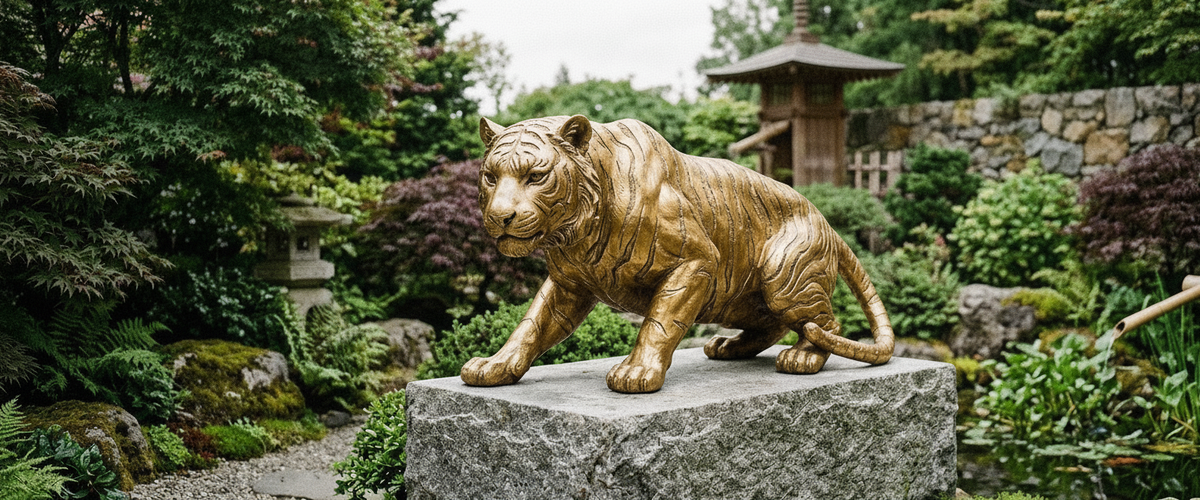

Almost every gold tiger looks good on the day it arrives. The question to ask before you buy a resin tiger statue is what that gold will look like after three Phoenix summers, or one winter on an exposed lawn in the Hamptons. The answer has surprisingly little to do with the tiger itself. It depends on how the gold was applied, where the piece will stand, and whether anyone has planned for the wind.

Quick Answer
Gold leaf holds its color longest outdoors. It also involves the most skilled labor.
Metallic paint is the most common finish and the first to fade.
Tinted gelcoat carries color through the outer skin, so chips show less. Expect a honey or ochre tone rather than mirror gold.
Sculpted stripes survive a refinish. Painted stripes have to be redone by hand.
A hollow-cast tiger needs mechanical anchoring on any open site.
Three Routes to a Golden Resin Tiger Statue
Most listings for a golden tiger resin statue describe the color and say nothing about the method. Ask about the method first, because on any resin tiger statue it largely decides how long the finish lasts.
Gold Leaf
Genuine high-karat leaf is laid over an adhesive size and burnished down. Gold does not tarnish, so the metal itself stays bright. The weak points are the size, the resin underneath it, and abrasion from hands, branches, and sprinkler grit. Exterior gilding is a specialist trade, and the Society of Gilders is a good starting point if you want to understand what a properly prepared exterior job involves.
Burnished leaf gives the brightest, longest-lasting gold.
Metallic Paint
Mica or metal powders are suspended in a binder and sealed under a clear coat. Cost is low and the color is even, which explains why most catalog tigers use it. Two things go wrong under sun: the clear coat chalks or yellows, and any true metal powder in the paint can oxidize toward brown or green.
Tinted Gelcoat
Here the pigment sits in the outer gelcoat layer itself, sometimes with mica added for shimmer, so the color is part of the material rather than a coating laid over it. The principle is easiest to see in clear casting: in a piece such as the Golden Yellow Splash & Clear Branching Crest Resin Sculpture - 102cm, the yellow is suspended within the resin rather than sitting on its surface. A tiger gelcoat is opaque, but the advantage carries over. A scuff exposes more of the same color, not gray filler.
Be realistic about tone. Pigmented resin reads warm rather than metallic, closer to the deep honey of the Honey Amber & Clear Curling Splash Resin Sculpture - 81cm than to the mirror flash of burnished leaf. If you want a tiger that looks gilded from across the garden, gelcoat alone will not get you there.

Why the Shoulders and Face Dull First
Sun doesn't hit a resin tiger statue evenly. The shoulders, the crown of the head, the muzzle, and the line of the spine are the near-horizontal surfaces, so they take the most UV and heat, and they hold dew and dust the longest. The flanks face sideways and get off lightly.
Picture a painted tiger set beside a pool in the Arizona desert. After a couple of summers the flanks can still look bright while the shoulders and the bridge of the nose have gone flat, and faintly green if the paint contains real bronze or brass powder. The wear tracks the afternoon sun almost exactly. Conservation scientists at the Smithsonian Museum Conservation Institute study this kind of light-driven breakdown in plastics and coatings. The practical lesson is simpler. Inspect the top surfaces, because they will show wear first.
Top surfaces fade first; the flanks stay bright.
Sculpted Stripes Versus Painted Stripes
This one detail decides whether a resin tiger statue reads as a centerpiece or a novelty. Sculpted stripes are cut into the master pattern, so each one sits slightly proud of or below the coat. Raking light throws a shadow along every stripe. When the gold eventually needs refreshing, the refinisher follows the relief and the pattern survives intact.
Painted stripes sit flat on a smooth body. From the patio they can look graphic and fun. From 30 feet (about 9 m) across a lawn, the tiger loses its musculature and starts to look like a toy. Refinishing also means a skilled hand has to repaint every stripe.
Hollow-Cast and Light: Anchoring Against Wind
A life-size resin tiger statue runs roughly 8 to 10 feet (2.4 to 3 m) nose to tail. In hollow fiberglass, that much side profile behaves like a sail. A crouching or lying pose sits low and resists wind well. A standing or roaring tiger with a high back is far more exposed.
The fix is mechanical. Stainless threaded rods should be bonded into the feet or into an internal armature and bolted down to a concrete pad or stone plinth. Do not rely on sand ballast inside the shell, because it traps moisture. The most common mistake is spending weeks choosing a finish and minutes thinking about fixings. Order the anchoring plan alongside the sculpture.

Indoor Plinth, Covered Terrace or Open Lawn
Think of placement as a sliding scale of how much gold you can get away with.
Indoors: Any finish lasts, and gold leaf glows under lamplight. A plinth matters more than you would expect. Even at tabletop scale, resin set on timber, as with the Clear Gold Sliver Stepped Skyline Rock Resin Sculpture on Wood Base - 40cm, reads as a finished object rather than a loose ornament. For a tiger in a Manhattan lobby, the same logic calls for a substantial stone or timber plinth sized to the body.
Covered terrace: Metallic paint under a UV-stable clear coat is realistic here, and reflected light keeps the gold lively.
Open lawn: Choose gelcoat or leaf, budget for periodic care, or consider bronze.
Resin or Bronze: When the Commission Quote Is Justified
A resin tiger statue is the right buy for interiors, hospitality refreshes, event installations, and rooftops with weight limits. If you are still weighing finishes and scales, our resin sculptures collection and the wider range of tiger statues are the natural places to compare poses and materials side by side.
For a permanent, fully exposed piece meant to outlast the owner, bronze changes the equation. Cast bronze tiger statues can be patinated or gilded gold, their weight does part of the anchoring work, and they weather slowly rather than fail. At Giant Sculptures we quote these commissions individually, because cost depends on scale, pose complexity, engineering, finishing, and installation. Ask for a tailored quote for both materials and compare the long-term ownership costs directly.

Checklist Before You Order
Ask exactly how the gold is applied: leaf, paint, or tinted gelcoat.
Confirm the clear coat is UV-stable and ask how it is refreshed.
Check that the stripes are sculpted, not only painted.
Request wall thickness and anchoring point details.
Plan the plinth or pad before delivery day.
Photograph the shoulders and face of your resin tiger statue on arrival so you can track wear.
For wider placement ideas, Clear Resin Sculpture for Sale? What the Listing Photos Won't Tell You is useful companion reading before finalising the setting and sightlines.