





































































































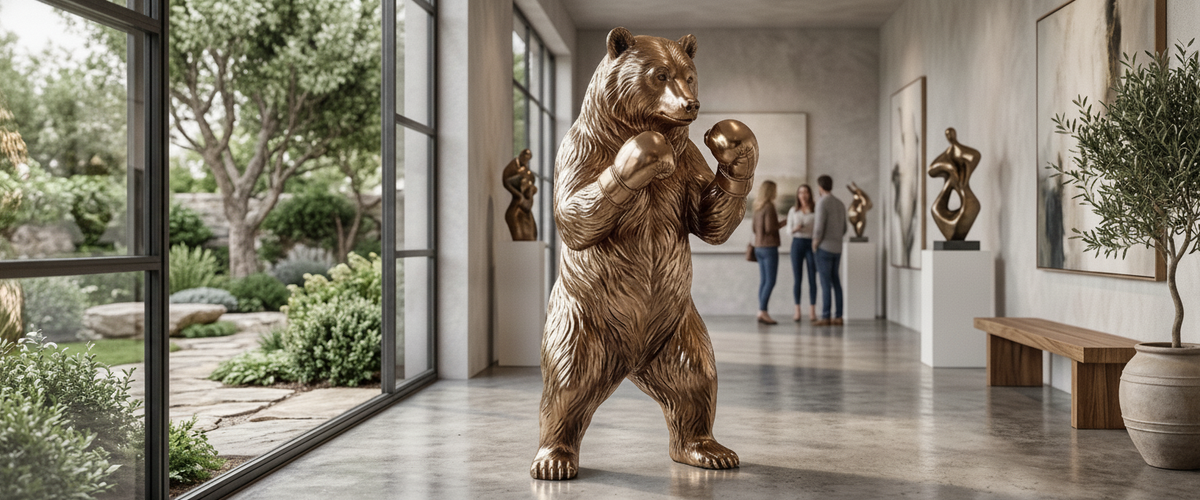

Lift a bronze electroplated bear sculpture at one paw and the whole material question answers itself in about two seconds. A plated resin bear at chest height moves like furniture. A solid cast bronze of the same size does not move at all without two people and a strap. Both can photograph identically. Only one of them will sit unbothered in a coastal garden for thirty years, and knowing which is which before you buy saves an expensive conversation later.

At a Glance
Electroplating is a skin, not a body. A bronze electroplated bear sculpture is a real metal layer, typically measured in microns, deposited over a resin or composite core.
Weight is your fastest test. Plated resin is a fraction of the mass of solid bronze at the same scale.
Edges wear first. Claw tips, ear ridges and knuckles take the thinnest deposit and the most contact.
Interior and sheltered placement suits plating. Full exposure, salt air and freeze-thaw cycles suit cast bronze.
Repairs are cosmetic, not structural. Plan for touch-up and re-clear coating rather than re-plating in place.
Budget depends on scale, substrate, plating spec, finishing and installation. Ask for a tailored quote rather than assuming a figure.
Lift It Once: What the Weight Difference Really Tells You
A resin bear sculpture standing around 4 ft (120cm) can often be repositioned by one person. A cast bronze bear of the same height is a rigging job. That gap in mass is the honest summary of what you are buying: plating gives you the optical properties of metal without its structural mass. For a hotel lobby in Miami where the piece may be moved for events, low mass is a feature. For a windy ridge property in Aspen, low mass is a liability, because anything light enough to carry is light enough to topple.
Mass also changes how a piece behaves under contact. Guests touch bears. They lean on them, they pose with them, they let a bag knock the shoulder. Solid metal shrugs that off. A bronze electroplated bear sculpture transmits the impact into its composite core instead, and if that substrate flexes, the plating above it can craze. This is why we always ask about foot traffic before quoting a plated commission at public scale.

Inside the Plating Bath: Why Claw Tips and Edges Take the Thinnest Layer
Electroplating deposits metal from solution using an electric current, and current does not distribute itself politely. It crowds toward high points and sharp edges and starves recessed areas, which is why plating shops fuss so much over anode placement and racking. Throwing power, the ability of a bath to reach into recesses evenly, is a standing subject for surface finishing trade bodies such as the National Association for Surface Finishing.
On a bronze electroplated bear sculpture, the practical consequence is predictable. Claw tips, the ridge of the muzzle, ear edges and any raised knuckle on a boxing pose end up with a different thickness than the deep fur channels between the shoulder blades. Those high points are also the first things a shoulder bag or a vacuum cleaner head will meet. When you inspect a plated piece on delivery, go straight to the extremities and look at them in raking daylight. Consistent color and no dulling at the tips are the signs of a well-racked, well-finished part.
Bull and Bear Pairs: One Pose Flatters the Finish, the Other Fights It
Financial-district commissions usually arrive in pairs, and a bronze electroplated resin bull & bear sculpture pairing is one of the most requested briefs we handle for offices and trading floors. The two animals do not treat a mirror finish equally. A bull has long, taut planes across the flank and shoulder, and a high-polish plated surface reads beautifully across them, catching one clean sweep of reflected light. A bear is a mass of fur texture and rounded volume, so the same finish scatters into a hundred small highlights and can flatten the modeling.
At 200cm, the mirror finish becomes the subject and the fur detail stops competing for attention.
Two ways out of that. Either give the bear a slightly softer or satin plating so the sculpt reads properly, or lean the other way and commit fully to the graphic gloss. At roughly 6 ft 7 in (200cm), Gacko Electroplated Chrome LV Boxer Bear Sculpture - 200cm takes the second route, and at that height the reflection becomes the point while the fur detail stops competing for attention. Where the setting needs a warmer tone alongside a bull, the Gacko Electroplated Gold LV Boxer Bear Sculpture - 120cm sits closer to patinated bronze without pretending to be one, and its smaller footprint suits a reception desk or lift lobby rather than an open atrium floor. If you are sizing the counterpart, the bronze bull statues range is the place to match height and finish.

How Plating Ages: Three Environments Compared
We have shipped enough plated work to be reasonably confident about how it ages by setting.
Heated interiors are the easy case: stable humidity, no UV load and wear limited to handling points.
Heated interior. The easy case. Stable humidity, no UV load, no salt. Expect the piece to look essentially as delivered, with wear limited to handling points. Dust weekly, hand-polish with a dry microfiber, and keep solvents away from the clear coat.
Behind sunlit glazing. The quiet problem. A south-facing atrium in Texas puts sustained UV and heat cycling into the clear lacquer above the plating. Lacquer yellows and can microcrack before the metal itself shows anything. Specify a UV-stable topcoat and expect to re-clear at some point in the piece's life.
Sheltered outdoor courtyard. Workable, with caveats. Under a soffit or loggia, out of standing water and away from irrigation spray, a bronze electroplated bear sculpture can hold up well. Full exposure is different: freeze-thaw cycles, driving rain and coastal chlorides will find any pinhole in the coating, and once moisture reaches the substrate the plating lifts from beneath. Conservation guidance for outdoor metals, including the National Park Service Conserve O Gram on outdoor bronze care, is worth reading before committing any metal-finished piece to open weather.
Chips and Scuffs on a Bronze Electroplated Bear Sculpture
Be realistic about what a repair means. Re-plating requires immersion in a tank, so it cannot happen in your lobby. What a good finisher can do on site is fill and rebuild a chipped area in the substrate, color-match with metallic coating, blend the edge and re-seal. Done well on a textured fur surface, it disappears. Done on a broad polished flank, it will always be findable under strong side light.
Two rules that save money. Fix chips early, before moisture wicks under the surrounding plating and lifts a wider area. And never let a cleaning crew use abrasive pads or acidic products on plated work; we have seen more finishes ruined by well-meaning maintenance than by weather.
What Solid Cast Bronze Buys You That Plating Never Will
Cast bronze is metal all the way through. Scratch it and you expose more bronze. Leave it outdoors and it develops a patina rather than a failure. It carries its own ballast, resists impact, and can be re-waxed or re-patinated repeatedly across generations. That is why our monumental outdoor commissions are cast rather than plated: work at the scale of Monumental Classical Bearded Rider and Horse Bronze Sculpture - 430cm has to anchor itself against wind load and weather on its own terms, which is not a specification a plated core can meet.
Choose a bronze electroplated bear sculpture when the piece lives indoors or under cover, when a mirror-bright chrome or gold look is the design intent, and when reduced weight helps with floor loading or moving. Choose cast when the piece is permanent, exposed, touchable or intended to outlive the building. The bronze bear statues collection covers both routes, and the broader bronze animal sculptures range is a good place to compare how the same subject reads in each material.

Questions to Put to the Studio Before You Commit
What is the substrate, and how dense is the wall section at load-bearing points such as ankles and the base plate?
Is there an internal armature or ballast, and how does the piece anchor to the floor or plinth?
What metal is deposited, at what nominal thickness, and how is uniformity controlled at edges and claw tips?
What is the final sealer, and is it UV stable for glazed interiors?
What is the recommended cleaning routine, and which products void the finish?
Can the studio supply matched touch-up material with the piece?
If it is a bull and bear pair, will both be plated in the same batch so the tone matches?
What crating, rigging and installation support is included for the size specified?
Bring those questions to any supplier, including us. A studio that answers them precisely is a studio that has done the work; Giant Sculptures builds bespoke bear and bull commissions in both plated and solid cast routes, and the first conversation is always about where the piece will stand rather than what it will cost. Placement decides material. Material decides everything after that.
For wider placement ideas, Buying a Bronze Horse Rider Statue: Measure From Hoof to Helmet First is useful companion reading before finalising the setting and sightlines.