

























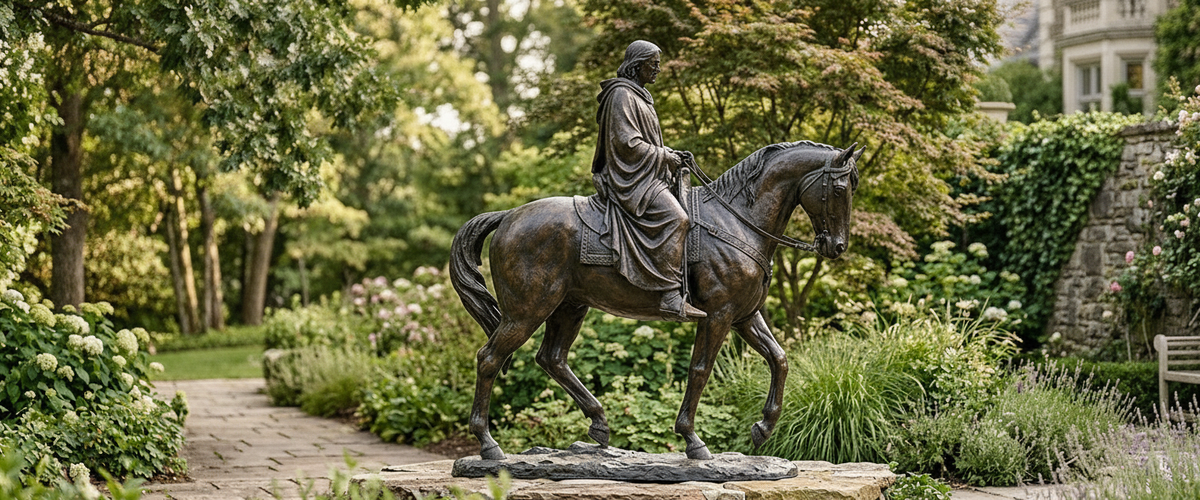

A standing horse tops out around the ears. Put a rider on its back and you have added a torso, a head, sometimes a raised arm or a plumed helmet, and the silhouette climbs by roughly a third. That single fact causes more sizing regrets than any other issue we see. Buyers picture a bronze horse rider statue at the height of the horse, order accordingly, and then watch a crane set something that reads as monumental in a space designed for a garden feature.
The fix is not a smaller sculpture. It is measuring the right thing on a bronze horse rider statue, choosing the right plinth, and giving a mounted figure the standing-back room it demands.

Key Takeaways Before You Shortlist
Measure hoof to helmet, not hoof to withers. On a bronze horse rider statue, the head, hat or raised weapon sets the true height.
Equestrian bronzes need lower plinths than plain horse statues, often half the height you would use for a standing animal.
Ten paces back is the working viewing distance. If your site cannot offer it, the composition collapses into a wall of bronze.
Gait changes footprint. A rearing horse needs depth behind it; a walking horse needs length beside it.
Patina should be chosen against the backdrop, not from a swatch card indoors.
Tack, hands and the saddle join are where thin reproductions give themselves away.

The Mounted Figure Sits Higher Than Buyers Picture
A life-size traditional group such as the Life-Size Traditional Charro Rider and Horse Bronze Sculpture stands 320cm, a shade over 10 feet 6 inches, before anything is placed underneath it. Lift the front legs into a rearing pose and a comparable group climbs past 360cm, near enough 11 feet 10 inches, because the whole mass is pushed upward.
Write the number on a length of timber and stand it in the garden. It sounds crude, and it has saved several clients from a hard conversation with an installation crew. One collector did exactly this with a batten and a bedsheet, saw that the piece would block a valley view from the terrace, and moved the site well down the drive before we cast anything.
Measured hoof to hat, this life-size group stands 320cm.
Plinth Proportion for a Bronze Horse Rider Statue
Here is the rule most people get backwards. A plain horse sculpture usually benefits from lift; a plinth of 18 to 30 inches (45 to 75 cm) puts the animal's body at eye level and gives the legs somewhere to resolve. A bronze horse rider statue rarely wants that much. The rider already supplies the vertical emphasis, and stacking a tall base underneath pushes the head out of comfortable sight lines and makes the whole group feel like a war memorial rather than a garden commission.
For most private sites we specify a low, broad base: enough to lift the hooves clear of splash and mower damage, wide enough to read as deliberate, and squared to the approach. Public and civic sites are different, since the piece is being read from across a plaza. Ask for the plinth to be drawn in elevation alongside the sculpture before it is quarried or poured. Stone, cast concrete and Corten-clad bases all behave differently against a bronze patina, and the decision is easier on paper than on site.
Ten Paces Back Is the Real Viewing Distance
An equestrian group is a wide composition with a long profile. Stand three feet away and you see a horse's flank. Walk ten paces back and the rider, the neck line and the gesture of the arm finally assemble into one image. That is the distance the sculptor modeled for, and it is the distance your site has to provide.
Practically, that means a bronze horse rider statue wants an approach: a gravel turning circle, a lawn seen from a terrace, a courtyard with a diagonal walk across it. A narrow side border will not do it, no matter how handsome the piece. Where the room is tight, a compact modern composition such as the Life-Size Contemporary Rotund Rider and Horse Bronze Sculpture - 200cm at 200cm holds up better than a scaled-down classical group, because the forms are simplified and the outline stays legible at close range.

Raised Hooves, the Cavalry Legend and the Silhouette
Someone always mentions the code: two hooves raised means the rider died in battle, one raised means he died of wounds. It is a good story with no basis in practice, and surveys of American equestrian monuments have found the pattern breaks down almost immediately, as Smithsonian Magazine has documented.
What gait genuinely controls is the silhouette and the engineering. A walking horse with three hooves down distributes load easily and gives a calm, processional profile. A rearing horse concentrates enormous weight onto two hind legs and the tail, which means internal armature, thicker wall sections and a base engineered for overturning forces. That is the trade-off behind a rearing bronze horse rider statue such as the Monumental Classical Armoured Rider and Rearing Horse Bronze Sculpture: the drama of the pose is bought with structural work you never see. Bronze handles it well. Thinner cast reproductions do not.
A rearing pose adds height and hidden armature work.
Sites That Can Carry the Extra Height
For wider placement ideas, A Large Bronze Horse Sculpture Needs Room to Move is useful companion reading before finalising the setting and sightlines.
Gravel turning circles are the most forgiving site we work with. They give the approach distance, they frame the base, and they let visitors circle the group. Open lawn works if there is a hedge or tree mass behind, because a mounted figure against open sky loses its edges. Enclosed courtyards suit smaller compositions where the walls become the backdrop.
Avoid sites where the sculpture is seen only head-on from one fixed point. A bronze horse rider statue is at its best in three-quarter view, where the rider's shoulders turn against the horse's line. It is worth comparing the wider bronze horse statues range with that in mind; the pose you choose should suit how people actually move through the space.
Patina Against Brick, Render and Hedging
Patina is a chemical surface, not a paint job, and it behaves differently against each backdrop. Warm brown and liver patinas can disappear into red brick. Verdigris and green-brown finishes read cleanly against pale render and stucco but can look chalky against light gravel. Dark yew or holly hedging is the most generous backdrop of all, throwing the highlights of a mid-brown patina into relief.
Buyers hunting for an antique bronze horse statue or a vintage bronze horse statue are usually chasing surface quality rather than age. That look can be specified from new: a hand-applied patina with selective highlighting on the muscle ridges and rein work, waxed rather than lacquered so it continues to weather. The Metropolitan Museum's material notes on bronze casting and finishing are a useful primer on why surface treatment, not alloy alone, drives how a piece ages.

Where Thin Reproductions Fail: A Quality Checklist
Reins and bridle: do they read as separate straps with tension, or as a raised ridge smeared into the neck?
Hands: knuckles and grip on the reins are the hardest passage in any bronze horse and rider statue. Ask for close-up photography.
The saddle join: the rider's thigh should meet the saddle convincingly. Sloppy work leaves a visible seam or an unresolved gap.
Stirrups and spurs: free-standing elements should be cast and welded in, not molded flat against the flank.
Hoof-to-base fixing: ask how the piece is anchored and whether a stainless steel armature runs through the legs.
Wall thickness: it governs rigidity and impact resistance, and matters most on anything over 8 feet (2.4 m).
Patina record: request the recipe and the finish notes so future conservation can match it.
Commissioning Instead of Compromising
Most of our equestrian work is adjusted rather than bought off the shelf. Clients change the rider's dress, shift the head angle, drop or add height, or ask for a specific gait to suit a sight line. One ranch entrance took a 430cm classical bearded rider and had the head turned toward the approach road so drivers meet the gaze rather than the flank. Small change, entirely different arrival.
Budget for a bronze horse rider statue moves with bronze volume, scale, pose complexity, armature engineering, plinth work, finishing and installation access. Rearing compositions cost more to engineer than walking ones. Send us the site photographs, the approach distance and the backdrop, and we will quote against what you actually have. You can also compare the broader horse sculptures and bronze garden statues ranges to test whether a mounted figure or a single animal suits your setting.