






































































































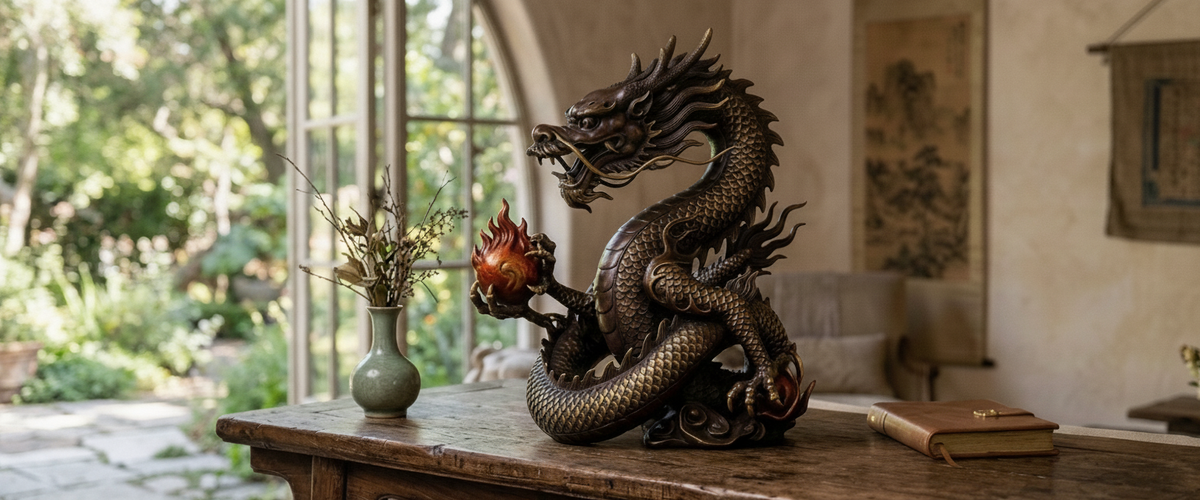

Most people buying a Chinese dragon indoor statue spend an hour choosing the plinth and ten seconds thinking about the wall behind it. That is backwards. A dragon is a creature of motion, and indoors that motion needs something to push against: a solid wall, a closed corner, a niche. Get the backdrop right and even a small bronze reads as deliberate. Get it wrong and a piece worth commissioning looks like it wandered in from a gift shop.

At a Glance
Backdrop first: set the dragon against a solid wall, never a window or an open doorway.
Facing: traditional placement turns the head toward the entrance or a window, never toward the wall at its back.
Pose sets the footprint: coiled forms suit consoles; striding and pearl-chasing dragons need length.
Read the details: claw count, whiskers and the pearl tell you which tradition you are buying into.
Size to the furniture: a dragon should take up roughly a third to half the width of the surface it sits on.
Why a Solid Wall Behind a Chinese Dragon Indoor Statue Matters
In Chinese placement conventions, the solid wall behind a guardian figure is its backing, the mountain at the creature's back. You can take or leave the symbolism. The visual logic holds either way. A dragon silhouetted against glass loses its outline in daylight and turns into a flat black cutout after dark. Against plaster, paneling or stone, the whiskers and the ridge of the spine stay legible from across the room.
Against a solid wall, the spine and whiskers stay legible from across the room.
The usual mistake looks like this: a bronze dragon sculpture in front of a bay window, and three different pedestals tried before anyone blames the glass. Move the same piece six feet (about 1.8 m) onto a paneled wall, on the original stand, and it finally looks anchored. If you are choosing between a better plinth and a better wall, choose the wall.
Facing the Entrance or the Window: What the Old Conventions Intended
Traditional guidance on dragon statue placement usually points the figure toward the main door or toward a window, so it greets whatever comes in or looks out over open space or water. Older cosmology also ties the dragon to the east, the Azure Dragon of the four directional symbols, which is why some households place it on the left side of a room as seen from the principal seat.
There is a practical reason to follow the custom even if the symbolism means little to you. A Chinese dragon indoor statue facing the entrance gives guests the head first, and the head is where the carving and chasing work is concentrated. A compact piece turned side-on to the door shows only its flank and wastes that detail. One thing to avoid: aiming the open jaws straight at a bedroom door or a dining chair. Symbolism aside, it simply feels confrontational.

Coiled, Striding or Chasing the Pearl: How Each Pose Claims Space
Pose decides the footprint of a Chinese dragon indoor statue more than height does. A coiled dragon stacks its body vertically and sits comfortably on a 14-inch (35 cm) deep console. A striding dragon spreads sideways, so allow at least 6 inches (15 cm) of clear surface beyond nose and tail. The pearl-chasing pose is the greediest of the three. The gaze line from eye to pearl has to read cleanly, which means no lamp base or stacked books in the way.
Heads and busts solve a different problem. In a narrow entry where a full-bodied dragon would block traffic, a vertical piece such as the Traditional Chinese Dragon Head Bronze Sculpture (Staff Mount), at 45 cm (about 17.7 in), delivers all the drama of the head on almost no footprint.
Claws, Whiskers and the Pearl: Reading Which Tradition You Are Buying
Count the claws. In Ming and Qing imperial art the five-clawed dragon was reserved for the emperor, four claws generally signaled princely rank, and three claws turn up more often in Japanese work. Before you buy, spend twenty minutes in a museum database such as the Cleveland Museum of Art collection; your eye will sharpen fast.
Long whiskers and barbels trailing from the snout mark a Chinese dragon, a feature often linked to the carp in its folklore. The flaming pearl, read variously as wisdom or the moon, is either gripped in a claw or floating just ahead. Fish-tailed dragons recall the carp that leapt the Dragon Gate, a story long linked to scholarly success, which is why they have traditionally belonged in the study.
Bronze, Carved Wood and Lacquered Resin Under Lamplight
Daylight flatters everything. The honest test for any Chinese dragon indoor statue is 9 p.m. under a warm table lamp, so ask to see a finished piece photographed under tungsten as well as daylight before it ships. Patinated bronze handles warm light best: scale edges catch highlights, recesses drop to deep brown, and the body reads fully in three dimensions.
Warm evening light is the real test of a patina.
Carved wood softens under the same light, and fine detail can blur at a distance, so wood rewards close viewing on a side table more than a lobby across the room. Lacquered resin is lighter and kinder to delicate furniture, but high-gloss lacquer throws hot spots back at the viewer. If the piece will sit under a recessed downlight, ask for a satin finish. Gold leaf glows under candle-warm bulbs and does its best work within arm's reach of a reading lamp. A small piece like the Clear Gold-Leaf Fish-Tailed Dragon - 22cm, at 22 cm (8.7 in), suits a study desk far better than a hallway console. Dust gold leaf with a soft brush only, never a cloth.

Sizing a Chinese Dragon Indoor Statue for a Console, Host Stand or Lobby Niche
Use these decision points before you fall for a photograph:
Hallway console: keep the dragon to a third or half of the console width. If a mirror hangs above, the head should sit clearly below its lower edge or clearly above it, never touching the frame line.
Restaurant host stand: stay under about 12 inches (30 cm) tall so staff keep sightlines to the door. Choose bronze; it survives daily handling and a heavy base resists knocks. A lighter piece on a busy stand can creep an inch every service.
Lobby niche: fill roughly two-thirds of the niche height and leave equal margin on each side. Where the lobby wall is wide but the floor has to stay clear, a wall-mounted panel such as the Traditional Dragon and Phoenix Bronze Relief, at 80 cm (31.5 in), makes more sense than a freestanding dragon on a plinth.
Load: bronze is dense. Confirm that the console or shelf is rated for the weight before delivery day.
When nothing in stock fits the niche, commission a bespoke dragon sculpture. Giant Sculptures builds a Chinese dragon indoor statue to measured dimensions, with the claw count, pose and patina specified up front. Budget depends on material, scale, complexity of the carving or casting, finishing, engineering and installation, so send us the niche drawing and request a tailored quote.
Quick Placement Checklist
For wider placement ideas, Chinese Dragon Garden Statues: How to Tell a Considered Carving From a Souvenir is useful companion reading before finalizing the setting and sightlines.
Solid wall behind, no glass.
Head toward the entrance or the light.
Pose matched to surface depth and length.
Claws and pearl checked against the tradition you want.
Finish tested under evening light.
Surface load confirmed.