






































































































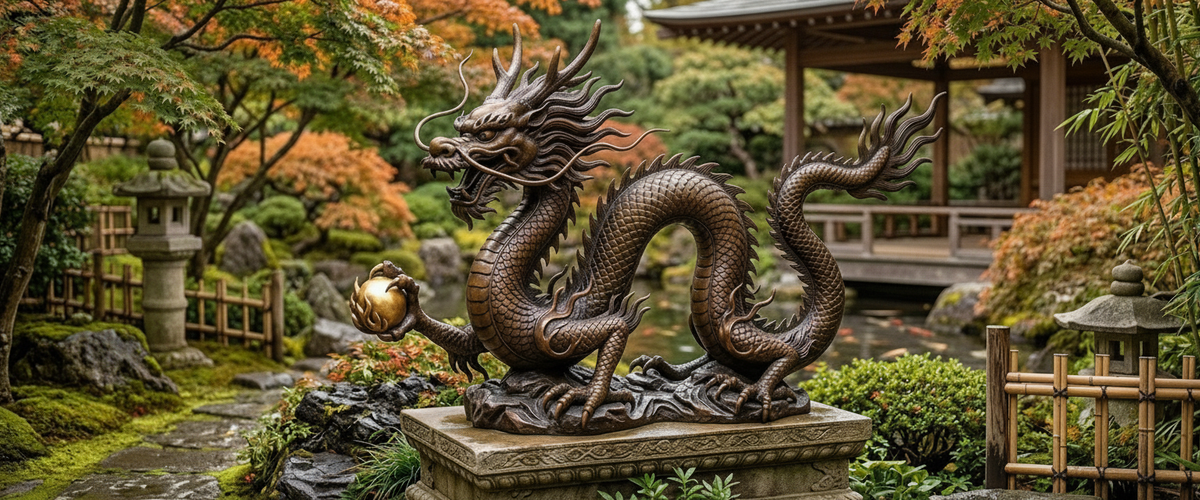

Many dragon statues sold for gardens are Western dragons in Chinese costume: a squat lizard body, four planted legs, and sometimes a pair of wings for good measure. A true Chinese dragon has none of that. It is long, wingless and serpentine. If you are shopping for Chinese dragon garden statues, that single fact decides whether the piece reads as a considered work of sculpture or a garden center impulse buy.
At Giant Sculptures we cast and carve dragons for private gardens, restaurant courtyards and hotel water features. The same handful of details separate the good ones from the rest, and none of them is hard to spot once you know where to look.

Quick Answer
Body: long and snake-like, with antlers, whiskers and carp scales. A stocky lizard is the wrong animal.
Claws: count them. Three, four and five each carried meaning, and a mismatched count is a quality tell.
Details: a pearl, free-standing whiskers and a directional mane mark a careful sculptor.
Placement: plan for ground length, water or a doorway rather than a tall plinth.
Material: bronze and dense stone hold crisp scales through freezing winters; painted resin rarely does.
Read the Body First: Why Chinese Dragon Garden Statues Are Serpents
Classical Chinese writers described the dragon as a composite of nine animals, among them the horns of a deer, the neck of a snake, the scales of a carp and the claws of an eagle. The result is a creature defined by length. It reads in curves, and its silhouette shifts as you walk past it, which is exactly why it suits a garden better than a mantelpiece.
That length changes how you should judge scale. A dragon listed at 5 ft (150 cm) can look modest in a photograph yet claim a broad sweep of ground once its coils are laid out. When comparing dragon statues for garden settings, always ask for the footprint as well as the height. With a coiled form such as the Large Traditional Coiling Chinese Dragon Bronze Sculpture, 150cm, the body loops back on itself, so its presence comes from width and movement more than from vertical reach, and the ground around it matters more than the height above it.
Three, Four or Five Claws, and Why Mass-Produced Casts Fudge It
By the Ming and Qing dynasties, the five-clawed dragon was associated with the emperor, while four claws were permitted for princes and high officials. Imperial robes, porcelain and architecture in the collection of the Palace Museum in Beijing show the five-clawed form again and again. Three-clawed dragons appear in earlier Chinese art and are typical of Japanese tradition.
Few buyers of Chinese dragon garden statues need imperial symbolism, but consistency is a reliable quality test. Cheap casts often show five talons on one foot and four on another, the result of patched or careless modeling, or soft lumps where claws should be, because detail blurs each time a master is copied into a new mold. In our studio the count is fixed at the clay stage, before any mold is taken. We have reworked feet on more than one maquette after a sharp-eyed client spotted a mismatch in the approval photos. Count every foot before you buy.

The Pearl, Whiskers and Mane
The flaming pearl, clutched in a claw or chased through cloud, is the dragon's emblem of wisdom and power. Its absence on Chinese dragon garden statues often means the sculptor skipped the iconography. Whiskers should be undercut, standing free of the jaw instead of drawn onto it in flat relief. The mane should flow in one direction, as if the dragon is moving into the wind. These are the places where a skilled maker spends hours and a factory saves minutes.
Head studies let you judge this at close range. For a gate pier or entrance planter, a head such as the Traditional Chinese Dragon Head Bronze Sculpture (Arcing Tusks) - 45cm often makes more sense than a full body, because teeth, whiskers and mane sit at eye level, exactly where their quality is easiest to see.
Coiled or Striding: Plan Ground Length, Not Plinth Height
A striding dragon wants a long, low run: a gravel bed, a terrace edge, the line of a path. A coiled dragon wants a circular footprint and room to walk all the way around. Neither is happy on a tall column, which crops the body and turns a serpent into a trophy. A low slab that lifts the piece clear of lawn and mulch is usually enough.
One client near Austin planned to set their dragon on a waist-high column at the end of a pool. On site, the column swallowed the movement entirely. They moved it to a low stone slab at the water's edge, and the body finally read from the house.
Give It Water or a Threshold
Chinese dragons are water creatures, linked with rivers, rain and the sea. Set one beside a pond, rill or basin and the body seems to rise out of it. In small courtyards in places like San Francisco or Manhattan, where there is no room for a pond, a piece such as the Traditional Chinese Dragon Bronze Fountain, 90cm brings the water into the sculpture itself and settles the placement question in one move.
The alternative is a threshold: a pair flanking a gateway, a single coil beside a front door, a head watching over a courtyard entrance. Movement needs somewhere to go. A dragon pointed at a fence looks stuck.

Stone, Bronze or Painted Resin Through a Hard Winter
Bronze is our default for Chinese dragon garden statues that need fine outdoor detail. It casts thin claws and undercut whiskers without fragility, develops a patina that deepens with age, and shrugs off freeze-thaw cycles from Aspen to upstate New York. A yearly wash and a coat of microcrystalline wax keep it looking sharp. If you inherit an older bronze with powdery green spots, ask a specialist through the American Institute for Conservation before scrubbing anything.
Granite and dense carving stone hold crisp scales and weather handsomely, though whiskers and antlers must be carved thicker to survive frost and knocks. Painted resin is light and easy to ship, but UV fades the paint within a few seasons, and water entering hairline cracks freezes and lifts the surface. For a dragon you intend to keep for decades, it is the weakest choice.
A Buyer's Checklist for Chinese Dragon Garden Statues
Get both height and full footprint, including coil width and tail length.
Count claws on every foot and check they match.
Look for a pearl, free-standing whiskers and a mane with clear direction.
Match material to your climate: bronze or dense stone where winters freeze.
Decide on water, threshold or ground run before you choose a pose.
Confirm weight, base fixings and site access for delivery and lifting.
Budget depends on material, scale, complexity, engineering, installation and finishing, so request a tailored quote.

When to Commission Instead of Buying Off the Shelf
Most Chinese dragon garden statues for sale come in fixed sizes and fixed poses. That works until your site has a particular pond edge, a curved wall or a gateway that demands a mirrored pair. A bespoke commission lets the dragon's body follow your landscape. Our process runs from brief and sketch to a clay maquette, where pose and claw count are approved, then casting, patination, crating and worldwide shipping.
If you want to see how dragons sit alongside other mythic subjects, explore our bronze mythology statues, or send Giant Sculptures a few photos of your site and we will suggest a pose and scale that gives the dragon room to move.
For wider placement ideas, Choosing a Dragon Statue for Your Garden Starts With What It Guards is useful companion reading before finalising the setting and sightlines.