











































A flying eagle is a trick played in metal: a heavy bird hanging in midair, held there by a few square inches of casting. That is the real engineering problem behind large flying eagle statues. It is also why two sculptures that look identical in a catalog photo can behave very differently after five winters on an exposed lawn. The wings get the attention, but the joint underneath them does the work.

Key Takeaways
A spread-wing eagle puts almost all of its load on one small contact point, so the hidden armature matters more than feather detail.
Where the bird meets its base changes both the silhouette and the engineering. The options are wingtip, talon or tail.
For large flying eagle statues for outdoors, bronze over a stainless steel armature is the long-term choice. Fiberglass is lighter but far less forgiving.
Coastal and hilltop sites need a fixing designed for wind as well as weight.
Inspect welds and pins before installation, while problems are still easy to fix.
Spread Wings Put Nearly All the Stress on One Small Joint
A perched eagle sits on its base like a paperweight. Large flying eagle statues behave like cantilevers. The bird's mass reaches outward across two wings and a tail, and all of that weight has to travel back through a single point of contact, usually a talon gripping a branch or a wingtip brushing a rock. In the foundry, that point is where the sculptor and the engineer argue.
The visible bronze at the joint may be only a couple of inches (about 5 cm) across. Inside, there should be a solid stainless steel rod that runs deep into the body of the bird and deep into the base, welded and pinned at both ends. When we open up a flying eagle in the studio before patination, that rod is the first thing we check. If it stops short, or if the design relies on the bronze skin for strength, the sculpture will look perfect until the day it cracks.
Wingtip, Talon or Tail: Three Mounting Points
Talon and wingtip mounts place the joint at very different distances from the center of mass.
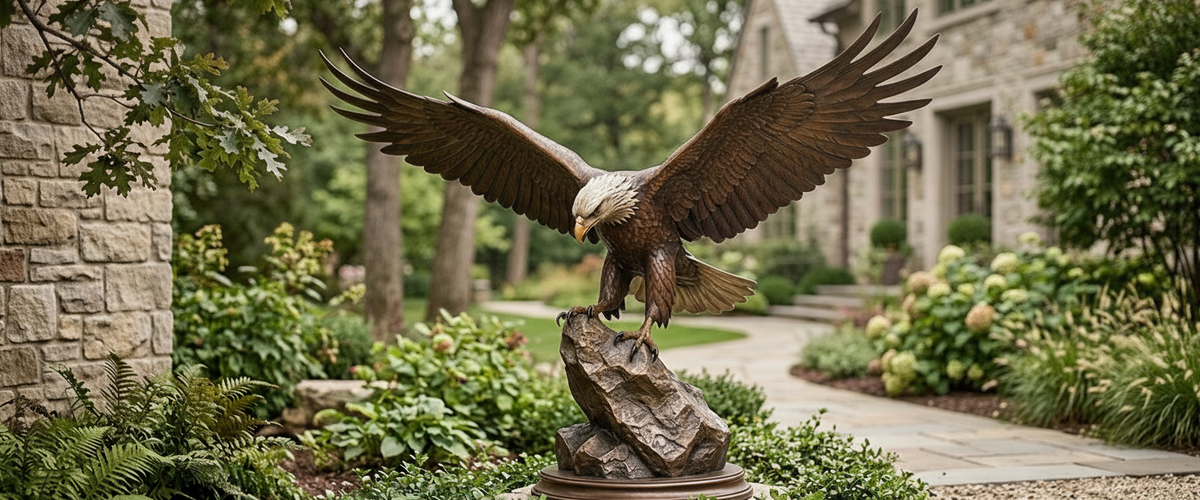
Talon mount. This is the classic hunting silhouette. The bird grips a branch or rock and the body hovers above it, with both wings clear of the base. Because the joint sits close to the center of mass, the engineering is manageable, and the eagle reads well from almost any angle.
Wingtip mount. This is the most theatrical option: the bird seems to bank off a rock with one wing touching down. The joint sits far from the center of mass, so use is at its greatest. Expect a thicker armature and a heavier base to counterbalance it. The pose looks superb in profile and weaker head-on, so it suits sites with a single main viewpoint.
Tail mount. This is less common and usually paired with a braking or landing pose, which leaves the talons free to reach forward. Landing compositions spread the load in their own way, because legs, talons and tail can all share the weight. Where you want the drama of flight without the use of a pure hover, a landing composition such as the Monumental Bald Eagle Landing Bronze Sculpture, 240cm (about 7.9 feet) keeps the sense of motion while sitting on firmer structural ground.

Bronze, Stainless or Fiberglass: What Changes Inside
Bronze is cast by the lost-wax method in sections, then welded and chased so the seams disappear into the feathering. Its weight helps it resist wind, but that same weight loads the joint, so the internal stainless armature has to be specified properly. Nearly every one of our bronze eagle statues for outdoor settings is built this way, and a good patina, waxed regularly, ages gracefully rather than failing.
Stainless steel is stronger for its weight, so the contact point can be slimmer and the pose more daring. It suits contemporary commissions such as faceted or mirror-polished eagles, where the sculpture is fabricated around its own frame.
Fiberglass keeps joint loads low because it is light. That lightness is also its weakness. Wind can lift it, the resin skin tends to crack around the embedded steel insert, and UV fades the paint. It works for a temporary event installation. We would not put it on a permanent estate.
Wind on Large Outdoor Eagle Statues: Coastal and Hilltop Sites
For wider placement ideas, Choosing a Large Bronze Fountain Statue That Sounds Right is useful companion reading before finalising the setting and sightlines.
On large flying eagle statues, the open wingspan acts like a sail. US engineers size wind loads on structures using the ASCE 7 standard, which assigns design wind speeds by region and exposure. A bird on a Montauk bluff or a Malibu ridge faces a very different figure from one in a sheltered Napa courtyard, so large outdoor eagle statues on exposed sites need a local engineer to size the footing.
We learned to ask for site photos early. One client on a ridge outside Austin sent pictures before ordering, and the prevailing wind ran straight up the slope, hitting the exact face the wings would present. We rotated the pose on the base drawing so the wings met the wind closer to edge-on, and the fixing specification dropped accordingly. On coastal sites, specify 316-grade stainless anchors and plan to wax the bronze more often, because salt spray is hard on patina.
Scaling Large Flying Eagle Statues Against a Facade or Entrance
A real bald eagle's wingspan is about 6.7 feet (roughly 2 m), according to the Cornell Lab of Ornithology. In front of a two-story Connecticut colonial or at a Texas ranch gate, even that span reads as modest, especially at ground level. Large flying eagle statues for these settings need height and mass as well as span. Against a substantial facade, a raised bird such as the Monumental Traditional Flying Bald Eagle Bronze Sculpture, 200cm (about 6.6 feet) holds its own on a plinth, where the same bird set on the lawn would read as a garden ornament.
Raised on a plinth, a monumental bird keeps its presence against a two-story facade.
Corporate entrances often call for symmetry rather than drama. There, a matched pair of formal birds such as the Large Heraldic Eagle Bronze Sculpture, 150cm (about 4.9 feet), set on plinths either side of the doorway, gives a balanced read that a single banking bird cannot. Before committing to either, cut a cardboard silhouette at full size, stand it in position and photograph it from the arrival point.

Check the Weld and the Pin Before Installation Day
Ask for an armature drawing showing how far the steel runs into the body and the base.
Request photos of the main joint before patination, while the welds are still visible.
Confirm the pin and anchors are 316 stainless, not plated mild steel.
Check the wing roots for weld porosity or hairline cracks.
Get an engineer's sign-off on the footing for your wind exposure.
Agree on lifting points so crane straps never bear on the wings.
Book an annual inspection of the joint and fixings.
Commissioning a Flying Eagle That Lasts
At Giant Sculptures, most commissions for large flying eagle statues begin with a question about the site rather than the bird. Budget depends on material, scale, pose complexity, engineering, installation and finishing, so we prepare a tailored quote once we know where the sculpture will stand. Our full range of eagle statues and sculptures is a good place to gather pose ideas, and our bird sculptures widen the search to other in-flight compositions. Then send us your photos, and we will start with the joint.