





































































































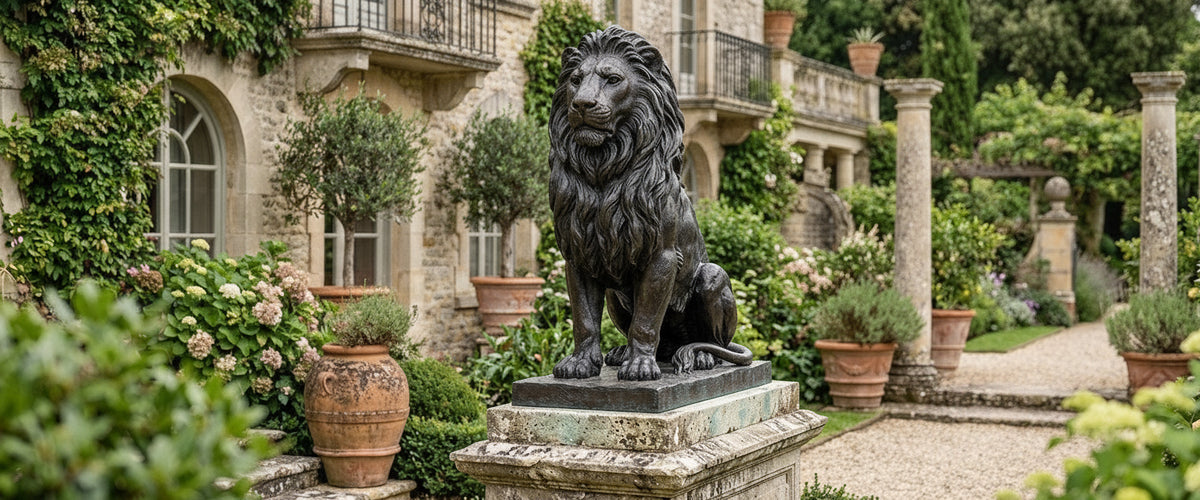

A pair of bronze lions can hold an entrance for a century, or they can sit at the gate looking like they wandered in from a smaller house. The metal is rarely the problem. The placement is. Most disappointing installs of bronze lion statues outdoor come down to a handful of decisions made before the crate is opened: how big the piece really is against the building behind it, how high it sits, and where the eye lands as you approach.
Looking for the full range in this category? Browse our Bronze Lion Statues collection for every available finish, size, and configuration of bronze lion statues outdoor.
We ship large bronze lions to driveways, hotel forecourts, and private gardens, and the same questions come up every time. This is the advice we give buyers before they commit to a pose, a size, or a plinth for their bronze lion statues outdoor.
Bronze lions guarding a formal entrance read as ceremonial and still.

Key Takeaways for Placing Bronze Lion Statues Outdoor
Scale to the backdrop, not the doormat. A lion reads against the wall, gate, or facade behind it, so size it to that, not to the paving underfoot.
Pedestal height changes everything. Raising a piece even a foot or two shifts its authority and how it meets your eyeline.
Pairs need symmetry and space. Guardian lions want a clear axis and matched setbacks, or the composition collapses.
Bronze earns its keep outdoors. With the right patina and care, bronze lion statues outdoor survive decades of weather; the finish matters as much as the form.
Budget follows material, scale, casting complexity, engineering, and installation. Ask for a tailored quote rather than assuming a figure.

What Bronze Lion Statues Outdoor Actually Look Like in Different Settings
The same lion behaves very differently depending on where it lands. Flanking a Georgian-style entrance, a seated bronze lion reads as ceremonial and still. Set one at the head of a gravel drive and it becomes a marker you register from a hundred feet out. Put it beside a modern glass wall in a courtyard and the contrast between hard bronze and reflective glass does most of the work. This is where bronze lion statues outdoor prove their range.
Indoors, a large bronze lion statue becomes a sculptural object you circle and study. A tower lobby or the foot of a grand stair suits a piece with fine surface detail, because visitors get close. Outdoors, the piece competes with sky, planting, and distance, so silhouette matters more than filigree. Where a lion has to carry across a lawn, a strong outline earns its place, which is why a roaring or crouching pose such as the Large Classical Recumbent Roaring Lion Bronze Sculpture - 150cm holds up at distance in a way a quieter recumbent figure, which rewards a slower approach, does not.

Scale, Sightlines, and Pedestal Height
Buyers almost always underestimate scale. On a screen, a 120cm seated lion (roughly 4 feet) looks commanding. Placed against a two-story facade, it can shrink to a garden ornament. The trick is to measure the visual field the lion has to fill. A tall gate pier, a wide portico, or a long approach all demand more presence than a compact courtyard, and outdoor bronze lions have to earn that presence.
For a broad entrance or a long drive, pieces in the 200cm-plus range (around 6.5 feet and up) hold their own against masonry and mature planting instead of getting swallowed; the Large Classical Seated Lion Bronze Sculpture - 220cm sits at the upper end of that band, where extra height and mass do the heavy lifting.
Raising a lion onto a plinth lifts it toward your eyeline and reads as a guardian.
Pedestal height is the lever people forget. A lion at ground level reads as an animal in the garden. Lift it onto a plinth so its head sits near your own eyeline and it reads as a guardian, formal and deliberate. Where you want the base itself to do that ceremonial work, a tiered treatment like the one under the Large Traditional Chinese Guardian Lion Bronze Sculpture (Tiered Greek Key Plinth) - 140cm lifts the figure into a raised register and gives the eye somewhere to travel up.
Sightlines decide where a lion belongs. Stand at your front door and look out. Stand at the gate and look in. Walk the driveway. The strongest position is usually where the piece terminates a view, at the end of an axis, framed by planting or architecture, rather than tucked against a wall where nobody stops. Well-sited bronze lion statues outdoor always reward that kind of planning.

Indoor Versus Outdoor: When Each Wins
Outdoor placement wins when you want the lion to work as a landmark and a statement of arrival. Weather actually helps here; a developing patina reads as age and gravity, which suits a guardian figure. The catch is that outdoor bronze lion statues need engineering for wind load and secure fixing, especially raised pairs.
Indoor placement wins when the surface detail is the point. A finely chased mane, tooled claws, and a crisp facial expression deserve close viewing and controlled light. If your instinct is to protect a fine finish and show it off at conversational distance, keep the lion inside. If you want it to hold a forecourt in January, put it out and let the bronze age honestly. That is the case for bronze lion statues outdoor in demanding sites.
Light, Backdrop, and Contrast
Bronze has a dark, warm surface that can vanish against certain backgrounds. Set a brown-patinated lion in front of dense evergreen planting or dark brick and it disappears into shadow. Place the same piece against pale stone, rendered walls, or open sky and its outline snaps into focus.
Think about the sun's path. A lion that faces morning light shows its modeling early and flattens by afternoon. Uplighting at night is where large bronze earns its drama; a low fixture raking across the mane throws texture into relief and turns the piece into an evening focal point. We regularly advise clients to plan the lighting for their bronze lion statues outdoor before the install, not after, because retrofitting cable runs into finished paving is painful.
Contrast also comes from finish. A polished or highlighted bronze catches light on its high points; a uniform dark patina reads as solid mass. Match the finish to the backdrop rather than choosing in isolation.
Common Placement Mistakes We See in Commissions
For wider placement ideas, Is Outdoor Bronze Sculpture Really Weatherproof? A Buyer's Guide is useful companion reading before finalizing the setting and sightlines.
The mistakes repeat, so they are easy to name and avoid when you place bronze lion statues outdoor.
Buying to the budget size, not the site size. A lion that fits the invoice but not the facade always looks undersized. Size to the space first, then discuss options.
Breaking symmetry on a pair. Guardian lions need matched setbacks, matched plinth heights, and a clear central axis. Even a foot of misalignment reads as a mistake. Where a matched composition is the goal, a piece conceived as a set, like the Large Classical Seated Lions Bronze Sculpture - 130cm, removes the guesswork of pairing two singles.
Ignoring the approach. People place lions for the photograph from the front, then never check how the piece reads from the car, the gate, or the path. Walk every approach before you fix anything.
Setting a fine-detailed pose too far away. Delicate modeling is wasted at forty feet. Reserve intricate surfaces for close-viewing positions.
No plinth plan. A lion dropped straight onto paving often looks stranded. Even a low, well-proportioned base grounds the composition.
Skipping the fixing detail. Large bronze is heavy and, raised, catches wind. Plan the foundation and anchoring with the same care as the pose.
Choosing and Commissioning Through Giant Sculptures
As a bespoke sculpture supplier working in large-scale bronze, we help buyers, designers, and landscape architects match pose, scale, and finish to a specific site. If a stock piece is close but not quite right, a commission lets you adjust size, patina, and plinth so your bronze lion statues outdoor suit the building they will stand in front of for decades. You can browse the range in our lion statues and sculptures collection, or look wider across metal sculptures if you are weighing bronze against other metals.
Budget for bronze lion statues outdoor depends on material, scale, casting complexity, the engineering behind the fixing, finishing, and installation, so we quote each project individually rather than quoting a headline figure. Tell us the site, the sightlines, and the effect you want, and we will size and finish the piece to match.
Caring for Bronze Lions Outdoors
Bronze is one of the most durable materials you can put outside, which is why civic monuments last for generations, and why bronze lion statues outdoor hold up so well. The patina is a protective layer, not just a color. Left to weather, it stabilizes; regular gentle cleaning and an occasional protective wax help it age evenly. The American Institute for Conservation offers sound general guidance on caring for weathered bronze if you want to understand the chemistry before you commit (culturalheritage.org).
Rinse with clean water and a soft brush a few times a year to clear grit and bird debris.
Avoid harsh chemicals and pressure washing, which strip patina and force water into fixings.
Re-wax the surface periodically, following your supplier's finish-specific advice.
Check anchoring and plinth joints annually, especially after hard winters.