





































































































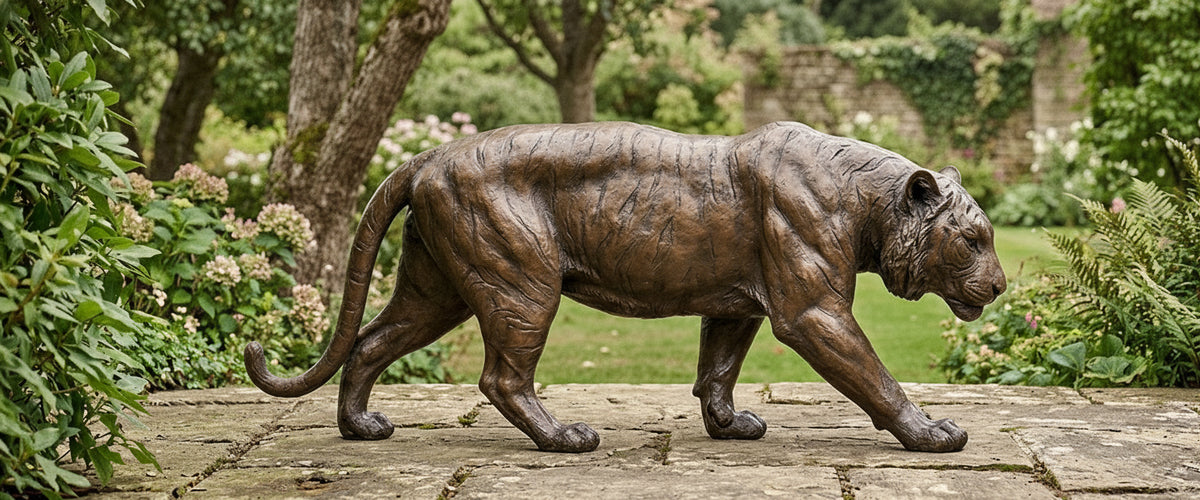

Bronze has been sitting outside for over two thousand years and it is still standing. That is the honest reason an outdoor bronze sculpture weatherproof enough for a coastal garden or a snow-loaded courtyard remains the material of choice for serious buyers. The nuance most people miss is that bronze does not fail in the rain; it changes. Understanding how it changes, and how the finish, base, and placement steer that change, is the difference between an outdoor bronze sculpture that reads as intentional in 50 years and one that looks neglected in five.
We ship large bronze work to gardens and public spaces across the US and beyond, so this guide is written from the delivery-truck end of the business, not from a textbook. If you are weighing up an outdoor bronze sculpture for your own site, that field view matters.
A mature patina protects the metal beneath rather than damaging it.

Key Takeaways
Bronze is genuinely weatherproof. It corrodes to a stable patina rather than rusting through like raw steel.
The finish matters more than the metal. A waxed or lacquered surface ages differently from a raw one, and that choice is yours to make at commission.
Water management beats water resistance. How an outdoor bronze sculpture drains, sits, and anchors decides its long-term health.
Scale changes everything. Weight, footings, and craning drive both placement and budget.
Bespoke bronze is a long-term asset. Buy for the site and the decades, not just the season.

What "Outdoor Bronze Sculpture Weatherproof" Actually Means
Weatherproof is a slightly loaded word. No outdoor material is inert; the useful question is how a material responds to weather over time. Bronze responds well. It is a copper alloy, and when copper alloys oxidize they form a surface layer that protects the metal underneath. That layer is the patina, the soft green, brown, or blue-black skin you see on old statues. The Statue of Liberty is bronze-clad copper, and its green coat is corrosion doing its job, not damaging the structure. Conservation research from institutions like the Getty Conservation Institute has long documented how stable these patina layers become once they mature.
So a weatherproof bronze designed for the outdoors is not one that never reacts to the elements. It is one where the reaction is controlled and predictable. That distinction matters when you place an outdoor bronze sculpture somewhere unforgiving: salt air in Malibu, freeze-thaw cycles in Aspen, or the humidity swings of a Texas summer.
Who is this material best for? Buyers who think in decades. Estate owners, collectors, landscape designers, and venue operators who want an outdoor bronze sculpture that outlives the planting scheme around it. If you want something disposable, bronze is the wrong spend. If you want an heirloom that shrugs off weather, it is close to ideal.

Materials, Finishes, and Scale Decisions
Not all bronze is equal, and the finish you choose at the point of commission steers how the piece will look for its whole life outdoors.
Patina and Finish
Most of our outdoor bronze sculptures are finished with a hot-applied chemical patina and then sealed, usually with a microcrystalline wax or a clear lacquer. Wax gives a warmer, more natural surface that you refresh periodically. Lacquer holds a color longer with less intervention but eventually needs stripping and redoing. Neither is objectively better; they suit different owners. A client who enjoys a seasonal wax routine gets the wax. A commercial venue that wants low touch gets the lacquer. If you want the patina to shift naturally toward green over years, you can leave a piece to weather more openly, which some buyers of classical work prefer.
Alloy and Wall Thickness
Cast bronze for an outdoor sculpture is typically a silicon or tin bronze, chosen for how it casts and how it corrodes. Wall thickness affects both weight and resilience. A thin-walled decorative casting is more vulnerable to knocks and thermal stress than a properly engineered outdoor bronze sculpture. This is one reason we caution against buying "bronze" garden ornaments with no stated foundry detail; the word alone tells you little.
Scale and Weight
Scale is where romantic ideas meet physics. Something like the Life-Size Classical Greek Warrior Bronze Statue at 250cm is a commanding focal point, but at that height you are into serious weight, a proper footing, and often a crane for installation. Smaller animal pieces read very differently. Where the setting needs presence without dominance, an outdoor bronze sculpture such as the Life-Size Contemporary Leopard Bronze Sculpture - 110cm can prowl along a low wall or terrace edge and animate a space at close range. Decide the emotional job of the piece first, then let scale follow.
A sealed patina holds its applied color longer with less intervention.
Browse the wider outdoor sculptures range to calibrate your eye on what different sizes actually do in a setting.

Where to Place Outdoor Bronze Sculpture for the Strongest Visual Impact
For wider placement ideas, Bronze Garden Statues: How to Choose a Piece That Earns Its Spot is useful companion reading before finalizing the setting and sightlines.
Placement is where the weatherproof credentials of an outdoor bronze sculpture get tested and where its impact is won or lost.
Give it a stage, not a corner. Bronze rewards a clean sightline. Set a figure at the end of a lawn axis, at a path terminus, or centered in a courtyard where the eye lands on it naturally. A piece jammed against a fence loses half its presence.
Think about light. An outdoor bronze sculpture looks best in raking light, early and late in the day, when the modeling catches shadow. East or west exposure often flatters a figure more than harsh noon sun overhead. If you can, walk the site at different hours before committing to a spot.
Respect the ground. Water pooling around a base is the real enemy, not the rain that lands on the sculpture. Set the piece on a plinth or a well-drained pad so it is never standing in a puddle. For a naturalistic border where the sculpture reads as part of the planting, a low grounded form such as the Life-Size Traditional Sow Bronze Sculpture at 120cm looks wonderful resting in a meadow edge, but it still needs firm, draining ground underneath.
Use pairs and groupings. Animal bronzes work beautifully in relationships. A pair set slightly apart, or a single dog placed as if it just wandered into the frame, gives a garden a sense of life. The best placements feel discovered rather than staged.
For water features, bronze earns its keep too. A well-made bronze fountain handles constant contact with water without the corrosion problems that plague cheaper cast metals; our bronze fountains collection shows how the material behaves when water is part of the design rather than an occasional visitor.

Budget, Commissioning, and Delivery
People always want a number, and the honest answer is that a single number does not exist for bespoke bronze. What drives the cost is real: the material volume, the scale, the complexity of the form, the engineering of the internal armature and mounting, the finishing method, and the logistics of getting a heavy object to your site and safely installed. A tightly detailed 300cm figure and a simple stylized animal are not remotely the same commission, so we quote each outdoor bronze sculpture rather than pretend to a price band.
What you can plan for:
Lead time. Cast bronze is not fast. Sculpting, molding, casting, chasing, and patinating each take time, and rushing any stage shows in the finish.
Foundation and fixing. A monumental piece such as the Monumental Traditional Seated Ganesha Bronze Sculpture - 300cm needs its footing designed before it arrives, not after. Talk to us early so the pad and fixings are ready.
Access and craning. Measure gateways, path widths, and overhead clearance. We have had beautiful installations complicated by a gate two inches too narrow, so this is worth checking twice.
Crating and freight. A large outdoor bronze sculpture travels in purpose-built crates. International shipping is routine for us, but weight and dimensions drive the freight plan.
A Quick Pre-Commission Checklist
Confirmed site, sightline, and sun exposure
Ground drainage assessed, plinth or pad specified
Access route measured end to end, including craning space
Finish chosen: waxed, lacquered, or left to weather
Long-term care plan agreed (who waxes it, how often)
Footing and fixing design confirmed before casting completes

How Giant Sculptures Helps With Bespoke Bronze
Giant Sculptures is a bespoke supplier of large-scale sculpture, and bronze is core to what we do. Some clients buy an existing design from our catalog and simply want it delivered and set correctly. Others come with a photograph, a pet, a mythological figure, or a rough sketch and want an outdoor bronze sculpture made from scratch. Both are welcome.
On a commission we work through the form, the scale relative to your site, the patina color, and the mounting engineering before anything is cast. Because we handle genuinely large work, we plan the unglamorous parts properly: the internal structure, the drainage detailing on the base, the fixing points, and the delivery method. A prowling animal like the Life-Size Traditional Prowling Tiger Bronze Sculpture - 180cm is a good example of a piece where pose, weight distribution, and anchoring all have to be resolved together so it stands safely for the long term.
The through-line of everything above is simple. A weatherproof outdoor bronze sculpture is one of the most durable things you can put in a garden or a public space, but it rewards buyers who plan the finish, the base, and the placement with the same care as the sculpture itself. Get those right and you own an outdoor bronze sculpture that ages into something better than the day it arrived. Explore our metal sculptures to see the range, then talk to us about your site.