





































































































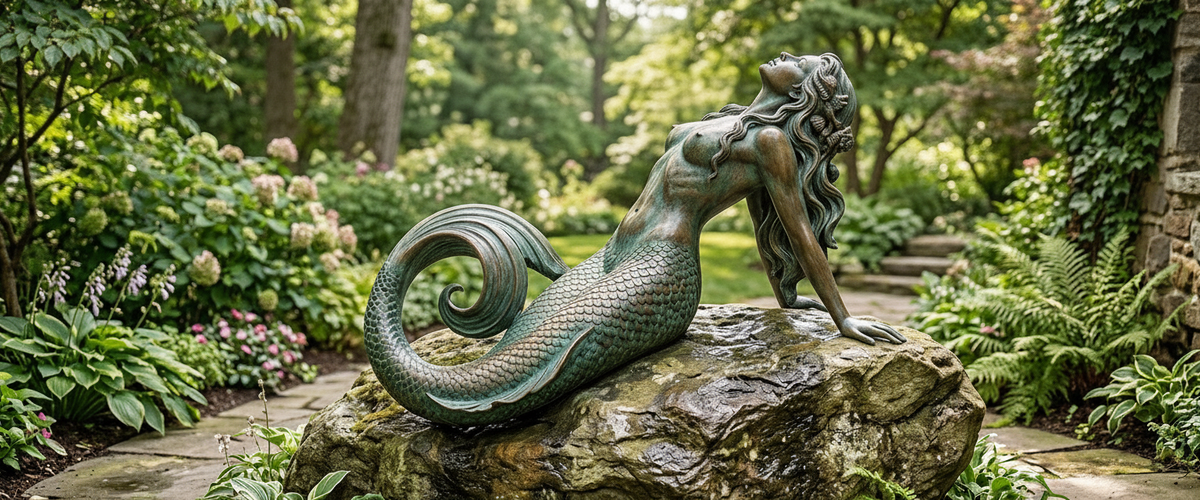

Most disappointing sculpture buys are not bad sculptures. They are good sculptures put in the wrong spot. A large bronze mermaid statue is especially unforgiving that way, because the form is long, low and directional; it points somewhere, it leans somewhere, and if the viewer approaches from the wrong angle they meet the back of a tail instead of the face. Get the sightline right and the same piece becomes the reason people walk into the garden.

Key Takeaways Before You Buy
Reclining forms need distance. A horizontal mermaid reads best from 15 to 25 feet (4.5 to 7.5 m) away, not from three feet in a corridor.
Pedestal height changes the story. Low plinths make the figure feel found and natural; tall plinths make it feel civic and formal.
Bronze wants a matte backdrop. Dark evergreens, weathered stone and stucco flatter patina. Glass and polished chrome fight it.
Water is optional but powerful. A mermaid fountain solves the ambient sound problem and the focal point problem in one purchase.
Coastal sites are fine for bronze if you commit to a rinse and wax routine. Salt air is a maintenance question, not a disqualifier.
Budget depends on scale, casting complexity, base engineering, plumbing and finish. Ask for a tailored quote rather than assuming a figure.
What a Large Bronze Mermaid Statue Actually Looks Like in Different Settings
In a garden, a large bronze mermaid statue behaves like a landscape element rather than an ornament. The long tail line pulls the eye sideways, which is why these pieces sit so well along pool copings, at the head of a lawn, or on a rock cluster at the edge of a pond. We shipped a reclining bronze to a Napa property where the client set it on a low fieldstone outcrop at the turn of a gravel path, and the effect was closer to discovering something than to viewing an object. That is the mermaid's advantage over an upright figure: she can look like she belongs to the site.
A reclining cast on a low stone outcrop reads as part of the landscape rather than an added ornament.
Indoors, the same shape needs generosity. A reclining bronze mermaid at 120 cm, roughly 4 feet across, works beautifully on a console in a double-height entry or on a low stone bench in a hotel lounge, where guests see it at a diagonal from the door. Push the same piece into a tight hallway and the eye never gets the run-up it needs. Interiors also change the finish conversation: under warm downlights, a darker chocolate patina picks up highlights, while a green verdigris can read gray and flat.
Commercial settings are their own category. Spa entrances, seafood restaurants, marina clubhouses and resort courtyards all use a large bronze mermaid statue as a wayfinding anchor. In those cases we usually push clients toward a bigger cast than they first ask for, because footfall spaces swallow scale. Where the space is a forecourt rather than a garden corner, a multi-figure cast such as the Life-Size Classical Mermaid and Merboy Bronze Sculpture, 350cm, about 11.5 feet, holds ground that a 4-foot piece would simply disappear in.
Scale, Sightlines and Pedestal Height
Three decisions do most of the work here. First, viewing distance. Measure the primary approach, then divide by roughly four; that gives a rough minimum length for a large bronze mermaid statue to register as a focal point rather than an accent. A 60-foot lawn wants something in the 8 to 10 foot (2.4 to 3 m) range, which is why a paired reclining mermaid group at 220 cm often lands better on medium terraces than on sprawling ones.
Second, eye height. A reclining figure placed at ankle level asks the viewer to look down, which flattens the face and hides the modeling in the shoulders and hair. Lifting the piece so the head sits somewhere between navel and chest height for an average adult usually restores the drama. On a Texas ranch commission the client initially set a reclining bronze directly on decking; a 16-inch (40 cm) limestone plinth added later completely changed the read, and cost a fraction of the sculpture.
Third, orientation. Sketch the two or three routes people actually walk, not the route on the site plan. Mermaids have a strong front and a quieter back, and the tail flick often looks best when it curls away from the approach rather than toward it. If the piece will be circled, as in a courtyard, choose a model designed in the round. A composition like the Large Classical Reclining Mermaid Bronze Sculpture (Arching Back) - 120cm holds up from behind because the spine line, not the face, carries the pose.

Indoor Versus Outdoor: When Each Placement Wins
For wider placement ideas, How to Choose a Bronze Mermaid Statue That Earns Its Spot by the Water is useful companion reading before finalising the setting and sightlines.
Outdoors wins when you want the sculpture to interact with weather, water and planting. Bronze is genuinely built for it. The alloy forms a stable protective layer as it ages, and the copper industry's own technical guidance notes that this surface film is what protects the metal beneath rather than eating into it, which is why architectural bronze has survived on exteriors for centuries (Copper Development Association). Outdoor placement also lets you use daylight movement: a mermaid on an east-facing pool edge in the Hamptons catches raking morning light across the tail scales that no interior fixture reproduces.
Indoors wins when security, climate or year-round visibility matters more. Collectors in NYC apartments and California hillside homes often choose interior placement simply because the piece gets seen every day. The trade-offs are practical. Floor loading needs checking on upper levels, since a large bronze mermaid statue can run into several hundred pounds (well over 150 kg) once the base is included. Radiant heat, direct sun through glazing and forced-air vents all dry out wax coatings faster than people expect.
There is a middle path clients often overlook: covered outdoor rooms. Loggias, deep porches and pergola bays give weather exposure without direct rainfall, which keeps maintenance light and lets the patina age slowly and evenly.
Light, Backdrop and Contrast
Bronze is a mid-tone metal, so it vanishes against mid-tone backgrounds. That single fact explains most underwhelming installations. A large bronze mermaid statue in a brown patina set against red brick simply blends away; put the same casting against clipped dark yew, gray basalt or pale stucco and she separates instantly.
One warm uplight, angled off-axis, keeps shadow in the hair and tail undercuts instead of flattening them.
For lighting, aim low and off-axis. A single warm uplight at roughly 30 to 45 degrees from the front creates shadow in the hair, collarbone and tail undercuts. Two lights at equal intensity from either side cancel that modeling and produce a flat, waxy look. Avoid mounting fixtures directly under the face; the result is theatrical in the worst sense. Where the sculpture sits near water, a light aimed through the surface toward the base can throw moving reflections up onto the bronze, which suits marine subjects particularly well.
Backdrop planting deserves a note too. Fine-textured foliage such as grasses and ferns flatters the smooth passages of a cast figure. Large-leaf tropicals compete for attention. If the mermaid sits in a border, keep a clear halo of 3 to 4 feet (about 1 m) around the silhouette so growth never swallows the tail.
What the Copenhagen Mermaid Teaches About Scale
The most famous bronze mermaid statue in the world is smaller than almost everyone expects. Edvard Eriksen's figure on the Langelinie promenade, show in 1913 and inspired by the Hans Christian Andersen story, stands barely over 4 feet tall on her granite boulder (VisitCopenhagen). Visitors searching for a bronze mermaid statue Copenhagen-style are often surprised by how modest she is in person.
The lesson is not that small works everywhere. It is that the Copenhagen piece succeeds because of siting: water directly below, open sky behind, an uninterrupted approach along the quay, and a rough natural boulder that makes the polished bronze pop. Reproduce those conditions on a private site and a moderately sized cast can carry enormous presence. Ignore them, and even a large bronze mermaid statue will still feel lost.
Placement Mistakes We See in Commissions
Ordering by budget instead of by sightline. Clients pick a size that suits the number, then discover the approach distance demanded something larger. Measure first.
Facing the sculpture at the house instead of at the viewer. A mermaid gazing back at a blank wall wastes the best surface of the casting.
Skipping the base engineering. A large bronze mermaid statue set on soft ground shifts. A reinforced pad, correct fixings and a level plinth prevent both tilt and theft.
Assuming a fountain can be added later. Plumbing, reservoir sizing and pump access are far cheaper designed in at the start. Where water is part of the intention, a plumbed model such as the Life-Size Classical Seated Mermaid Bronze Fountain, 250cm, around 8 feet, arrives with those details resolved in the casting rather than retrofitted around it.
Neglecting the wax routine on coastal sites. Salt spray dulls a finish quickly. A rinse with clean water and an annual coat of microcrystalline wax keeps things stable.
Forgetting access for delivery. Gates, tight corners, soft lawns and overhead cabling decide whether a crane or a gantry is needed. Send site photos early.

A Quick Siting Checklist
Mark the proposed position with stakes and string at the finished height, then live with it for a week.
Photograph the spot from every approach at morning, midday and dusk.
Check the backdrop tone against a bronze sample or a printed image of the patina.
Confirm ground bearing, drainage and any below-grade services.
Decide pedestal material and height before finalizing the sculpture size.
Plan lighting circuits and, for fountains, power and water runs.
Confirm crane or forklift access, gate widths and turning radius.
Agree the maintenance rhythm: rinse frequency, wax schedule, winter protocol.
Commissioning a Bespoke Bronze Mermaid
Catalog pieces cover most needs, and browsing our large bronze sculptures or bronze garden statues is the fastest way to calibrate what a given height feels like. A bespoke large bronze mermaid statue earns its place when the site imposes something specific: a tail that has to follow a curved coping, a patina matched to existing metalwork, a group composition sized to a particular courtyard, or a mounting detail that ties into an existing water feature.
A commission usually runs through drawings, a scale maquette for approval, clay modeling, lost-wax casting, chasing and welding of sections, then patination and waxing. Lead times reflect that sequence honestly. Pricing depends on finished scale, the complexity of the casting, structural and base engineering, plumbing if water is involved, patina work and installation, so the sensible move is a tailored quote against your actual site rather than a guessed number.
Whichever route you take, treat the large bronze mermaid statue as a permanent piece of the property. Bronze outlives the people who commission it. Spend the extra hour on sightlines, backdrop and plinth height at the start, because that hour is what people will see for the next hundred years.