






































































































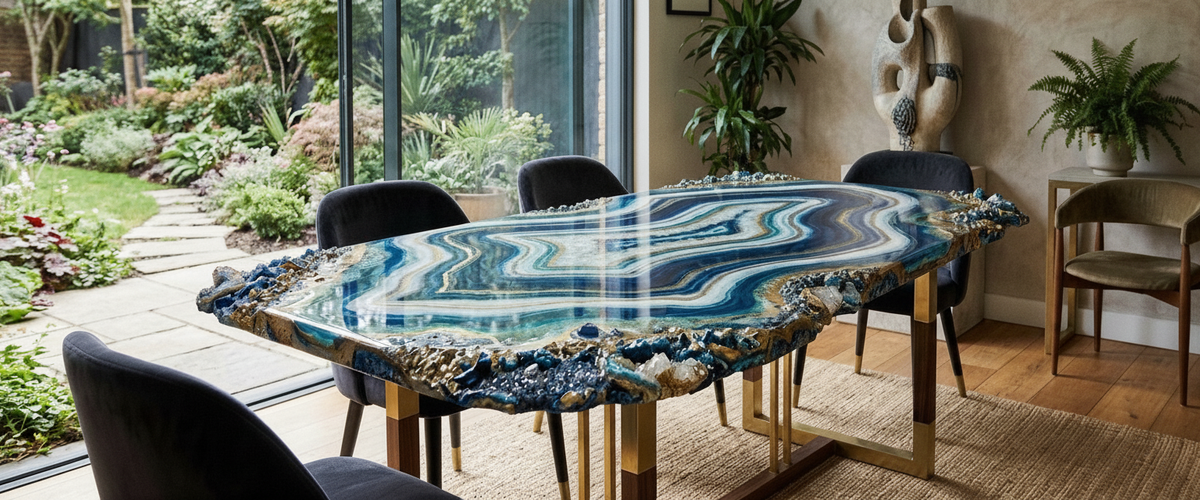

Put a resin artwork on a dining table and you are asking it to survive hot casserole dishes, spilled wine, sliding plates and afternoon sun, sometimes all in one evening. Dining table resin art can stay clear and deep for years. That only happens when the design, the pour and the habits around the table are chosen with those hazards in mind. Most tired, hazy tops were let down by one of those decisions. The material itself is rarely the problem.

At a Glance
The three big hazards are heat, abrasion and ultraviolet light.
Busy, layered agate and geode designs hide wear far better than glossy, solid-color river pours.
Resin grade and pour depth decide whether an inlay yellows, clouds or cracks.
Skip solvent-based sprays. Mild soap and a microfiber cloth do the job.
Surface scratches can be polished out. Deep yellowing or cracking usually means a re-pour.
Why a Dining Table Is the Harshest Place for Resin Art
For wider placement ideas, Large Framed Wall Art Above the Dining Table: Depth, Glass and Evening Light is useful companion reading before finalising the setting and sightlines.
A wall relief only has to cope with light and dust. A table surface gets touched, loaded and wiped every day. Epoxy softens with heat, so a pan straight from the oven can leave a permanent ring or a slight dish in the surface. Grit under a ceramic plate behaves like fine sandpaper. Sunlight works slowly, breaking down the resin and shifting clear areas toward amber. Controlling one hazard is not enough. Dining table resin art needs a plan for all three.
River, Geode and Agate Pours: Which Hide Scratches
Under a pendant light, dining table resin art with a dark, high-gloss river pour shows every hairline scratch. A single smooth band of deep blue or black resin is basically a mirror, and mirrors are unforgiving.
Agate pours, with their stacked bands and cells of color, break up reflections, so light scuffs disappear into the pattern. Geode designs that use crushed glass, mineral chips or metallic leaf hide wear well too. The tradeoff is texture. If the geode relief stands proud of the surface, it needs a level flood coat on top. Otherwise crumbs and wine settle into the crevices. For a hard-working family table, choose pattern over polish. Save the glassy river look for a console or side table that sees less traffic.
Layered agate bands break up reflections, so everyday scuffs fade into the pattern.
Pour Depth and Resin Grade Decide How a Geode Inlay Ages
Resin is not one product. Deep-pour casting resins cure slowly so they can fill thick voids in a geode or river channel. Thin coating resins cure harder and are made for the top layer. Pour a coating resin too thick in a single pass and it can overheat as it cures, leaving cracks, bubbles or a milky cloud trapped inside. Gougeon Brothers' technical journal Epoxyworks covers how cure heat and UV exposure affect epoxy over time, and it is worth reading before you buy.
When you commission dining table resin art, ask the maker three plain questions. Which resin was used for the cast and which for the topcoat? Was the topcoat UV-stabilized? How many layers went into the deepest section? A maker who answers these without hesitation has usually done it properly.

Cleaning Sprays That Dull a Resin Top, and What to Use Instead
Most dull tops are not worn out. They have been cleaned badly. Rubbing alcohol, acetone and ammonia-based glass cleaners soften or haze the surface, especially where someone wipes the same spot every night. Abrasive kitchen sponges leave a fine swirl that turns a gloss finish satin within months.
The fix is easy. To keep dining table resin art clear, use warm water, a drop of dish soap and a soft microfiber cloth. Put trivets with felt feet under anything hot, coasters under glasses, and placemats where people actually eat. Never set a hot pan down directly, even for a moment.
Sunny Bay Windows Yellow Resin Faster
Position matters more than most buyers of dining table resin art expect. A table sitting in a bright bay window yellows noticeably faster than the same table set a few steps back in the room. Light damage is cumulative, a point the Smithsonian's Museum Conservation Institute makes about light-sensitive collections generally. The pattern is easy to spot on an uneven exposure: the end of a table nearest a west-facing window can warm to pale honey while the far end stays water-clear. If you cannot move the table, UV-filtering window film and sheer drapes during peak afternoon sun buy a lot of time.
The sunlit end of a resin top can warm toward amber long before the shaded end changes.
Re-Polishing Versus Re-Pouring After the First Hard Year
Surface damage is the good news. Fine scratches, haze and light heat marks usually sit in the top fraction of a millimeter. A professional can wet-sand and polish them out, or add a fresh flood coat. Damage inside the resin body is a different job. Yellowing through a deep geode, internal cracks or clouding means routing out the affected section and re-pouring, sometimes with the whole top refinished afterward so the sheen matches. That is the main reason pour quality matters at the start. Well-made dining table resin art needs polishing. A poorly made piece needs surgery.

Buyer Checklist Before You Commit
Choose a pattern busy enough to hide everyday wear.
Confirm separate casting and UV-stabilized coating resins.
Check that any raised texture sits under a level topcoat.
Note where afternoon sun falls on the table.
Budget for trivets, coasters and a gentle cleaning routine.
Ask whether the maker offers re-polishing later.
When Resin Art Belongs on the Wall Instead
Some households love the look of poured resin but run a table that takes real punishment. In that case, it often makes more sense to let a plain, uncomplicated top such as the White Oval Dining Table (180 cm, roughly 71 inches) carry the daily load, and move the resin somewhere it never gets touched.
A compact wall piece such as the Ocean Blue Resin Splash & Character Wall Relief (40 cm, about 16 inches) keeps the same liquid depth with none of the heat or abrasion risk. At that size it reads as an accent rather than a centerpiece, so it works best above a sideboard or in a small grouping, not alone on the long wall behind a full-length table. To see how pieces scale against a complete table setting, the resin art and dining room art collections are the easiest place to compare sizes side by side.
For larger rooms, Giant Sculptures also takes bespoke commissions in harder-wearing materials, from bronze wall art to engineered metal reliefs, built for decades of ownership. Budget depends on material, scale, complexity, finishing and installation, so the best starting point is a tailored quote based on your room and how you actually use it.