






































































































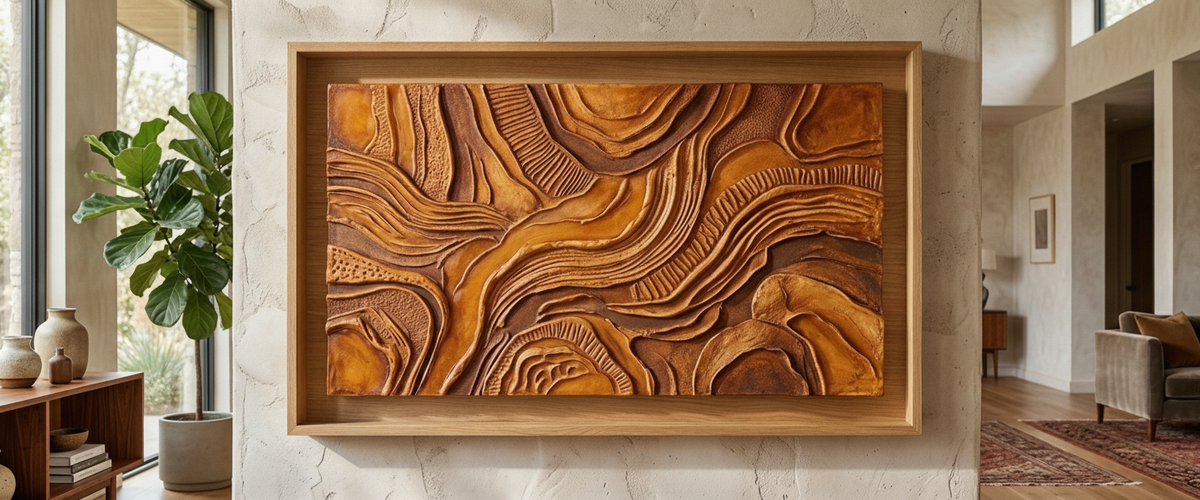

Most framed art is hung for people walking past it. A dining wall gets the opposite treatment: six or eight guests sitting within arm's reach for two hours, staring at the same surface between courses. That changes how you should buy large framed wall art. Every decision you make about the frame gets judged at close range, in low light, by people with nothing else to look at while the main course is plated.

At a Glance
Give any relief or textured piece a shadow-box or tray frame with real depth. Seated viewers notice a flat, cramped mount.
Glaze only when the artwork needs protection. If the wall faces a window, pay for anti-reflective museum glass or skip glass entirely.
Judge the piece under your evening lighting, not afternoon daylight.
Above about 4 feet (120 cm), the frame becomes structure. Choose solid oak or metal moulding and hang it on a cleat.
Near a sideboard, a frame protects the edges from steam and the knocks that come with serving.
Why Large Framed Wall Art Needs More Depth at the Table
A standing viewer sees a wall piece straight on. A seated diner sees it from below and slightly to the side, often from only a few feet away. From that angle the inside walls of the frame show, and so does every bit of space, or lack of it, around a raised surface. A relief pressed tight against the glass, or crammed into a shallow rebate, looks trapped.
Check any relief from a dining chair before you commit, because the seated view shows problems that standing never reveals. A ridged surface depends on those ridges throwing shadow, so allow an inch or two of clearance between the highest point of the surface and the frame lip. Above a long walnut or oak table, a deeply textured abstract such as Terralume Amber Rust Abstract Textured Framed Wall Art needs that open tray-frame clearance far more than it needs a slim gallery profile. When comparing large framed wall art for dining room walls in our 3D wall art collection, judge every option from that seated sightline.

Glass Opposite the Window: When Museum Glass Pays Off
For wider placement ideas, When a Large Wall Hanging Sculpture Becomes Part of the Building is useful companion reading before finalising the setting and sightlines.
Hang standard glass across from a big window and you get a mirror with art somewhere behind it. Anti-reflective museum glass solves this, and it earns its cost when the piece is paper, photography or pigment that fades. The Northeast Document Conservation Center sets out how UV-filtering glazing slows light damage on vulnerable works, and a sunny dining room is exactly where that damage builds up.
Metal, wood and sculpted relief are a different case. Glass flattens texture and catches the pendant above the table, and work with its own reflective elements suffers most. Where the wall calls for sparkle rather than flat colour, an open-faced crystal piece like Glacia Dual Jaguar Crystal Hanging Framed Wall Art should stay unglazed, because glass in front would double every reflection. For these, leave the face open and let the frame protect the perimeter.
Candles, Pendants and Dimmers
Dinner light is low and warm, and it usually comes from the wrong place. A pendant lights the tablecloth, not the wall. Candles light from below, which turns relief shadows upside down, so a carved form that reads well at noon can look muddy at nine.
Bring your own bulbs when you test. Dim the room to dinner level and look again. A picture light or a single angled spot set to warm white will rake across a textured surface and bring it back. Backlit work sidesteps the problem entirely. If the room spends most evenings at candlelight levels, a self-lit piece such as Celestique Ancient Bonsai Framed Long Hanging LED Wall Art holds its presence where an unlit relief would sink into shadow. Give it a separate dimmer so it can sit quietly behind the candles instead of competing with them.

Float Mount, Tray Frame or Full Moulding
With large framed wall art, each frame type sets a tone for the table below it.
Float mount: the artwork sits forward on a hidden spacer and seems to hover. It suits glass or stone tables and minimal, loft-style rooms.
Tray frame: a slim, open-faced box with a gap around the panel. It is clean and contemporary and pairs well with walnut or oak tables. It is our default recommendation for textured relief.
Full moulding: a profiled, traditional frame. It belongs in formal dining rooms with paneling, carved chairs or a mahogany table, and it can make an abstract piece feel collected rather than decorative.
Above 4 Feet (120 cm), the Frame Outweighs the Art
Once a piece of large framed wall art runs past about 4 feet (120 cm) on its long side, the frame stops being trim and starts carrying load. A large relief panel can be heavy, and a thin decorative moulding will twist or sag over time. Solid oak resists racking and looks honest at close range. Blackened steel or bronze-toned metal moulding is slimmer for the same strength, which suits contemporary rooms. Our wood wall art and metal wall art collections show both approaches.
Keep the frame in proportion to the piece. Hang it on a French cleat fixed into studs or masonry, never on a single wire. Your contractor will thank you, and so will the guest sitting underneath it.

Why a Frame Beats an Unframed Panel Beside a Sideboard
The wall above a sideboard has a hard job. Steam rises from serving dishes, trays clip the lower edge, and people lean on it while plating. Unframed wood panels in this spot tend to fail from the bottom up: the face stays fine, but the lower edge darkens and lifts where steam rises every evening. A frame shields that vulnerable edge, restrains a panel against seasonal movement and gives you a surface to wipe down. In this one spot, framing is the practical choice, not just a style preference.
Buyer Checklist for Large Framed Wall Art in a Dining Room
Sit in every chair and check the sightline before choosing size and depth.
Aim for art roughly two-thirds the width of the table or sideboard beneath it.
Hang the bottom edge 8 to 10 inches (20 to 25 cm) above a sideboard.
Decide on glazing based on material and window position.
Test under evening light at dinner brightness.
Match frame type to your table and room style.
Confirm wall structure and cleat hanging for anything over 4 feet (120 cm).
When a standard size will not fit your wall, you can commission a bespoke relief and frame together from Giant Sculptures, built to your room's proportions and lighting. Budget depends on material, scale, complexity, framing and installation, so ask for a tailored quote, or start with our full wall art and wall decor collection.