


























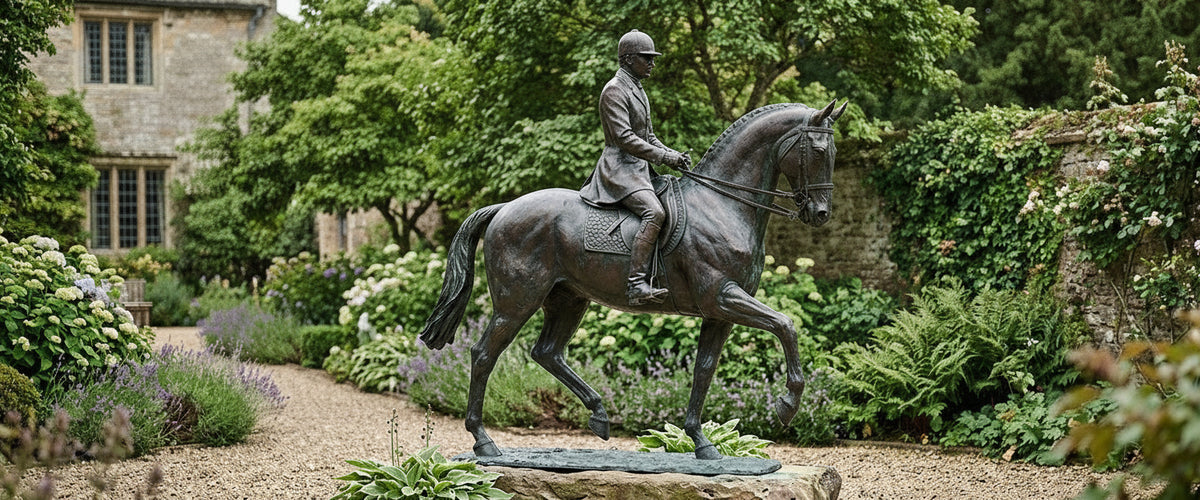

Put a rider on a horse and you have asked four slender legs to carry two bodies and a great deal of use. That is the engineering problem hidden inside every bronze horse rider statue, from a desk-sized study to an estate centerpiece seen from the far end of a drive. Get the balance wrong and the piece looks timid or needs a clumsy prop. Get it right and nobody ever thinks about the steel.

At a Glance
The rider moves weight forward, so the front legs carry most of the bending stress.
Hidden stainless steel runs through the legs and into the plinth on anything larger than a tabletop piece.
Walking poses with three hooves down are the most forgiving. Rearing poses usually need a tail, a rock or serious internal engineering.
Weight grows far faster than height, so a statue twice as tall is a different structural project.
Ask about the foundation first, not the patina.
A Rider Shifts the Center of Gravity Forward
A living horse already carries more of its weight on the forehand than the hindquarters. Seat a rider just behind the withers and the balance tips further toward the front. Raise the rider's arm, add a sword or a pointing hand, and you create a lever that pulls the whole mass forward again.
In bronze, that load lands on the front cannon bones and pasterns, the thinnest parts of the anatomy. A well-made bronze horse rider statue is sculpted with this in mind. The leg angles, the set of the shoulders and even the rider's posture are tuned so the mass sits over the supporting hooves. When you look through bronze horse statues, check where the hooves land relative to the girth line. The confident pieces put a hoof directly beneath the heaviest point.

Inside the Armature: The Steel That Carries Two Figures
Monumental bronze is cast hollow, with walls only a fraction of an inch thick, using the lost-wax process described in detail by the Victoria and Albert Museum. The shell is strong in compression but cannot carry a cantilevered rider on its own. So the strength comes from inside.
On our larger commissions, stainless steel rods run up through the supporting legs, are welded to an internal frame in the barrel of the horse, and continue down through the hooves as threaded studs. The rider is pinned through the saddle into that same frame, so horse and rider behave as one structure. We specify stainless rather than mild steel for a simple reason: conservators opening older bronzes regularly find iron armatures that have rusted, swelled and split the metal from within.
Stainless rods run through the legs and tie horse and rider into one frame.
Walking, Standing or Rearing: Which Poses Stand Alone
A walking pose with three hooves down is the workhorse of equestrian sculpture, and the safest choice for a first bronze horse rider statue. It reads as movement while keeping a stable tripod under the mass. A square standing pose is even easier to engineer, though it can feel static on a large lawn.
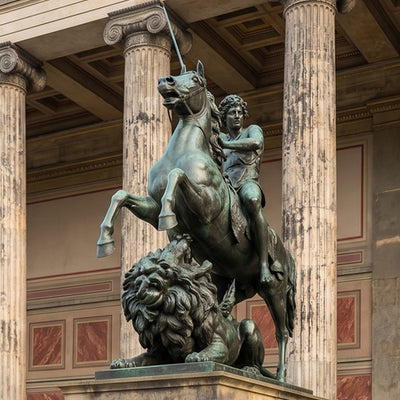
Rearing is where budgets and engineering both climb. With only the hind hooves on the plinth, the entire load passes through two legs, and the rider sits high above them. Most rearing horses quietly borrow a third support: a sweeping tail touching the base, a tree stump, a rock under the belly. The 1853 Jackson monument in Washington's Lafayette Square is famous precisely because it balances on hind legs alone, using a heavily weighted hindquarter. Ask for that look and you are asking for bespoke structural work.
Why the Rider Is Cast Slightly Larger Than Life
Stand under a bronze horse and rider statue and the horse dominates. Its barrel and neck fill your view, while the rider's head recedes upward and shrinks through foreshortening. Sculptors have corrected for this since antiquity. The rider of the ancient bronze Marcus Aurelius at the Capitoline Museums is noticeably generous in scale against his mount.
On a bronze horse rider statue destined for a raised plinth, we usually nudge the rider up a little relative to the horse, and the head a touch more. The eye forgives it because the viewer reads the rider as the subject. Ignore the correction on a tall plinth and the figure looks like a child on a pony.

From Tabletop to Estate Scale: The Load Grows Faster Than the Statue
Double the height of a sculpture and its volume, and therefore its weight, rises roughly eightfold, while the cross-section of each leg only rises about fourfold. The legs fall behind the load with every step up in size. A 2-foot (60 cm) tabletop bronze can stand on solid cast legs. A life-size bronze horse rider statue needs internal steel. Something that reads at 12 feet (3.6 m) from a Napa terrace needs an engineer's calculation.
Material changes the math too. For a console or hallway horse at roughly tabletop height, a lightweight composite piece like the Steed Blue Horse Sculpture - 67cm sits happily on furniture because it carries a fraction of the weight of solid metal. Bronze at the same size is several times heavier, so the furniture beneath it has to be up to the job. Where an interior calls for the warmth of a bronze tone rather than the mass of cast metal, a bronze-finish figure such as the Cranwold Bronze Figure Sculpture - 51cm is a more practical choice for a shelf or sideboard than a foundry casting.
The same physics applies to an antique bronze horse statue or a vintage bronze horse statue you are considering at auction. Check the fetlocks and pasterns for hairline cracks, old solder lines or bent alignment. Those are the stress points, and repairs there are rarely cosmetic.
Bolting Down a Bronze Horse Rider Statue
The installer's first question is never about color. It is about the ground. On a ranch site outside Austin, a good contractor will want the soil report before looking at the plinth drawings, because the expansive clay there moves seasonally. In Aspen the concern shifts to frost depth. In the Hamptons, it is salt air and coastal wind.
A sound installation for a bronze horse rider statue typically involves threaded studs from the hooves set into the plinth with chemical anchors, a reinforced concrete foundation sized to the load, and stainless fixings to avoid corrosion where metals meet. Wind matters more than buyers expect. A rider with a raised arm or a flowing cloak presents a large silhouette, and the overturning force acts high up. Pieces from the bronze garden statues range are specified with these fixings in mind.
Threaded studs from the hooves are set into the plinth with chemical anchors.

Buyer Checklist Before You Commission
Before you brief a bronze horse rider statue, work through these points with your sculptor and installer.
Viewing distance: decide where people will first see the piece, because that sets the scale.
Pose and support: confirm whether the pose stands alone or needs a hidden third contact point.
Armature material: ask for stainless steel and how it connects to the plinth.
Plinth height: agree the rider's proportions against the final viewing angle.
Site conditions: share soil, frost, wind and access details early.
Budget: it depends on scale, pose complexity, engineering, finishing and installation, so request a tailored quote rather than guessing.
Giant Sculptures builds equestrian commissions from maquette to installation, and our wider range of horse sculptures and statues is a good place to test pose and proportion before you brief a bespoke piece. Start the conversation with the site, and the sculpture will follow.
For wider placement ideas, How to Judge an Abstract Bronze Sculpture Before You Buy It is useful companion reading before finalising the setting and sightlines.