






































































































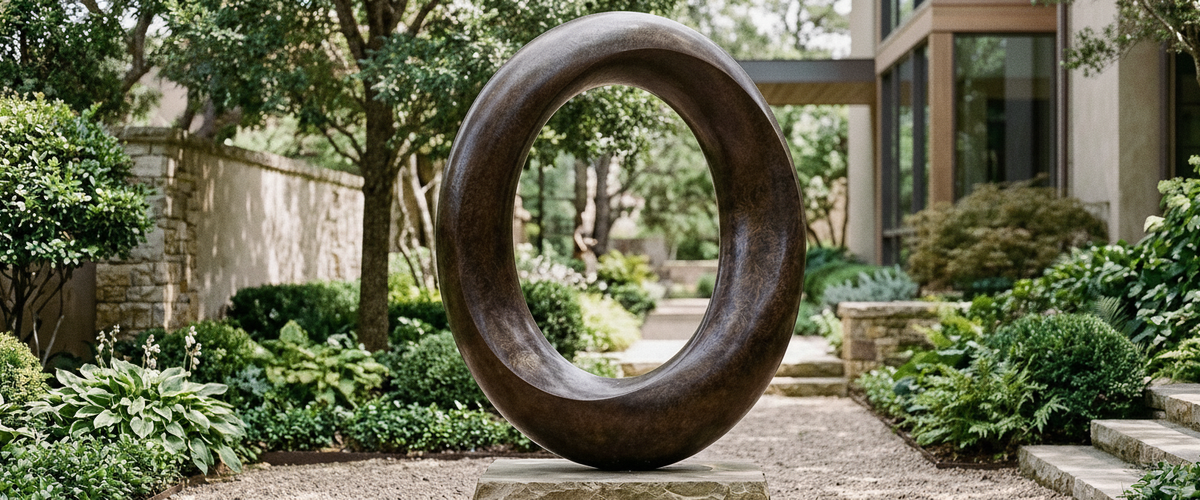

Most buyers judge an abstract bronze sculpture by its photograph, and a photograph is the one place where a mediocre piece looks fine. A clean silhouette against a white background hides almost everything that separates a lasting piece from a disappointing one. The real tests are surface, patina, seams and finishing marks, and you can learn to read all of them in a few minutes.

At a Glance
Surface first: a good abstract feels consistent under the hand. Ripples, pinholes and soft edges show rushed finishing.
Patina changes speed: dark finishes slow a curve down; polished finishes make it race.
Check the closure: on loops and eternity forms, the point where the form meets itself is where weak welds hide.
Watch the gap: in two-part pieces, negative space does most of the work.
Match finish to setting: fine surfaces need a plinth and close viewing; open lawns need bold form.
Run Your Hand Along It First
Abstract work has nowhere to hide. A figurative bronze can distract you with a face or a hand; an abstract bronze sculpture asks you to look at nothing but surface and line. That is why surface flaws show first. Run your palm along the longest curve. You want a continuous plane with no flat spots where a grinder lingered, no tiny craters from trapped gas in the casting, and edges that stay crisp where the designer meant them to be crisp.
On a long sweeping form, a flat spot as small as a coin will catch light and break the line from twenty feet away. If you are buying remotely, ask for a raking-light photo taken with the light almost parallel to the surface. Any honest maker will send one.

How Patina Speeds Up or Slows a Curve
Patina is chemistry applied to bronze with heat and reactive solutions, and the Tate's notes on patina are a good primer on why artists treat it as part of the work rather than a coating. In practice, color changes how fast the eye travels around a form.
Traditional brown is the most forgiving. It reads warm, slows the eye slightly and suits pieces meant to be studied.
Verdigris pools in recesses and lightens on high points, so it exaggerates depth. Lovely on carved, folded forms; muddy on very smooth ones.
Black compresses a shape into a silhouette. Use it when the outline is the point.
Mirror polish makes curves feel faster and lighter, but it reflects every surrounding object and shows every flaw.
When the outline is the whole idea, a tall black form such as the Hazewold Bronze Abstract Sculpture - 209cm, at 209cm (about 6 ft 10 in), reads as a single gesture against a hedge or pale wall. The same shape in polished gold would become something busier. Bear in mind that several pieces in our range are bronze-finish rather than cast, which affects weight and outdoor exposure. Always ask which you are looking at.
Eternity Loops and the Seam Nobody Checks
Buyers searching for an abstract bronze sculpture representing eternity usually want a loop, a Möbius twist or an infinity form. These are some of the hardest abstracts to finish well, because large ones are cast in sections and welded, and the form has to close on itself somewhere. That closure is where the seam ends up.
The flaw is easy to miss. A closed loop can look flawless at noon, then at six in the evening, with sun coming in low and almost parallel to the surface, a faint line appears exactly where the form closes. The fix is to re-chase the joint and re-patinate before shipping, not after installation. Ask any supplier to inspect closed forms under low, evening-style light before sign-off, and to send you the photos.

Two-Figure Abstracts Live in the Gap
Many abstract bronze sculptures use two leaning or interlocking forms to suggest a couple, a family or a conversation. In these pieces, the space between the forms carries the whole meaning. Too wide and they read as two unrelated objects. Too tight and the shape collapses into a lump from most angles.
Walk around the piece, or ask for a rotating video. The gap should change shape as you move, opening and closing like a breath. If it looks identical from three sides, the design is flat.
Hand-Chased or Tumbled: Reading the Finishing Marks
Chasing is the hand work done after casting: removing seam lines, refining edges, adding texture with chisels and punches. Britannica's entry on chasing covers the technique's long history. Hand-chased surfaces show slight variation in direction and depth; you can often see where the maker's wrist changed angle.
Tumbled or uniformly machine-finished surfaces look even and slightly soft everywhere. That suits small editions but rarely satisfies on a one-off. If a piece is sold as unique, the finishing marks should look like decisions, not like a process applied to the whole batch.
Plinth or Open Lawn: Where Surface Reads
Fine surfaces need proximity. A hand-chased texture or a subtle two-tone patina only pays off within six or eight feet, so a plinth-scale piece in a warm brown finish, such as the Amber Bronze Abstract Sculpture - 90cm at 90cm (about 35 in), belongs in an entry hall or library, where light is controlled and people stop.
On an open lawn in Aspen or the Hamptons, viewers meet the sculpture from fifty feet away. Surface detail disappears and silhouette takes over. For outdoor placement, choose cast bronze, a bolder outline and a darker or more forgiving patina, and look through our bronze garden statues for scale cues.

Buyer Checklist for an Abstract Bronze Sculpture
Ask whether the piece is cast bronze or bronze-finish, and what that means for outdoor use.
Request a raking-light photo of the longest curve.
On loops and eternity forms, ask to see the closure point close up.
For two-part pieces, review the gap from at least three angles.
Confirm whether finishing is hand-chased and whether the work is unique or editioned.
Match patina to viewing distance: subtle for plinths, bold for lawns.
Plan the base, anchoring and lifting route before you order a large piece.
Budget depends on material, scale, complexity, engineering, installation and finishing, so the most useful next step is a tailored quote. Explore our bronze abstract sculptures for direction, or talk to Giant Sculptures about a bespoke commission. We can adjust scale, patina and form for your site and ship worldwide.
For wider placement ideas, Abstract Garden Sculptures for Sale: Judge Every Angle Before You Buy is useful companion reading before finalising the setting and sightlines.