






































































































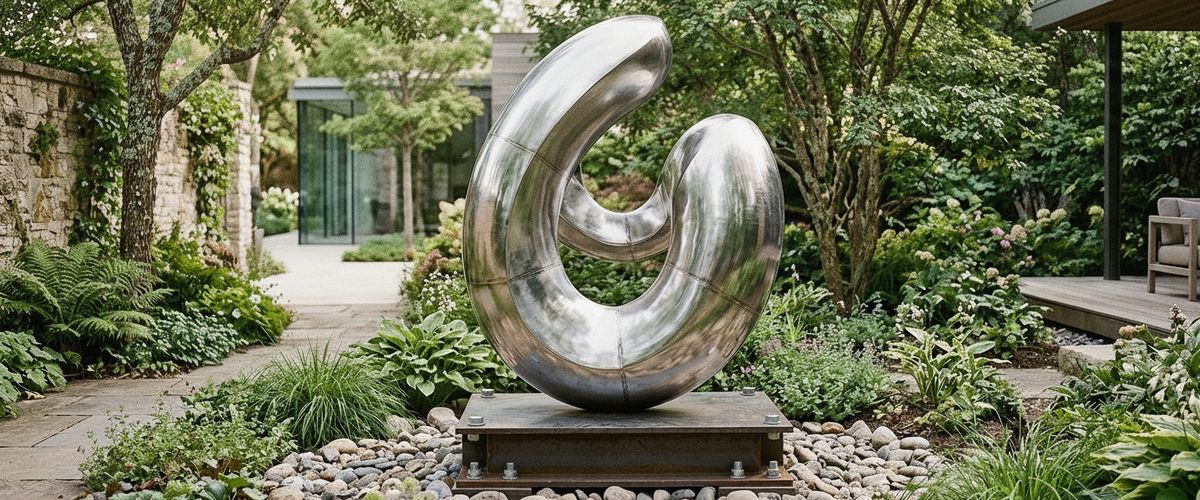

Most people judge a large stainless steel sculpture by its reflection. Most failures start somewhere nobody photographs: the internal frame, the weld schedule, and the plate bolted into the concrete. At Giant Sculptures we spend more studio hours on what sits behind the polished skin than on the skin itself. That hidden structure decides whether a piece still looks right after twenty winters.

Quick Answer
Structure comes first. The armature carries the load. The polished panels are cladding.
Panel size drives finish. Smaller, closely supported panels give a truer mirror than large sheets.
Expansion is real. Big outdoor pieces need joints that allow movement.
Grade follows location. Type 304 suits most inland sites. Type 316 is for coastal or road-salted sites.
Plan the install early. Lifting points and base plates should be designed into the frame before fabrication starts.
The Skin Gets the Photographs, the Armature Gets the Decades
A finished piece arrives as a single gleaming form, so it is easy to assume it is solid metal. It almost never is. A large stainless steel sculpture is usually a fabricated shell of formed panels welded over an internal armature of tube, plate and ribs. You see the shell. The armature resists wind load, carries the weight across long spans, and keeps the surface from slowly sagging out of true.
The armature before cladding: every rib sits where a panel seam will fall.
That split matters to buyers because the two parts of a stainless steel piece age differently. A scratched panel can be refinished. A frame that was undersized, or built from a lower grade than the cladding, is a structural problem hiding inside a cosmetic one. When we quote outdoor work, we settle frame material and wall thickness before we discuss the polish.

From Maquette to 3D Scan: Where the Frame Layout Is Decided
Every bespoke stainless steel commission starts as a maquette, a small model in clay, foam or printed resin that the client approves for proportion. We then 3D scan it and scale the digital model to full size. This is where the real engineering of a large stainless steel sculpture happens. On screen, the fabrication team slices the form into panels and draws the ribs that will sit behind each seam. That way the internal supports line up with weld lines and never float under open panels.
This is also the cheapest stage for changes. Lengthening a limb or tilting a head on a maquette costs an afternoon. Making the same change after the ribs are cut means rebuilding part of the frame. Designers and architects working to a site plan should bring that plan to this stage. Sightlines, approach angles and the height of surrounding planting all affect where the frame needs to be stiffest.
Why Smaller Panels Mean Fewer Ripples in a Mirror Finish
A mirror-polished sculpture is unforgiving. Any broad, gently curved area that the steel cannot hold rigidly will show oil canning, the soft wobble you notice when a reflected horizon line bends for no reason. The fix sounds backward: use more panels, make them smaller, and add more welds. Each panel is formed closer to its final curve, the ribs behind it sit closer together, and the welds are ground and polished back until they disappear.
Smaller panels, polished seams: the reflection stays true across the curve.
We learned this the hard way on an early polished commission. It looked perfect under the workshop's diffuse light, then showed faint ripples on the first sunny morning in the client's courtyard. Low raking sun finds every weakness, so we now inspect polished pieces outdoors at dawn before they ship. Glossy forms like our large balloon dog sculptures depend entirely on this discipline, because the curves only read as liquid when the panelling is tight.
Tall vertical work follows the same rule, and height makes it less forgiving. At around 320cm (about 10.5 feet), a design such as the White and Gold Blossom Columns Stainless Steel Sculpture - 320cm stays crisp because each bloom is built as a separate, rigid unit. A single long skin at that height would be far harder to keep true.

Thermal Movement: Giving a 30-Foot Piece Room to Breathe
Austenitic stainless steel expands by roughly 9.5 millionths of its length for every degree Fahrenheit it warms (about 17 per degree Celsius). Worldstainless, the industry body, publishes these figures. On a 30-foot (about 9 m) sculpture, a 100°F swing between a cold desert night and a sun-baked afternoon means about a third of an inch (8 to 9 mm) of movement from end to end. Polished steel in Texas or Arizona sun also runs much hotter than the surrounding air.
If you lock that movement into a long, rigidly welded frame, something gives. A seam cracks, a panel buckles, or stress collects at the base. We build larger pieces in sections joined with slotted or sliding connections hidden inside the form, so the skin can shift slightly against the frame without opening visible gaps. Smaller indoor pieces rarely need this. Any large stainless steel sculpture built for outdoor display, especially a long one, should have it.
304 Near a Road, 316 Near the Sea
Grade choice for a large stainless steel sculpture is mostly about the steel you never see. Type 304 performs well in most inland gardens and city plazas. Near the coast, or beside a road treated with de-icing salt, chlorides settle into crevices and onto internal surfaces where rain never rinses them off. Type 316 contains added molybdenum and resists that pitting much better. The Nickel Institute publishes practical guidance on matching grade to environment.
A coastal client in the Hamptons once asked us to build the visible shell in 316 and the frame in 304 to keep the quote down. We advised against it. The frame sits in damp, salty shade, which is exactly where corrosion starts, and mixing grades brings its own problems. The whole piece went to 316. If your site can see the sea or sits beside a winter-salted driveway, plan for 316 throughout.
Lifting Points and Foundation Plates Belong in the Frame
A large stainless steel sculpture is lifted at least three times: off the workshop floor, into its crate, and onto its foundation. Lifting eyes must connect to the armature, never to the cladding, and they need to be placed so the sculpture hangs level. We position them on the 3D model and then hide them under removable caps or inside the form.
The base works the same way. A welded foundation plate with pre-drilled anchor holes lets your contractor pour the concrete footing to a template weeks before delivery. Installation day then comes down to a crane, a few bolts and a level check. Modest pieces benefit from the same thinking: even at 130cm, a sculpture that arrives on a defined, bolt-ready base, like the Champagne Lion Column on a Steel Foot - 130cm, is far simpler to site than one that relies on its own weight to stay put. For anything taller than head height outdoors, ask for a structural engineer's sign-off on the footing.

What to Ask Before Buying a Large Stainless Steel Sculpture
What is the internal frame made of, and in which grade?
How large are the panels, and is every seam backed by a rib?
Is the piece sectioned for thermal movement and for shipping?
Where are the lifting points, and are they tied into the armature?
Does it come with a foundation plate and an anchor template?
Which finish (mirror, brushed or colored PVD) suits the site and the cleaning routine you can realistically keep up?
You can see finished forms in our stainless steel sculptures collection, or the wider outdoor sculptures range if you are still comparing materials. If you are planning a bespoke large stainless steel sculpture, send Giant Sculptures your site details, approximate scale and environment. Budget depends on grade, scale, complexity, engineering, installation and finishing, so we quote each commission individually. The earlier we see the site, the better the frame we can design for it.
For wider placement ideas, Large Stone Garden Sculptures Weigh More Than You Think is useful companion reading before finalizing the setting and sightlines.