
























































Most buyers get the weight wrong first. Large stone garden sculptures are chosen by height and admired in photographs, then they arrive measured in tons. Projects stall in the gap between those two units: a lawn that ruts under the delivery vehicle, a side gate eight inches too narrow, a terrace never designed for a concentrated load. Plan for the weight before you fall for the pose, and almost every later decision gets easier.

Quick Answer
Plan for weight before style. Granite and marble run roughly 165 to 175 pounds per cubic foot (about 2,650 to 2,800 kg per cubic meter). A figure on its plinth passes two tons quickly.
Build the base first. Pour a reinforced pad on footings below your local frost line, with drainage, and let it cure before delivery.
Survey the route, not just the spot. Gates, slopes and soft ground decide whether you need a telehandler or a crane.
Match the stone to the climate. Granite stays crisp. Limestone and sandstone soften and green faster.
Choose hand-carved for distance viewing. Tool marks hold shadow. Cast stone tends to flatten.
Why Large Stone Garden Sculptures Outweigh Every Guess
Stone is dense in a way the eye does not register. A solid block 3 feet square and 6 feet tall holds 54 cubic feet. In granite, that is around 9,000 pounds (roughly 4,100 kg) before the carver touches it. Even after a third or more is cut away, the finished piece is a multi-ton object, and the plinth adds more. That one fact sets your insurance, handling equipment, foundation spec and whether the piece can go on a roof terrace at all.
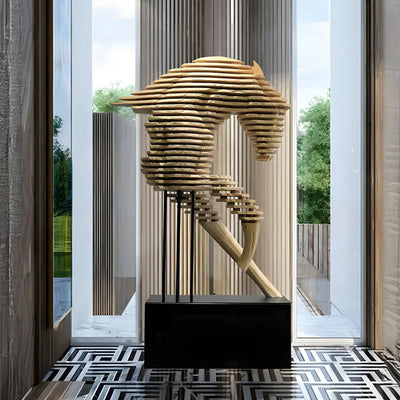
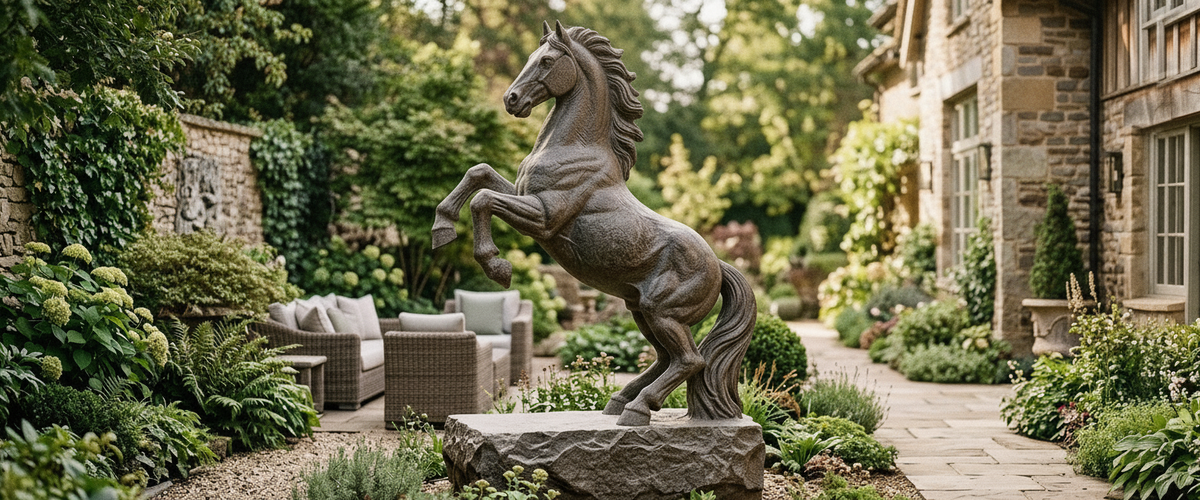
Height compounds it. An equine carving such as the Majestic Horse Black Marble Outdoor Sculpture, at 220cm (about 7 feet 3 inches), carries its mass high and through slender legs. That combination of tall pose and narrow contact points is exactly why a precise fixing plan and a level base matter: a slight tilt on soft ground can worsen into a real stability problem over several winters.

The Pad, Drainage and Frost Depth a Multi-Ton Carving Needs
The foundation should exist before the sculpture leaves our studio. For most large stone garden sculptures, that means a reinforced concrete pad on a compacted gravel sub-base, with footings taken below the local frost line. Frost depth varies enormously. A garden in Minnesota needs far deeper footings than one in Napa, so check with your local building department rather than copying a spec from another state.
A level, reinforced pad with drainage is poured and cured before delivery.
Drainage gets ignored more than anything else here. Water pooling against the base of a stone plinth wicks upward, and in freezing climates that moisture expands inside the pores. Slope the pad slightly, keep the gravel free-draining, and fix the sculpture with stainless steel dowels rather than relying on gravity alone. Concrete generally needs around four weeks to reach its design strength, so pour early. On terraces, decks or anything over a basement, get a structural engineer to sign off the load.
Gates, Soft Lawns and the Day a Crane Is the Easiest Route
Large stone garden sculptures travel crated, so measure the narrowest point on the route, then add the crate. That is your real constraint. Tracked carriers and ground-protection mats can cross a lawn without scarring it, but only on firm, dry ground.
One install in the Hamptons taught us to stop arguing with the obvious. The side gate was a few inches narrower than the crated piece, and the lawn had been irrigated the night before. A crane lifting over the roofline turned a full day of risky maneuvering into a short, controlled lift, and the turf survived untouched. In dense urban sites like Brooklyn brownstone gardens, a crane may need street permits, so budget time for that too.
When the gate is too narrow or the lawn is soft, a crane is often the safer route.

Limestone, Sandstone or Granite?
Each stone trades weight, weathering and crispness differently, and that choice shapes how a carved piece ages in your climate:
Limestone is lighter than granite and carves finely. It softens gracefully, collects moss and lichen, and is sensitive to acidic rain over decades.
Sandstone has warm color and porosity that greens quickly in shade. Correct bedding during carving matters; a face-bedded block can shed layers after hard freezes.
Granite is the heaviest and hardest to carve, but it holds sharp edges for generations. Fine detail reads slightly bolder than in softer stone.
Marble sits between limestone and granite in hardness, with polished or honed finishes that suit formal gardens in California and Texas. Like limestone, it is sensitive to acid rain, so expect a high polish to dull outdoors over the years. Biological growth is not always damage, and conservators at the Getty Conservation Institute study when it protects stone and when it harms it. Decide early whether you want patina or crispness.
Hand-Carved Versus Cast: What Reads at Thirty Paces
Reconstituted stone is crushed aggregate and cement poured into a mold. It is consistent and lighter, and it suits repeated balustrades or urns. Seen from across a lawn, though, its surfaces tend to go blank. Edges round off and there is little texture to catch low sun.
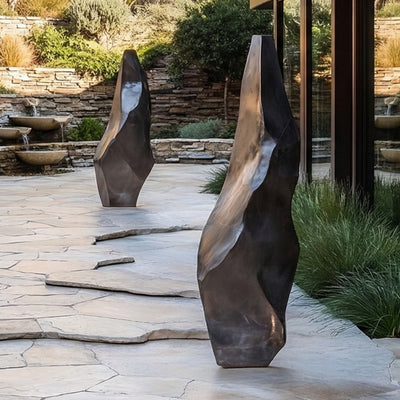
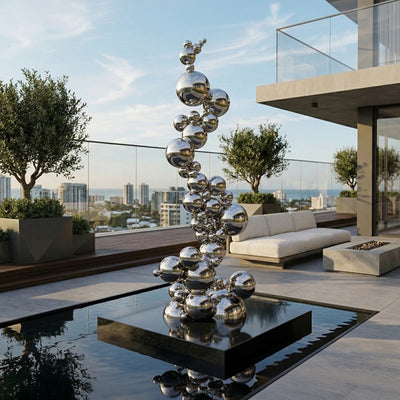
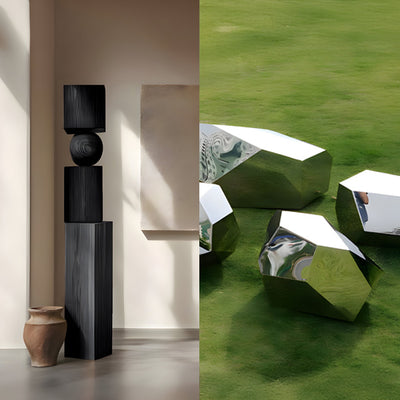
Hand-carved stone keeps the record of the claw chisel and the point. Those marks hold shadow, which is why a carved figure still has definition at thirty paces while a cast one reads as a silhouette. Where weight rules out stone entirely, say on a roof terrace or a deck without engineering headroom, a pebble-like form in polished steel such as Monoform Stone II Steel Sculpture keeps the organic, rounded silhouette of river stone at a fraction of the load.
Commissioning for One Site
For wider placement ideas, Large Eagle Statue in the Garden: Why the Perch Matters More Than the Bird is useful companion reading before finalising the setting and sightlines.
At Giant Sculptures, bespoke commissions for large stone garden sculptures start with a maquette, then block selection. We send photographs of the actual block, so you can see veining and any flaws before carving begins. For larger pieces, we recommend a full-height profile or mock-up placed where the sculpture will stand, viewed from the house, the drive and the far end of the garden. Sign-off happens there, not on a screen. Budget depends on stone, scale, complexity, engineering, installation and finishing, so ask us for a tailored quote. Our large garden statues are a useful way to compare heights and footprints before you brief a commission.

A Pre-Delivery Checklist
Confirm finished weight, including plinth, in writing.
Pour the pad below frost depth and let it cure fully.
Check drainage around the base after heavy rain.
Measure every gate, path and turn on the route.
Book ground protection or a crane, plus any permits.
Agree on fixing details and who handles final leveling.
Get those six right and the sculpture becomes the easy part. For smaller stone pieces that suit a terrace, see our garden statues.