






































































































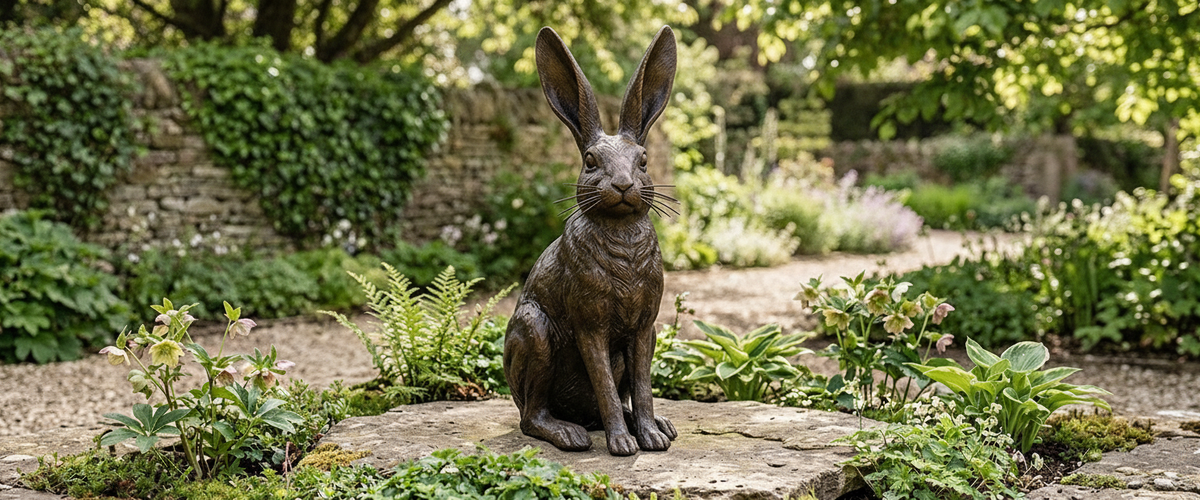

Leave a cheap rabbit statue outside for three winters and then look at the ears. Water creeps into hairline cracks, freezes, expands and snaps off the thinnest part of the figure. A bronze rabbit garden statue does not have that problem, which is why it is the version we recommend to anyone who wants the piece still looking alert in twenty years. Rabbits are small subjects, so every material weakness shows sooner and every casting shortcut is easier to spot.

At a Glance
Bronze holds thin ears, whiskers and toes that resin and concrete lose to frost and knocks.
Soft fur texture or blurred claws usually point to a tired mold or heavy-handed finishing.
Bronze is several times denser than resin or concrete, so even a small rabbit stays put.
Patina decides whether a small figure reads clearly or disappears into soil and lawn.
Place single rabbits at border edges and path verges, and group them with irregular spacing.
Why the Ears Go First on Resin and Concrete
Resin is light and cheap to mold, but sunlight breaks down its surface, and thin ear sections soften in summer heat and turn brittle in cold. Cast concrete is porous. Water wicks into the ears, and freeze-thaw cycles in Colorado or upstate New York finish the job. A bronze rabbit garden statue is cast in a copper alloy that does not absorb water or go brittle in frost, so the ears can be as thin as a real animal's without being fragile.
It is a familiar story in our studio: a client replaces a pair of concrete hares after both lose an ear in a single hard winter. The bronze pair that goes in their place typically needs nothing beyond an occasional coat of wax.
Thin, crisply cupped ears are where bronze outlasts resin and concrete.

Whiskers, Claws and Fur: Where Casting Quality Shows
This is where good foundries pull ahead. In lost-wax casting the wax model carries every hair line, and a good foundry chases the metal afterward to restore anything the pour softened. Whiskers are the hard test on any bronze rabbit garden statue. On a well-made piece they are cast as fine rods or cut crisply into the muzzle, never left as a blurred lump. The fur should follow the body, longer over the haunches and short and tight on the face.
Poses with movement raise the bar further. In a composition such as the Contemporary Sparring Rabbits Bronze Sculpture (60cm, about 24 in), raised paws and stretched bodies pull the fur taut, and that tension only reads if the texture survived casting. In our studio we check the inside of the ears first. If the shallow cupping there is crisp, the rest of the casting usually is too.
Weight Is Security for a Small Bronze Rabbit Garden Statue
A palm-sized resin rabbit can be pocketed by anyone walking past a front yard. Bronze is roughly seven times denser than typical resin and more than three times denser than concrete, so a small figure has real heft. That is usually enough to beat wind, curious dogs and casual opportunists. For pieces near a sidewalk or a hotel entrance, ask for a drilled and tapped base so the rabbit can be bolted to a stone plinth or buried footing. It adds little to the cost and removes the main worry with small outdoor bronze.
Brown, Verdigris or Left Alone: Patina at Rabbit Scale
On a monumental piece patina feels cosmetic. On a bronze rabbit garden statue it decides whether the sculpture can be seen at all. A warm mid-brown sits naturally against mulch and gravel and reads as a real animal at a glance. Verdigris greens look lovely beside pale limestone or a gray slate path but can vanish into lawn. Unprotected bronze darkens outdoors and slowly picks up greens and streaks over the years, which suits a meadow planting better than a clipped border. Whichever you choose, a thin coat of microcrystalline wax once or twice a year keeps the color even.

Place It Where a Real Rabbit Would Sit
For wider placement ideas, Garden Bronze Keeps a Calendar: How to Clean Outdoor Bronze Sculptures is useful companion reading before finalizing the setting and sightlines.
Wild rabbits rarely sit in the middle of open grass. According to the University of Michigan's Animal Diversity Web, eastern cottontails favor edge habitat, feeding where cover meets open ground so they can bolt. A bronze rabbit garden statue placed the same way looks believable: at the front of a perennial border in the Hamptons, at the bend of a gravel path, or where an Aspen lawn runs into a hedge.
Set at a border edge, a small bronze rabbit looks as if it has just paused to feed.
Entrances are the exception. Beside a front step, a rabbit with something to do holds attention better than a plain seated figure. A piece like the Traditional Rabbit with Lantern Bronze Sculpture (50cm, about 20 in) suits that spot because the lantern gives it a job and a reason to be noticed. Wherever it goes, keep a small rabbit near the walking eye line. At thirty feet (about 9 m) across a lawn, a 14 in (35cm) figure becomes a dot.
One Rabbit or Three? Getting the Spacing Right
One rabbit half-hidden in the hostas looks as if you caught it in the act. Three identical rabbits in a row look like a garden center display. If you want more than one, vary the poses and break the rhythm: a pair close together, a third set a few feet back at an angle. If you would rather not compose the group yourself, a single casting such as the Contemporary Five Rabbit Bronze Sculpture (80cm, about 31 in) has the spacing and contrasting postures already cast in. For separate figures, look through our rabbit and hare statues and choose contrasting postures.

Buyer Checklist Before You Order
Ask for close-up photos of ears, whiskers and toes.
Confirm it is solid cast bronze. "Cold cast bronze" is resin mixed with metal powder.
Check whether the base can be drilled and tapped for fixing.
Pick the patina against the ground it will sit on, not the product photo.
Measure the main viewing distance and scale up if it will be seen from a terrace.
Plan any group as a composition before ordering multiples.
Commissioning a Bespoke Rabbit
Many pieces in our bronze rabbit and fox statues collection can be adapted in patina or scale, and plenty of clients go further: a portrait of a family's pet rabbit, a hare enlarged for a hotel courtyard, or a matched pair modeled for a specific border. As a bespoke sculpture supplier, Giant Sculptures prices each rabbit commission on scale, complexity, engineering, installation and finishing, so the useful first step is a tailored quote with a few photos of the site. For companion pieces, our bronze garden statues are a good place to keep looking.