











































































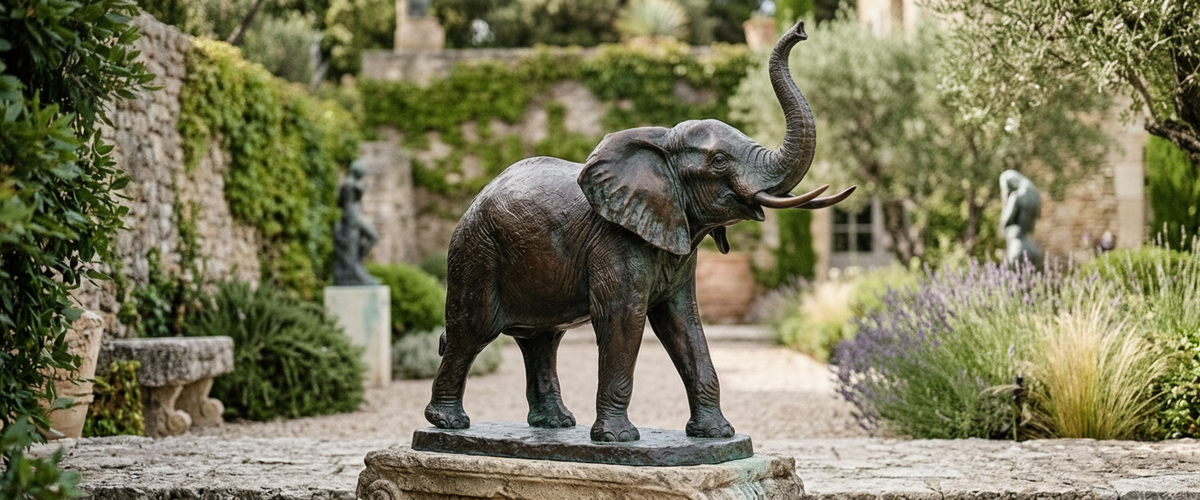

Set a bronze elephant statue on a good-looking summer lawn and it will please everyone for about three weeks. Then the first serious rain arrives, the soil softens under four bearing points the size of dinner plates, and one front foot drops a half inch further than the others. Nobody notices the tilt straight away. They notice that the piece has stopped looking calm. Weight is the whole story with a bronze elephant statue, and it is the part most buyers plan for last.

Key Takeaways
Lawn and soft borders are the worst hosts for a heavy bronze elephant statue; compacted gravel over a proper sub-base is one of the best.
Footings should reach below your local frost line, not just below the topsoil.
A plinth changes how heavy the animal reads. Raise it and mass turns into presence; keep it low and you get intimacy.
Indian ceremonial styling and African naturalism distribute weight very differently across the feet.
Measure the tightest turn on the delivery route, not just the gate width.
Splashback at ankle height is why so many outdoor bronzes go green from the feet up.
Why a Bronze Elephant Statue Sinks Into Lawn and Sits Happily on Gravel
Bronze is dense. A large bronze elephant statue concentrates several hundred pounds (well over 150 kg, and often far more at monumental scale) onto four contact patches. Turf sits on living, breathing soil that swells and shrinks through the year, so those patches act like slow-motion post drivers. Compacted gravel over a crushed stone sub-base spreads the load, drains fast, and does not heave the way clay does.
Compacted gravel over a crushed stone sub-base spreads the load and drains fast.
If a lawn setting is non-negotiable, the answer is a buried pad flush with the grass line, wide enough that the mower passes over it cleanly. We have done this for clients in the Hamptons who wanted the animal to look as though it had simply walked out of the hedge. It works. It just has to be poured before the bronze elephant statue arrives, not after someone spots the lean.
Footings, Pads and Frost Depth
The rule that catches out bronze elephant statue buyers in Aspen, Chicago and upstate New York is frost depth. Water in the ground expands as it freezes and lifts anything sitting above it, which is why residential foundation guidance ties footing depth to the local frost line rather than a single national number (see the International Residential Code foundation provisions). A pad poured 8 inches (20 cm) down in Texas may be fine. The same pad in Colorado will tip your elephant over three winters.
Ask your installer for three things: pad thickness, reinforcement, and how the sculpture ties down. Cast bronze animals are usually fixed with stainless steel studs epoxied into the slab, which stops both movement and theft. We specify stainless rather than galvanized because dissimilar metal contact in wet ground is a slow, invisible problem.

Plinth Height Versus Trunk Height
Here is the design decision that changes everything and costs nothing to think about early: how high do you lift it? A ground-set bronze elephant statue invites touch. Children put a hand on the trunk, guests walk the full circle, and the piece feels like an animal in the garden. Put the same casting on a tiered stone base and it becomes architecture. Mass drains downward into the plinth and the silhouette reads against the sky instead of the shrubs.
Raised on a stepped base, the same casting reads as architecture rather than wildlife.
Tiered plinths do a lot of quiet work for heavy animal subjects. Where a stepped stone base carries the figure, as it does under the Large Traditional Chinese Guardian Lion Bronze Sculpture (Tiered Greek Key Plinth) - 140cm, the eye gets somewhere to land before it reaches the animal, and the whole composition feels intentional rather than dropped. Apply the same logic to an elephant and watch how the raised trunk suddenly has room to breathe.
Indian Ceremonial Casting or African Naturalism
These are two different sculptures wearing the same name. A bronze Indian elephant statue tends to carry ceremonial detail: caparison cloth, bells, a howdah, a broad forehead and smaller ears. All that surface ornament adds metal high on the body, which raises the center of gravity and puts more load through the rear feet if the animal is posed stepping forward.
African naturalism goes the other way. Big ears, deeper flank hollows, more open leg positions, and a pose that often distributes weight across all four feet more evenly. For exposed sites, that wider stance is genuinely easier to anchor. For courtyards and entrance forecourts where you want ornament and symmetry, the ceremonial version earns its keep. Browse the range in bronze elephant statues with that split in mind and the shortlist gets short fast.
Delivery Day Arithmetic
Gate width is the number everyone measures. The turn is the number nobody measures. A crate can clear a 6 foot (1.8 m) opening and still be defeated by the 90 degree pivot two yards past it, because the crate is rigid and the path is not.
Before we ship large bronze elephant statues, we ask for the full route: driveway gradient, overhead cables, tree canopy, soft verge that a machine will sink into, and the crane arc if lifting over a wall. On a Napa install we ended up craning across a pergola because the side return narrowed by 4 inches (10 cm) at a downpipe nobody had mentioned. That single detail added a machine to the day. Once you are working at the scale of something like the Monumental Classical Falconer and Bird of Prey Bronze Sculpture - 450cm at 450cm, access planning starts at the road rather than the garden gate.

Splashback Is Why the Patina Goes Green From the Feet Up
Look at neglected outdoor bronzes and you will see the same pattern: a warm brown body and pale green legs. Rain hitting hard paving bounces mineral-laden water back onto the lower 12 inches (30 cm) of a bronze elephant statue, over and over, and that repeated wetting drives corrosion faster than anything falling from above. Gravel, planting or a slightly proud plinth all break the splash cycle.
Care is otherwise straightforward. Rinse with clean water, dry, and apply a microcrystalline wax coat once or twice a year, more often in coastal salt air; museum metalwork guidance from the V&A on caring for metalwork covers the principle well. Wax before winter, not in it. Water features raise the stakes again. Where water and metal share a footprint, as they do in a piece such as the Large Traditional Crane Pair Bronze Fountain - 190cm, the lower body never fully dries, so the wax cycle has to be more frequent than it would be for a dry-set animal on gravel.
Small and Antique Bronze Elephants Indoors
Indoors, the conversation changes from footings to floor loading. A small bronze elephant statue on a console table is fine; a cluster of solid castings on an antique writing desk is not, and neither is a heavy floor-standing piece placed mid-span on an older timber joist floor. Set weight over a joist line or near a bearing wall, and use a felt pad to protect stone hearths.
Antique bronze elephant statue collectors tend to buy in groups, and bronze baby elephant statues are the natural companion pieces: a parent figure with two calves reads far better than three matched sizes in a row. Keep them away from radiators and direct sun through glass, both of which dry out old wax coatings. If you want the same subject at architectural scale later, the large bronze sculptures collection is where the indoor habit usually escalates.

Buyer Checklist
Confirm the ground type at the exact spot where the bronze elephant statue will stand, not the general garden.
Check your local frost depth before agreeing a pad specification.
Decide plinth height against the eye level of the main viewing point.
Choose ceremonial or naturalistic styling before you compare sizes.
Measure the tightest turn, lowest branch and softest verge on the route.
Plan splash control at ankle height on paved settings.
Agree fixings, lifting points and who supplies the machine.
Book a wax cycle into the garden calendar, ideally before first frost.
Commissioning a Bespoke Bronze Elephant
Most of the bronze elephant statues we make to order start as a site problem rather than a style preference: a forecourt that needs a focal point at a specific height, a pair flanking a gate where symmetry matters, or a family group scaled to a lawn that will not take a single heavy casting. Bespoke work lets us set the pose, the stance width, the patina tone and the fixing detail together, which is far easier than adapting all four afterwards.
Budget depends on scale, wall thickness, casting complexity, plinth work, finishing and installation, so the sensible next step is a tailored quote against your site photographs and measurements. Send us the awkward corner too. That is usually where the real design decision lives. You can also see how bronze behaves across other subjects in our bronze garden statues range before settling on a final direction.
For wider placement ideas, What Nobody Tells You Before Buying a Bronze Dog Statue is useful companion reading before finalizing the setting and sightlines around your bronze elephant statue.