





































































































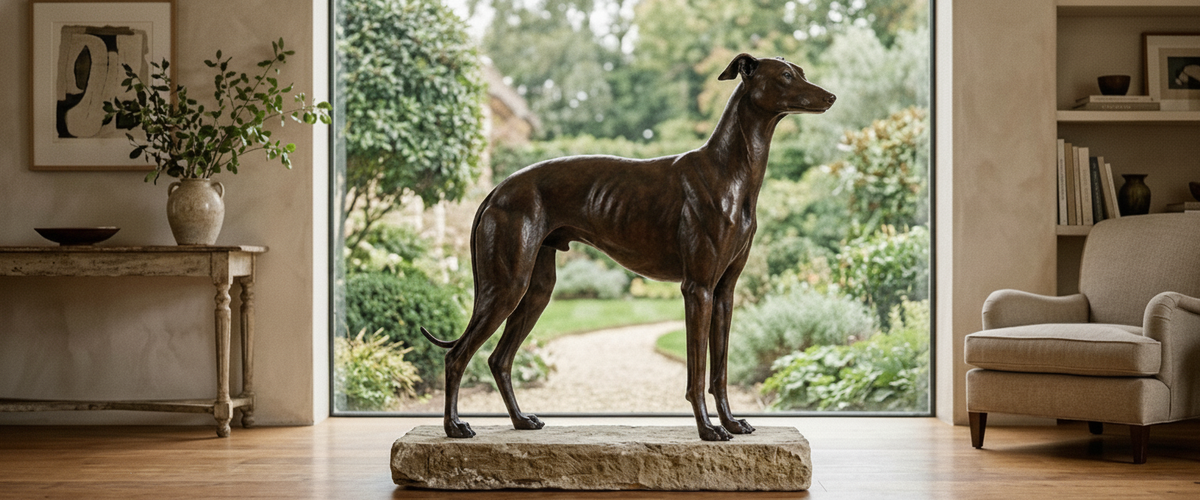

Two bronze dogs can measure exactly the same at the shoulder and look nothing alike from the top of a driveway. That is the trap. Most people shop for a bronze dog statue by height, because height is the number listed on the page, and then wonder why the piece that looked commanding in photographs reads as a garden ornament once it is sitting on real ground. Height tells you almost nothing about how a bronze dog statue will land on site. Volume, stance and where the eye line falls tell you everything.

Key Takeaways
Breed silhouette drives presence. A greyhound and a mastiff at identical height occupy wildly different amounts of air, so judge a bronze dog statue by volume rather than by the shoulder measurement.
Stance decides legibility. Seated and alert poses read further across open ground than a walking pose.
Life-size dogs sit low. Most need a plinth, but a low one; over-lifting kills the illusion.
Foo dogs are not dogs. They follow sculptural convention, which changes how you pair and place them.
Patina should fight the ground, not match it. Dark brown vanishes on shaded lawn; it sings on pale gravel.

Breed Volume Beats Height Every Time
Put a bronze greyhound and a bronze mastiff side by side at 32 inches (81 cm) at the shoulder. The two bronze dog statues could not behave more differently. The greyhound is all negative space: a deep chest, a tucked waist, four thin legs and daylight everywhere between them. The mastiff is a solid block with a head on it. From 60 feet (18 m) away, the mastiff still reads as an object; the greyhound reads as a line drawing and needs either a bigger scale-up or a clean backdrop to hold its shape.
This is why bronze greyhound dog statues work best against a hedge, a rendered wall or a still pool, where the outline gets a contrasting field to sit against. Drop the same piece into mixed herbaceous planting and the legs disappear by midsummer. Broad-bodied breeds are far more forgiving. If you want a bronze dog statue in a planted border rather than on hard landscaping, favor mass over elegance, or budget for a taller cast.
A lean breed needs a plain backdrop before the outline can do its work.

Standing, Sitting, Alert: The Three Stances That Carry Distance
Seated is the workhorse. A bronze dog statue in a seated pose gives you a stable triangular silhouette, a raised head and a footprint that mounts easily, which is why seated hounds have flanked entrance steps for centuries. Standing alert, with the head turned and one paw lifted, carries narrative and looks superb at the end of an axis, but it is directional; it must be aimed at something worth looking at. A walking pose is the hardest to place well because it reads as mid-action and can look aimless unless there is a path, gate or arrival point it is clearly heading toward.
Figurative groups behave differently again. A composition such as the Traditional Boy and Dog Bronze Sculpture - 150cm holds together because the dog has a reason to exist within the scene, so the eye travels to the interaction rather than to the animal alone. Where a site needs that narrative at monumental scale instead of domestic scale, a piece like the Monumental Soldier and German Shepherd Bronze Sculpture - 300cm puts the emotional weight of the commission on the dog rather than leaving it as decoration at someone's ankle.
The Ankle-Height Problem
A life-size bronze dog statue of a retriever is roughly knee-high on an adult. Set it straight onto turf and two things happen: the grass swallows the paws, and everyone looks down at it. A plinth fixes both, but the instinct to lift it 3 feet (0.9 m) is almost always wrong. That turns a dog into a trophy.
Our rule of thumb is to lift only enough to clear planting and mowing height, typically 8 to 16 inches (20 to 40 cm), on a base slightly narrower than the animal's footprint so the plinth reads as ground rather than furniture. On gravel, a flush stone pad often beats a plinth entirely. On a terrace in Scottsdale we set a pair directly onto the paving with concealed pins, and the client's first comment was that the dogs looked like they had wandered out and stopped.
Lift only enough to clear the planting line, then stop.

Bronze Foo Dog Statues Follow Convention, Not Anatomy
Bronze foo dog statues are lions, not dogs, and they answer to a design tradition rather than to a breed standard. That changes the rules. They are almost always specified as a male and female pair placed as guardians flanking an entrance and facing outward: the male with a paw resting on a brocade ball, the female with a paw over a cub. Where the setting is formal and the entrance needs guarding rather than softening, a cast supplied with its own tiered base, such as the Large Traditional Chinese Guardian Lion Bronze Sculpture (Tiered Greek Key Plinth) - 140cm, is closer to the right design language; unlike a naturalistic bronze dog statue, guardian lions expect elevation. The National Museum of Asian Art holds strong examples of the form if you want to understand the iconography before specifying a pair.
Split a pair across a driveway and keep the spacing tight enough that both stay in one field of view. Two guardian lions 40 feet (12 m) apart stop being a pair and start being two lonely statues.
Commissioning a Custom Bronze Dog Statue
A custom bronze dog statue lives or dies on reference material, and the photographs owners naturally take are the wrong ones. A client in Marin County once sent forty images of her whippet. Every one was a portrait of the face. Not a single shot showed the feet.
What a sculptor actually needs: profile shots from both sides at the dog's eye level, a straight-on front and rear, a clear overhead if you can manage it, and close-ups of the head from three angles. Add video of the animal walking and settling, because gait tells the modeler how weight sits. Include a measured reference in frame, such as a ruler or a tennis ball. Note the quirks in writing too, the ear that folds, the scar, the tail carriage, because those are what the family will look for when the finished bronze dog statue arrives.
Expect a clay maquette for approval, then a full-scale clay before molding and pouring. Budget depends on scale, complexity, foundry time, patina work and installation, so ask for a tailored quote rather than working from a headline figure.

Patina Color Against Your Ground
Chocolate and dark brown patinas are the default for a reason; they read as traditional bronze and they age gracefully. They also disappear against a shaded lawn or a dark yew hedge. On pale gravel, limestone paving or a snow-prone site in Aspen, a dark finish on a bronze dog statue is exactly right. Against deep green or in heavy shade, a lighter brown with flecked verdigris or a highlighted green gives the form somewhere to catch light.
All exterior patinas move over time, which is expected rather than a fault. Regular waxing slows the change and protects the surface; the National Gallery of Art's sculpture conservation team is a good reference on how coatings protect outdoor metalwork. Coastal salt air accelerates everything, so plan on more frequent maintenance on a shoreline site than in a dry inland garden.
Foundry Tells: Reading a Casting Before You Buy
Before you commit to a bronze dog statue, look at the paw contact points. On a well-made cast, the pads meet the base with clean, even contact and no filler bridging a gap. Then run your eye along the seam lines where mold sections met. They should be chased back until they follow an anatomical line, not left as a raised ridge running up a shoulder. Inside the ear, under the jaw and between the toes are where hurried finishing shows.
Weight distribution matters as much as detail. A dog with three paws down and one raised has a genuine engineering problem, and a serious foundry solves it with internal armature and hidden fixings rather than by thickening the raised leg until it looks swollen. Ask how the piece anchors before it ships.

Buyer Checklist
Measure the viewing distance from the main approach, then size for that, not for the room in the photograph.
Check the backdrop; slim breeds need contrast behind them.
Decide direction of gaze before you decide pose.
Keep plinths low and narrower than the footprint.
Confirm anchoring method, fixing points and lifting arrangements for delivery.
Match patina to ground color and light levels, not to a mood board.
For pairs, confirm they are cast as mirrored partners rather than two identical casts.
Giant Sculptures works across bronze, stainless steel, Corten and stone at scales most suppliers will not attempt, and dogs are one of the most requested bespoke subjects we handle. Browse the bronze dog statues collection for finished pieces, the wider dog statues and sculptures range for other materials, or send us reference photographs if the dog you have in mind only exists in your own back yard.
For wider placement ideas, A Large Bronze Horse Sculpture Needs Room to Move is useful companion reading before finalising the setting and sightlines.