
















































































The most expensive mistake in carved timber is invisible from six feet away. If you are browsing a large wooden sculptures sale, online or in a showroom, the photos will show you pose and finish. They will rarely show you a glue line, the direction of a check, or how a horn was fixed to a skull. Those details decide whether the large wooden sculptures for sale on your shortlist last for decades or split in their second winter.
At a glance
Laminated blocks are fine when disclosed. Hidden lamination is the problem.
At large scale, the timber species shapes longevity more than the carver's skill.
Fine checks that follow the grain are normal. Cracks that cross grain or run through a joint are not.
Fully exposed outdoor placement is the hardest test for any wood, in either UK or US climates.
A serious seller can tell you the weight before the piece ships.

Single Trunk or Laminated Block? Look for the Glue Lines
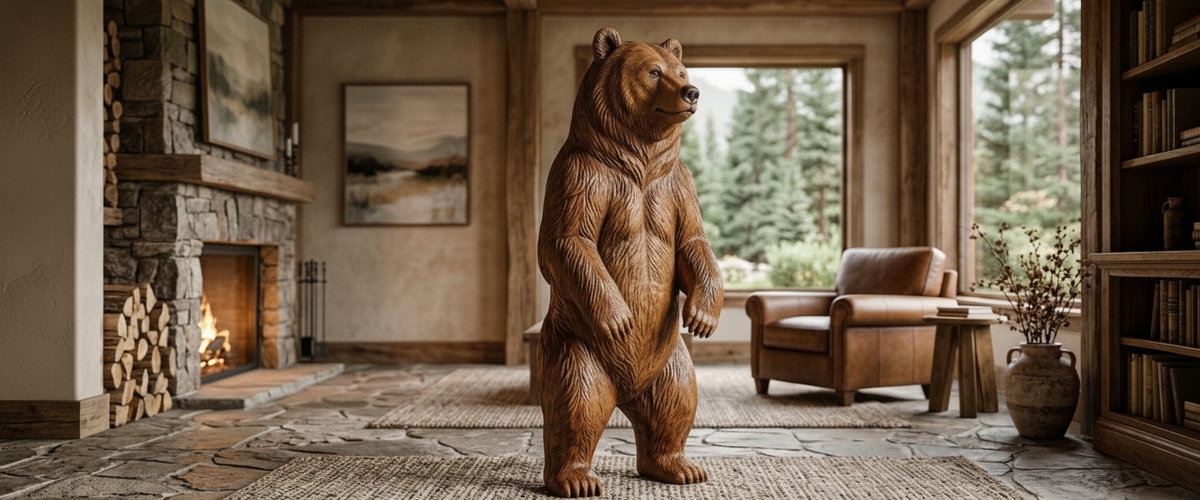
Few trees are wide enough to yield a big carved bear or a life-size figure from one piece, so many carvings start as boards glued into a block. That is a legitimate technique. What matters is whether the seller tells you, and whether the glue-up was done with properly dried stock.
Look at the piece under low, raking light. Glue lines show as dead-straight seams that ignore the form, often with an abrupt shift in grain pattern or color on either side. Run a hand across the seam: any ridge suggests the boards have moved at different rates. It is a familiar story: a teak bear sold as "single-trunk" arrives, and a flashlight held at a low angle reveals three parallel stripes running clean through the torso. None of the listing photos showed them. Ask the question directly, and get the answer in writing.
Low, raking light makes laminated seams easy to spot.
Oak, Cedar, Teak and Suar: At Large Scale, Species Matters More Than the Carver
A gifted carver cannot stop a poor choice of timber from moving. The bigger the piece, the more internal stress it carries, so species becomes the main predictor of how large wooden sculptures behave once they leave the workshop.
Oak is dense and strong but checks dramatically as it dries. Its tannins also react with iron, leaving black stains around steel fixings.
Cedar is light and naturally rot-resistant, yet soft enough to dent when moved carelessly.
Teak carries natural oils that help it shed moisture, which is why it earned its reputation in boatbuilding. The Wood Database entry on teak covers its density and durability ratings.
Suar (monkeypod) yields wide slabs, which makes it popular for big Indonesian carvings. When it has not been dried thoroughly, it moves a great deal.
Checks and Splits: Honest Character or Structural Warning?
Almost every large carving shows fine radial checks as the surface dries faster than the core. These are narrow, follow the grain, and open and close slightly with the seasons. They are part of the material.
Warning signs look different. A simple test: slide a business card into any crack you are unsure about. A check that barely takes the card's edge is cosmetic. Treat a crack as structural if it:
runs across the grain rather than along it
passes through a joint or a narrow load-bearing point such as an ankle or neck
has widened noticeably since the piece was photographed
shows soft fibers or dark staining inside, which can indicate rot
A narrow check running with the grain is cosmetic, not structural.

Separate Legs, Horns and Tails on Big Carved Animals
Grain runs one way through a trunk. A stag's antlers branch in several. Carving thin projections from the main block leaves short grain that snaps, so on big animals good makers carve legs, horns and tails separately and join them.
A good joint is a mortise and tenon or a hardwood dowel, ideally with the grain of the part aligned along its length. The seam should be tight, with no putty packed into a gap. You should see no screw heads. On oak, any metal pin should be stainless steel, never mild steel. Ask how each limb is attached, and be wary of a seller who cannot answer.
Indoors, Under a Canopy or Fully Exposed: The Honest Limits
Indoors, the enemy is dry air. Forced-air heating in a New York apartment or an Aspen chalet in January can open checks fast. Keep big timber away from radiators and vents, and aim for steady humidity. The Canadian Conservation Institute publishes clear guidance on how relative humidity affects wooden objects.
If the room simply cannot hold steady humidity, it can make sense to keep timber to the base rather than the whole form. A cast resin piece raised on a wooden stand, such as the Clear Russet Leaf Rippled Cliff Rock Resin Sculpture - 80cm, keeps the warmth of grain in view while leaving very little wood exposed to the seasonal movement that troubles a solid carving.
Under a canopy, such as a covered Texas porch or a loggia in the Hamptons, teak and cedar can do well. Raise the piece on a plinth so it never sits in standing water, and plan to re-oil it periodically.
Full exposure is where honesty matters. British rain and North American freeze-thaw cycles will gray, check and eventually degrade any timber. If you want a permanent piece on an open lawn, ask about casting a carved original in bronze, or commissioning the form in Corten or stainless steel. Giant Sculptures handles many outdoor commissions this way, and the wider sculpture collection is a useful place to compare how those metals read against timber at garden scale.
What a 6.5-Foot Carved Figure Weighs, and Why It Matters
Weight is roughly volume multiplied by density. Dried cedar sits near 23 lb per cubic foot (about 370 kg/m³). Teak and suar come in closer to 37 to 41 lb (about 600 to 655 kg/m³), and oak is heavier still. A solid 6.5-foot (2 m) figure can easily reach the low hundreds of pounds before crating. Wood that has not fully dried weighs considerably more.
That number decides the freight class and whether the piece fits a stair turn. It also decides whether your floor needs checking and how many people the install requires. At any large wooden sculptures sale, a seller who has not weighed a piece has probably not crated many like it.

Large Wooden Sculptures for Sale: A Buyer's Checklist
Before you commit to any of the large wooden sculptures for sale on your list, confirm:
Single trunk or laminated, stated in writing.
Species, and how and for how long it was dried.
Close-up photos of every visible check, under raking light.
How each projecting limb is joined.
Intended placement, matched honestly to the species.
Weight, crated dimensions and the delivery method.
If a seller at a large wooden sculptures sale cannot answer those questions, a commission often can. Talk to Giant Sculptures about scale, species and whether timber, bronze or engineered metalwork suits the spot you have in mind. Budget depends on material, scale, complexity, engineering, installation and finishing, so ask for a tailored quote.
For wider placement ideas, How a Large Bronze Sculpture Is Really Built, and What the Seams Tell You is useful companion reading before finalising the setting and sightlines.