






































































































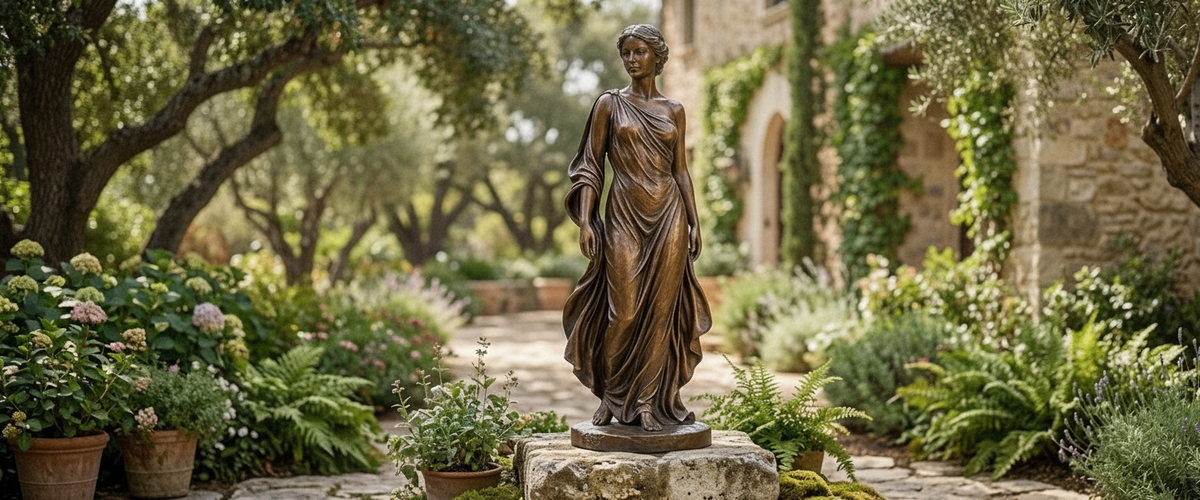

Every large bronze sculpture you have ever admired is a quiet deception. It reads as one continuous form, yet it was poured in pieces, welded back together and chased until the joins disappeared. How well that last step was done decides whether the piece still looks right in twenty years or starts showing its scars after the first hard winter.
At Giant Sculptures we spend a surprising amount of time on seams. Here is why buyers should too.

Quick Answer: What to Know Before You Buy
Life-size and larger bronzes are cast in sections, often many of them, then welded and hand-finished.
Good foundries place joins along drapery folds, muscle lines and natural breaks in the form.
A color mismatch over a weld usually means the chasing or patina was rushed.
Wall thickness and the internal armature drive weight, and weight drives cost, shipping and installation.
Sectional construction lets a big piece pass through gates a single casting never could.
Why No Foundry Pours a Large Bronze Sculpture in One Go
Lost-wax casting works because molten bronze fills a thin, even cavity left behind by burnt-out wax. A large bronze sculpture amplifies every risk in that process. Metal cools unevenly over long runs, gas gets trapped, and the ceramic shell can crack under its own load. So the foundry cuts the wax model into manageable sections before casting.
A life-size standing figure might be split at the head, arms, torso, legs and base. A large bronze dog sculpture with an extended tail and a raised paw can need more pieces than its size suggests, because every projection becomes its own pour. Count matters less than planning. Ten well-placed sections beat five careless ones.

Where a Skilled Foundry Hides the Joins
The best metal chasers think like tailors. They put seams where the eye already expects a line: the underside of a drapery fold, the furrow between two muscle groups, the point where fur changes direction across an animal's flank. Weld beads are ground back, surface texture is re-cut by hand, and the sculptor's original modeling marks are carried across the join so the eye has nothing to catch on.
When you look through our large bronze sculptures, try this test. You should be able to work out where a section must be, and still not find it.
The Color Shift That Gives a Rushed Patina Away
Weld filler is not quite the same alloy as the cast bronze around it, so it takes chemical patina slightly differently. A careful patineur compensates, building color in thin heated layers until the weld zone matches. A rushed job leaves a faint band, lighter or greener than its surroundings, tracing the seam like a scar.
Indoors that band can stay subtle for years. Outdoors, rain and UV exaggerate it. We once took a call from a collector in Westchester whose secondhand bronze had developed pale stripes across both shoulders within two seasons; the original foundry had patinated over unfinished welds. Refinishing was possible, but only by stripping the whole figure. On large outdoor bronze sculptures, this is the most common flaw we see, and the most avoidable.

Same Height, Double the Weight: What Sits Behind the Quote
Two bronzes can stand at the same height and differ hugely in weight. The reason is wall thickness. Thin-walled casting saves metal, but it dents, rings hollow when tapped, and gives welds less material to bite into. A properly specified large bronze garden sculpture typically has heavier walls than the bare minimum, plus an internal stainless steel armature that ties sections together and carries loads down into the base fixings.
Moving from walls of roughly 1/4 inch (6 mm) to something more substantial can add hundreds of pounds (well over a hundred kilograms) to a single figure. That extra weight changes crating, freight, lifting gear and foundation design. It is why we never price from a photo. Budget depends on material, scale, complexity, engineering, installation and finishing, and a tailored quote is the only honest number.
Weight also tells you when cast bronze is the wrong answer. On a Manhattan roof terrace with a strict load limit, a bronze-finish fibreglass piece such as the Quoin Bronze Reeds Sculpture - 400cm, which rises to about 13 feet (4 m), delivers vertical presence without asking a structural engineer to reinforce the slab.
Sectional Casting Is an Advantage When Access Is Tight
Sections are not only a compromise. For one Napa estate, the only route into a walled courtyard was a gate a little over four feet wide. A one-piece casting would have needed a crane over the roofline. Instead the figure shipped in crated sections, rolled through the gate on a pallet jack, and was reassembled on site, with the final seams chased and patinated in place.
Mixed-material work follows the same logic. Where bronze is combined with stainless steel and acrylic, as in the Bronze Stainless Steel & Acrylic Boat Sculpture - 150cm, each material is fixed differently, and contact points between bronze and steel need isolating to prevent galvanic corrosion, so crating and assembly have to be planned around every component. Tell us about stairwells, gates and elevator sizes early. They shape how we split the casting.

Buyer Checklist: The Seam Review We Insist On
Before any large bronze leaves the foundry, we review it against this list. Ask any supplier for the same:
Weld photos: every join shot in raking light, before and after patina.
Texture continuity: modeling marks carried cleanly across each seam.
Wet test: no color banding when the surface is wetted, since water exaggerates patina differences.
Specification: written confirmation of wall thickness and armature material.
Drainage: weep holes in any cavity that could hold water, which matters for animal forms among our bronze garden statues.
Fixing plan: anchors matched to the base and site, signed off before crating.
Commissioning a Bronze Built for Long Ownership
Whatever the subject, the goal is the same: a large bronze sculpture that will outlast its first owner. Look through our bronze animal sculptures for proportion and pose, then talk to us about a bespoke commission. Bring site photos, access measurements and a rough sense of scale. We will tell you how many sections the piece needs, where the seams will sit, and what the finished weight means for your garden or venue.
For wider placement ideas, Why Large Resin Garden Sculptures Blow Over, and How to Anchor Them is useful companion reading before finalising the setting and sightlines.