






































































































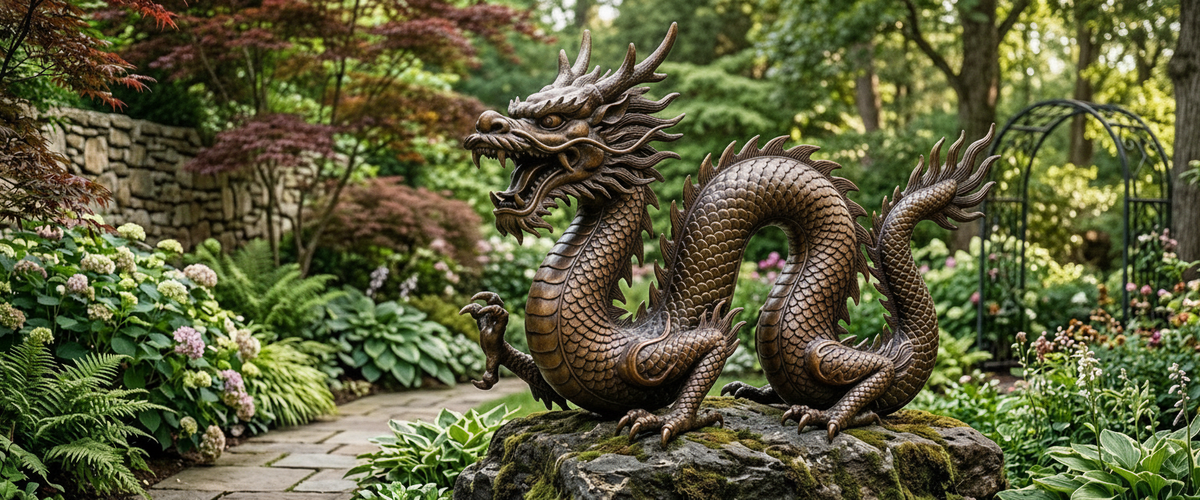

Two bronze dragons can look identical in a photograph, share a pose and a listing title, then age in completely different ways once they are bolted down outside. A bronze dragon garden statue is one of the hardest subjects a foundry can cast well. It has thousands of overlapping scales, a spine that runs the full length of the body, and a gaping jaw full of undercuts. Each of those details is a place where the maker either took care or took a shortcut, and you can read most of it before you buy.

Key Takeaways
Scales: sharp, individually defined scales point to a fresh mould and hand-chased wax.
Seams: visible lines along the spine or under the tail mean welds were left unfinished.
Walls: a thin cast rings tinny when tapped and dents under impact.
Joints: separately cast horns and whiskers need full welds, not surface tacks.
Patina: a good hot patina is even in deep recesses; a cheap one pools or looks painted.
Lifespan: a well-cast bronze dragon garden statue lasts generations outdoors, while resin fades and cracks.
Crisp Scales Versus Soft Scales: What the Detail Tells You About the Mould
Scales are the fingerprint of the mould. In the lost-wax process, a wax copy is pulled from a rubber mould, chased by hand, then invested and burned out before the metal is poured. Every wax pulled from a tired mould loses a little definition, so a foundry pouring its hundredth dragon from the same rubber produces scales that look melted at the edges. Good scales have a crisp leading edge and a clean shadow line beneath each one. Soft, blurred scales that merge into a general texture mean a worn mould or wax nobody bothered to chase.
Sharp leading edges and clean shadow lines where the scales change size.
Look hardest where the scales change size, around the shoulders and the base of the tail. That transition is difficult to sculpt and harder to cast. It tells you more than the broad flank ever will.
Seam Lines Along the Spine and Tail
Large dragons are cast in sections and welded back together. That is normal, and any honest foundry will say so. What matters is whether the welds were chased, meaning ground back and re-textured by hand so the scale pattern runs across the join without a break. The spine and the underside of the tail are where shortcuts hide, because the dorsal ridge is fiddly and the tail belly rarely gets photographed. A faint straight line, a band where the scales lose rhythm, or a short run of smooth metal is a seam someone decided was good enough.
A careful foundry will re-chase a dorsal ridge if the spines on one side read even a fraction heavier than the other in low afternoon light. That level of fuss is invisible in a catalog photo and very visible on a lawn at 5 p.m.
Wall Thickness and Why a Thin Cast Rings Hollow
Bronze is heavy, and some suppliers keep weight and cost down by pouring thin. A thin-walled cast looks identical in pictures, but knock it with a knuckle and it rings tinny. Drop a branch on it in a storm and it dents. A properly cast dragon gives a duller, denser note. Ask for the wall thickness and the finished weight in pounds; a supplier who cannot tell you either is guessing.
Climate sharpens the point. A bronze dragon garden statue in OKC has to ride out hail, ice storms and straight-line winds, and the same applies across Texas and the Plains. Thick walls shrug off impact, and a heavy cast anchored through an internal armature and baseplate stays where you put it. For larger pieces we specify the fixing alongside the sculpture, before it ships.

Whiskers, Horns and the Weak Joints They Hide
Whiskers, horns, tusks and claws are usually cast separately because thin projecting forms do not fill reliably in a single pour. The real question is how they go back on. A sound joint is welded through the full section and chased smooth. A weak one is tacked at the surface, sometimes with filler disguising the gap. Check the base of each horn for a hairline ring or a sudden change in patina color. For a smaller accent on a gate pier or entrance wall, a dragon head of roughly 18 inches (45 cm) such as the Traditional Chinese Dragon Head Bronze Sculpture (Arcing Tusks) concentrates that risk in one place: the tusks are the first thing a visitor grabs, so that joint takes real load and deserves the first question.
Scale up and the stakes rise. Where the garden calls for a narrative group rather than a lone beast, a figure such as the Saint George and the Dragon Bronze Statue, about 11.5 feet (350 cm), is assembled from multiple castings, with wings and contact points carrying load as well as detail. At that size, joint engineering is structural, and it should be documented.
Reading the Patina Under the Jaw
A hot patina is made by heating the bronze with a torch and brushing on chemical solutions so the color bonds into the surface, then sealing it with wax. Done well, it sits evenly in the hollows under the jaw, inside the nostrils and between the scales, with high points relieved slightly lighter by hand. A cheap patina pools. You see dark puddles in recesses, streaks running downhill, or a flat opaque tone that is really lacquer. Lacquer tends to flake within a few seasons outdoors; a true patina weathers slowly and can be refreshed with wax.
An even hot patina reaches the deepest recesses without pooling or streaking.
Fountains test this hardest because water crosses the surface every day. If the dragon is meant to anchor a pool or courtyard rather than stand dry on a lawn, a water-bearing form like the Large Classical Dragon-Griffin Hybrid Bronze Fountain, about 7.5 feet (230 cm), puts the throat and jaw exactly where water exits, so even color and a well-sealed surface there matter more than anywhere else.
Why a Well-Cast Bronze Dragon Outlasts Resin by Generations
Resin dragons are lighter to ship and look fine for a few summers. Then UV chalks the surface, freeze-thaw opens hairline cracks, and the painted bronze effect drifts toward gray. Bronze ages on a different clock. Outdoors it forms a stable surface layer that slows further corrosion, the kind of behavior conservators at institutions such as the Smithsonian Museum Conservation Institute study on metal objects expected to last centuries. Set bronze garden statues dragon for dragon against resin and the gap shows within a decade. A bronze dragon garden statue from our bronze garden statues range, waxed once or twice a year, gets handed down rather than replaced.

Buying a Bronze Dragon Garden Statue: A Checklist
Before you commit to any bronze dragon garden statue, ask for close-up photos or a video and work through these:
Are the scales crisp at the shoulders and tail base, not just the flank?
Are the spine and tail underside free of visible seam lines?
What are the wall thickness and finished weight?
How are horns, whiskers and claws attached, and are the welds full-section?
Is the patina hot-applied and wax-sealed, or lacquered?
How will it be anchored for your ground and climate?
Who handles freight, crating and installation?
When to Commission Instead
A coiled Eastern dragon and a winged European one read completely differently on a Napa terrace or a Hamptons lawn, and catalog poses rarely match a specific site. When no off-the-shelf bronze dragon garden statue fits, Giant Sculptures commissions bespoke bronze dragons, setting scale from site photos and sightlines, and agreeing pose, patina and fixings before the wax stage. Our bronze mythology statues are a useful place to compare traditions and poses before writing a brief. Budget depends on material, scale, complexity, engineering, installation and finishing, so ask us for a tailored quote.
For wider placement ideas, Choosing a Dragon Statue for Your Garden Starts With What It Guards is useful companion reading before finalising the setting and sightlines.