





































































































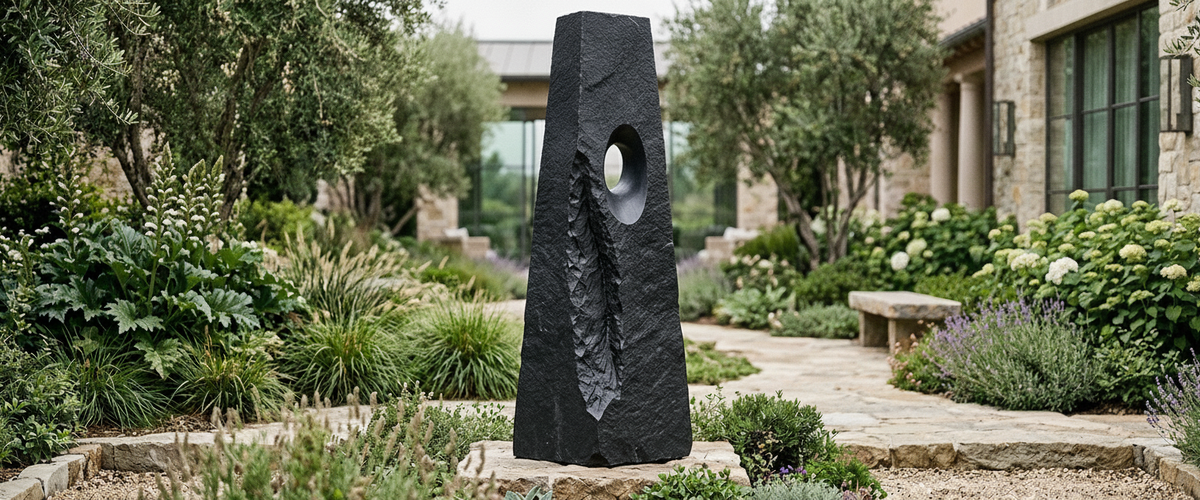

Stand twenty paces back from a large abstract stone sculpture and you will not see the carving at all. You see mass, outline, and the way a block of granite or basalt cuts into the horizon line behind it. Walk in to five paces and the piece switches jobs: now it is surface, facet, tool mark and shadow. Most buyers choose for the close view and then wonder why the piece disappears from the terrace. Get both distances right and the sculpture earns its footprint every day of the year.

Key Takeaways Before You Commission
Silhouette beats detail. At distance a large abstract stone sculpture is only an outline. Test it by squinting at the maquette photo until it blurs to a shape.
Finish controls light more than color does. Honed, flamed and polished granite behave like three different materials under the same sky.
Basalt holds a true matte black; black marble rarely does. That matters if you want the mid-century modern look.
Orientation is a design decision, not a placement afterthought. Rotate the block before the crane leaves.
Rain redraws the silhouette. Wet stone darkens unevenly, and porous stone shows it for days.
Budget follows stone type, block size, carving complexity, base engineering and installation access. Ask for a tailored quote rather than working from a headline figure.
Why a Large Abstract Stone Sculpture Reads as Mass First
A monolith at 8 to 12 feet (2.4 to 3.7 m) does something no tabletop piece can: it occupies volume in the landscape and makes the space around it feel measured. From a house window or the far end of a lawn, the eye registers proportion and edge. Anything subtler than about two inches (5 cm) of relief simply flattens out.
This is why we push clients toward bold primary gestures on any large abstract stone sculpture destined for open ground. A single deep cleft, a pierced void, an asymmetric taper. The fine chisel work then rewards the walk-up. One piece we shipped to a Hudson Valley property carries a 14-inch (36 cm) pierced aperture through the upper third, and the owner tells us the first thing guests do is look through it at the tree line. That hole is the silhouette and the close-up detail in one move.
Seen from the far side of a lawn, only mass and outline survive.
If your site cannot take the weight, or crane access rules out a carved block altogether, cast metal is the honest alternative. A form such as the Large Modern Abstract Anthropomorphic Figure Bronze Sculpture - 220cm reaches similar visual height with a far smaller foundation load, and bronze can cantilever in ways carved stone cannot. Where the sightlines are short rather than long, scale down rather than out: on an entry approach or an enclosed courtyard, a Large Modern Abstract Bronze Sculpture - 120cm holds the space that a full-height monolith would simply crowd.
Honed, Flamed and Polished Granite Under Flat Gray Light
Finish, not color, decides how a large abstract stone sculpture behaves under a dull sky. On a bright July afternoon almost any surface looks good. The test is an overcast day in February, when the sky is one flat sheet of gray and there is no directional sun to carve out form.
Polished granite becomes a mirror of that gray sky and can go strangely blank, though it snaps back to deep black or green the moment the light angles in. Honed finishes hold a steady matte value and are the safest choice for cloudy regions. Flamed (thermal) granite is the quiet winner outdoors: the torched surface spalls off a shallow rough layer that scatters light, keeps its color when wet, and grips underfoot if the piece doubles as seating. The Natural Stone Institute publishes useful technical guidance on how these finishes are produced and where each performs best.
Seeing finishes side by side beats any description. Memorial work is the easiest place to make that comparison in person, because a piece such as this Black Heart in a Grey Granite Surround Headstone - 120cm sets a mirror polish directly against a matte face, in the same light, at close range.

The Mid-Century Look: Large Abstract Black Stone Sculpture in Basalt or Marble
Type large abstract black stone sculpture MCM into a search bar and the results all point to one thing: dense, matte, near-graphite stone with a soft sheen and no veining. Basalt delivers it. It is a fine-grained volcanic stone, low in porosity, and it stays visually black rather than drifting to charcoal-brown as it ages outdoors.
Matte basalt keeps the MCM silhouette clean, with no veining to break the profile.
Black marble fakes the look convincingly indoors and then fails outside. It is a carbonate stone, so acidic rain slowly etches the polish, and the white calcite veining that reads as elegant in a foyer turns into pale scratches across a weathered face. Black granite sits between the two: tougher than marble, a little more reflective than basalt, and excellent when honed. For the true mid-century silhouette, the Brancusi-adjacent stacked or ovoid form in basalt is hard to beat, and it stays legible from a distance because the profile does the work.
Orienting the Cut So One Face Catches Morning Light
A large abstract stone sculpture has no internal light. It borrows all of it, which means a face that never receives raking sun stays dead all day regardless of how well it was carved.
Before the installation crew unstraps anything, walk the site at 8am and again at 5pm. Note which direction the useful low light comes from, then rotate the block so the most sculpted face sits roughly 30 to 45 degrees off that axis. Head-on light flattens; oblique light rakes across texture and pulls the carving forward. We once left a monolith on timber bearers for three days so the client could see it in four positions before we grouted the dowels. She chose the orientation that was third on our list, and she was right.
Shadow Is the Second Material
Carving depth is really a shadow budget. On an overcast noon there is no directional light, so only self-shadowing survives: undercuts, deep grooves, sharp arrises. A groove cut at 1 inch (2.5 cm) vanishes under a flat sky. The same groove at 3 inches (7.5 cm) with an undercut edge holds a dark line all day.
Ask your maker how deep the principal cuts go, not just how wide. When we develop a bespoke stone commission at Giant Sculptures, the clay maquette gets photographed under diffuse light specifically to prove which features survive with no sun on them.
Uplighting a Monolith Without Turning Your Garden Into a Film Set
Lighting a large abstract stone sculpture takes less hardware than most people expect. Two ground-recessed fixtures, tight beam, low output, set close to the base and aimed to skim the surface rather than blast it. That is usually the whole recipe. Light raking across the stone at a shallow angle pulls the texture out; a wide flood from six feet away erases it and throws glare at anyone on the terrace.
Warm color temperature suits stone better than cool. Around 2700K keeps granite and basalt looking like stone instead of like concrete. Shielded, downward-biased fixtures also keep spill out of the sky, which DarkSky International recommends for residential landscape lighting. One light on the silhouette side and one on the carved face gives depth. A third is usually one too many.

Wet Stone, Wrong Stone
Rain is the cheapest stress test you will ever run on a large abstract stone sculpture. Porous limestone and sandstone soak unevenly and can hold dark patches for days, which means the silhouette you approved in the yard is not the one you live with in November. Dense stone sheds water fast and darkens uniformly, which often looks better than dry.
Detailing matters more than sealer. Avoid flat upward faces that pond water, keep a shallow fall on any horizontal surface, and insist on a base detail that lifts the stone clear of soil splash. Drainage under the pad stops freeze-thaw pressure from working at the bed joint.
Pre-Commission Checklist
View the silhouette from your three main sightlines, blurred or squinted.
Confirm the stone type, quarry and finish in writing, including how the finish behaves wet.
Check foundation requirements and crane or gantry access before the block is cut.
Ask for maquette photos taken under flat, diffuse light.
Agree on final orientation on site, not in the workshop.
Plan lighting positions before hardscaping goes down.
Request a full quote covering stone, carving, base, delivery and install.
Stone rewards patience more than almost any material we work with. Get the silhouette, the finish and the orientation right and a large abstract stone sculpture will outlast the planting scheme around it, the house's paint color, and probably the next two owners. Browse our abstract sculptures for form ideas, compare the same gestures in metal across our bronze abstract sculptures, then talk to us about a bespoke carve for your site.
For wider placement ideas, Large Abstract Wall Art for Hallways: Bold Lines Win at Walking Speed is useful companion reading before you finalize the setting and sightlines.