






































































































Most hallway art fails for the same reason: someone chose it standing still, at arm's length, under showroom lighting. A corridor offers none of those conditions. Large abstract wall art earns its keep in a hallway by reading at walking speed, from a sideways glance, under a ceiling fixture that was never specified to flatter anything. Get that right and the narrowest run of wall in the house becomes the one guests remember.
Looking for the full range in this category? Browse our Wall Art & Wall Decor collection for every available finish, size, and configuration.

Quick Answer: What Works in a Corridor
One dominant gesture, not a dozen competing details. Complexity dies at walking speed.
Relief over flat. Carved or formed surfaces make their own shadow, which matters when the light is poor.
Scale to the wall plane, taking up roughly two thirds of the clear run, not to the console table beneath it.
Put the piece at a stopping point, the far end of the hall or a turn, so it gets looked at rather than passed.
Favor matte, brushed or hand-finished surfaces. High gloss in a tight corridor just throws the downlights back at you.
Two Seconds and a Sideways Glance
A hallway is a transit space. Nobody stands in one. The average person covers a domestic corridor in four or five strides, head forward, eyes catching the wall at an angle of maybe thirty degrees. That is the real viewing condition, and it should govern every decision you make about large abstract wall art for a hallway.
What survives that glance? Silhouette, contrast, rhythm and depth. What dies? Fine linework, subtle tonal shifts, small internal detail, and anything that relies on a title card to make sense. We have watched clients fall for a delicate piece in a well-lit studio, install it in a corridor, and quietly stop noticing it within a month. The art did not change. The viewing conditions did.

The Three-Foot Problem
Hallways are typically three to five feet wide (0.9 to 1.5 m). That means you never step back from the work. You see it from about three feet away, or in peripheral vision from the far end of the run, and almost never from the eight or ten feet that a painting-sized composition wants.
Up close, texture wins. Anything finer than a confident brushmark or a carved groove collapses into noise. From the far end, mass wins: the outline of the panel and its single strongest line. Large abstract wall art for a hallway has to work at both those distances and ignore everything in between. That is a design constraint, and a useful one, because it rules out roughly ninety percent of what people consider.
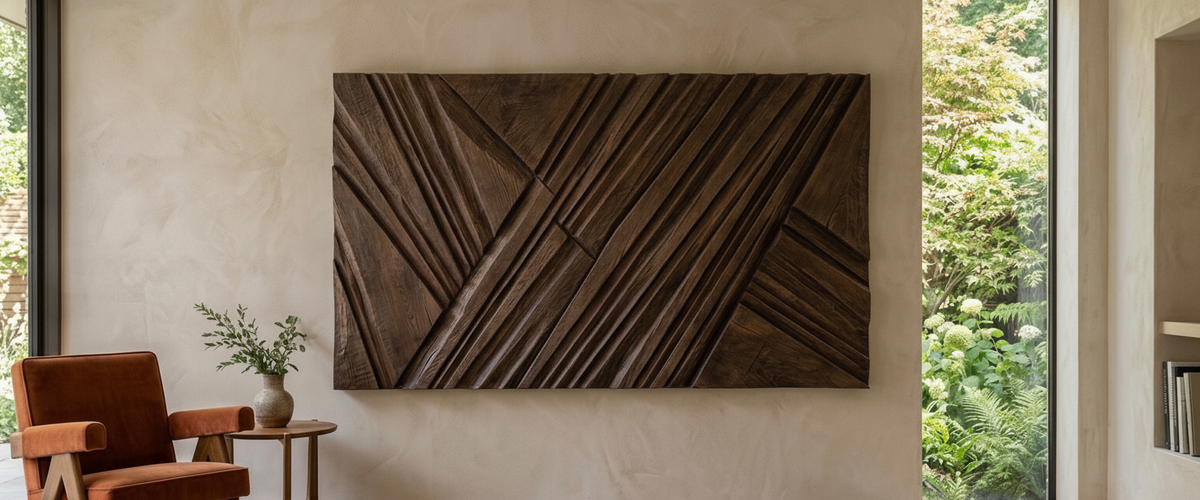
Large abstract wall art sized to the wall plane: one carved stroke still reads from the far end of the corridor.
One Dominant Line Beats Twelve Clever Ones
In a wide living room you can afford a busy composition; the eye has room to wander. A corridor has no wandering. Pick a piece with a clear governing gesture, a diagonal sweep, a repeating rhythm, a single deep trace, and let everything else support it. Where one sweep is doing all the work, a carved panel such as Barwick Mocha Stroke Abstract 3D Carving Wall Art survives both viewing distances: the stroke carries from the far end of the hall, and the tool marks hold up when you are close enough to touch them.
Repeating patterns are the other reliable option. Grid and trace compositions give a corridor a beat that matches your stride, which is why they suit long runs better than a single asymmetric composition would. For a wall meant to be traveled along rather than faced, a repeating carving like Barwick Mocha Trace Abstract 3D Carving Wall Art paces the run in a way a single focal gesture cannot. Browse the wider abstract art collection with that filter in mind: if you cannot describe the piece in one short sentence, it is probably too busy for a hallway.

Relief Carving Versus Flat Canvas Under Weak Light
Hallway lighting is usually a row of downlights or a single central fitting. Both produce steep, unflattering light that flattens a canvas and creates glare on anything varnished. Relief work turns that same problem into an asset: a carved timber panel or a formed metal surface generates its own shadow line, and the shadow shifts as you walk past. The piece animates.
Relief surfaces give large abstract wall art its own shadow line under steep, unhelpful hallway downlights.
Lighting professionals have long recommended aiming accent light at roughly a thirty-degree angle to reduce glare and reveal surface texture, guidance summarized by the Illuminating Engineering Society. Few hallways allow that. Relief sculpture is the workaround. If you want metal rather than wood, our metal wall art range covers brushed aluminium, stainless and patinated finishes that catch light without mirroring it.
One caveat on carved timber: corridors near kitchens, mudrooms or unconditioned garages see real humidity swings, and wood moves. The V&A's guidance on caring for wooden objects makes the same point conservators make in the studio. Keep panels off external walls that get cold, and away from vents.
Size to the Wall Plane, Not the Console Table
The most common mistake we correct at quotation stage is sizing large abstract wall art to the furniture. A console table is 4 feet (1.2 m) wide, so the buyer orders a 4-foot panel, and the result looks like a headboard with nowhere to sleep. Hallways are read as planes, not vignettes. Measure the clear uninterrupted wall between door casings and let the piece take roughly two thirds of it.
Height matters too. Standard picture-hanging convention centers work at 57 to 60 inches (145 to 152 cm), but in a corridor where you are close and looking slightly up, lifting the center a few inches often reads better. Hang a sample of cardboard cut to size, walk the hall three times, then decide.
Give the Panel a Stopping Point
A piece mounted halfway along a hall gets seen in passing. A piece on the end wall, or on the return face of a turn, gets looked at. That single placement decision does more for the perceived value of large abstract wall art than any upgrade in size. If your corridor ends in a blank wall, that is the prime location; if it ends in a door, use the wall that faces you as you come up the stairs instead. Multi-panel runs are the exception, since they are designed to be traveled along rather than faced.

Two Hallway Pieces We Shipped
The first was a brushed aluminium run for a Tribeca loft, just under 8 feet (2.4 m) long, split into three vertical sections with a continuous formed ridge crossing all three. The client's architect had specified a wash of light along the wall, and the ridge read differently from each end of the corridor. We adjusted the ridge depth twice during sampling because the first version disappeared under the installed fixtures.
The second was a carved timber wall for a Napa guest wing: a full-height panel array in a deep, quiet finish, cut in a repeating trace pattern close to the Barwick Charcoal Flow Abstract 3D Carving Wall Art language, chosen because the darker finish held its shadow line under a very warm, very low light level. The lesson from that job was mounting, not art. Timber at that scale needs a proper cleat system and a wall survey before anything is fabricated. Giant Sculptures handles both as part of a bespoke commission, along with finish samples matched to the paint and flooring you already have.
Hallway Buying Checklist
Measure the clear wall width between casings, switches and thermostats, not the whole corridor.
Note the light source type and position before choosing between relief and flat.
Test the composition from the far end of the hall at your normal walking pace.
Check wall construction, stud, masonry or plasterboard, and confirm fixings early.
Decide whether the piece is a destination or a rhythm along the run.
Ask for a finish sample viewed in the actual corridor, not under studio lights.
Confirm access: stairwells and tight turns dictate maximum single-panel size.
Commissioning Large Abstract Wall Art
Standard sizes rarely match a real corridor, which is why most of the large abstract wall art we make begins as a made-to-measure wall sculpture commission. Budget depends on material, overall scale, depth of carving or forming, engineering for the fixings, and the finishing process, so the honest answer is a tailored quote once we have your wall dimensions and a photo of the space. Send the measurements, the lighting layout and a shot taken from the far end of the hall. That last image tells us more than anything else you could send.
For wider placement ideas, Large Acrylic Wall Art Lives or Dies by the Light You Give It is useful companion reading before finalising the setting and sightlines.