





































































































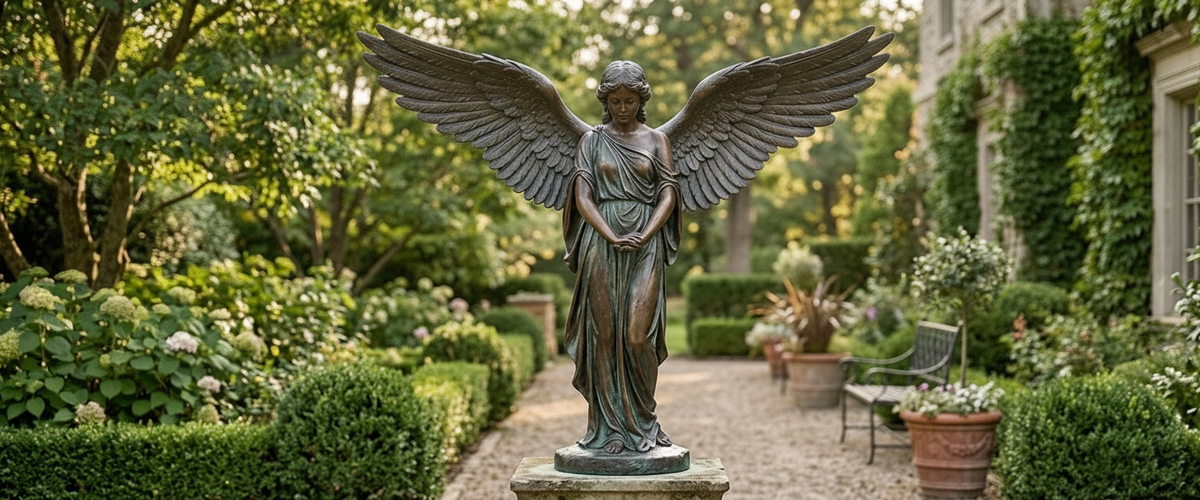

Two angels can share the same pose, the same wingspan and the same catalog photograph, and still be separated by fifty years of service life. One is cast bronze with chased feather detail and a patina that will keep improving. The other is resin with a sprayed coating that chalks out after four summers in Texas sun. Most people searching for bronze angel statues for sale are looking at images; the useful buying decision happens somewhere else entirely, in the metal, the wall thickness and the way the maker handled the parts you never photograph. Read any bronze angel statues sale listing for those three things first.

At a Glance: What Separates a Good Bronze Angel From a Cheap One
Material honesty. Ask whether it is solid cast bronze, bronze-clad resin, or brass alloy sold loosely as bronze. The three age nothing alike.
Wing engineering. Outstretched wings are cantilevered weight. They need internal armature or generous wall thickness at the shoulder joint.
Patina intent. Dark brown, verdigris green and bare weathering are decisions you live with for decades, not finishes you swap on a whim.
Height follows setting. A memorial plot, a planted border and an entrance hall each demand a different scale of figure.
"Sale" is not one thing. A bronze angel statues sale can mean a stock cast ready to crate, a numbered edition, or a quote-only commission.
Why Bronze Wingtips Outlive the Marble and Resin Versions of the Same Pose
Wings are the weak point of every angel ever made. In marble, a raised wingtip is a thin blade of stone running against the grain, and one hard frost cycle or one careless landscaping crew can take the end off it. In resin, the tip survives impact better but the surface does not survive UV; pigment fades unevenly and the coating crazes along the edges where it is thinnest. Bronze behaves differently because the strength is in the metal itself rather than in a surface layer. A well-cast wingtip flexes marginally, absorbs a knock, and carries no color that can wash off.
That structural advantage is why nearly every serious outdoor memorial figure we ship is bronze. The lost-wax process used for most figurative casting has barely changed in principle since antiquity, which is part of why ancient bronzes survive in recognizable condition while their marble contemporaries arrive in fragments. When buyers compare bronze angel statues for sale against a cheaper composite version of the same figure, the honest comparison is not purchase day. It is year fifteen.

Casting Tells: Seam Lines, Chasing Marks and What the Underside of a Wing Admits
Turn the photographs sideways. Large figurative bronzes are cast in sections and welded, so seams are normal; sloppy seams are not. On a good cast, the weld line through a wing or a shoulder has been chased back by hand until the feather pattern runs continuously across it. On a rushed cast, the detail stops, restarts and does not line up.
Then look underneath. Most bronze angel statues sale photography is shot from the front and slightly above, which conveniently hides the underside of a wing, and that is exactly where foundries economize because buyers rarely inspect it. Well-finished work carries the same chasing texture top and bottom; weaker work shows raw casting skin, pitting or grinder swirls. Ask for a photograph of the wing underside and the base plate before you commit. Sellers with nothing to hide send it within the day. Ask also about wall thickness at the shoulder, since that single dimension predicts whether an outstretched wing stays true after a decade of thermal movement.
Hand chasing carries the feather pattern straight through the weld line on a properly finished wing.
Dark Brown, Verdigris or Bare Weathering: Choosing a Patina You Can Live With
Patina is chemistry applied with heat, and it sets the mood of the piece permanently; nothing else in a bronze angel statues sale commits you quite so firmly. A dark chocolate or near-black brown reads formal and holds up beautifully against pale stone, gravel and limestone paving; it suits memorial and architectural settings where you want gravity rather than color. Verdigris greens lift a figure out of dense planting and look at home in a shaded Hamptons garden or a Napa courtyard where foliage would otherwise swallow a dark bronze. Bare or lightly waxed bronze left to weather naturally will drift toward brown and then toward streaked green over years, which some collectors love and some find unruly.
Whichever you choose, the finish is maintained, not permanent. Outdoor bronzes are conventionally protected with a wax coat renewed on a regular cycle, and conservation guidance from the National Park Service Conserve O Gram series remains the clearest plain-English reference for that routine. Indoors the burden almost disappears, and the design language can soften with it: where a room wants quiet contemplation rather than ceremony, a 50 cm piece like the Contemporary Contemplative Angel Bronze Sculpture - 50cm sits on a console table and asks for little more than a dry cloth and no direct radiator heat.

Memorial Plot, Planted Border or Entrance Hall: How the Setting Dictates Height
Height is the mistake we correct most often, and it is the one thing a bronze angel statues sale listing cannot decide for you. A memorial plot has tight footprint rules and sightlines from a standing viewer, so a figure between roughly 3 and 5 feet (90 to 150 cm) on a low plinth usually reads correctly without overwhelming neighboring stones. A planted border eats scale alive; anything below waist height disappears by midsummer, so we push clients taller and set the piece where a hedge gives it a backdrop.
Entrance halls and stair landings are the opposite problem, where a tall piece works precisely because the eye travels upward. A standing figure such as the Classical Winged Angel Candelabra Bronze Sculpture - 190cm, at roughly 6 ft 3 in (190 cm), holds a double-height lobby in a way a three-foot version never will. Water changes the arithmetic again: with something like the Large Classical Woman and Cherubs Bronze Fountain - 150cm at about 5 feet (150 cm), the basin adds visual width before the figure adds any height, so measure the pool diameter before you argue about the figure. Browse the full bronze angel and cherub statues range with the setting measured, not guessed.
The same pose at 90 cm and 190 cm: setting, not preference, should set the height.
What the Word "Sale" Hides: Stock Casts, Editions and Commissions
Listings for bronze angel statues for sale cover three different transactions. A stock cast exists, is crated and ships on a known lead time. A numbered edition is cast to order from an existing mold, which means production time and often a choice of patina. A commission is a new model built to your drawing, scale and site, quoted individually. Budget follows material volume, scale, complexity of the modeling, engineering for wind and water, installation and finishing, so any bronze angel statues sale priced as a flat figure before anyone has seen your site is guesswork. Request a tailored quote and a lead time in writing.
Two Questions Worth Asking Any Seller Before a Bronze Angel Leaves the Foundry
Two questions separate a sound bronze angel statues sale from an expensive lesson.
How is it fixed down? Threaded rods cast into the feet, a hidden base plate, or nothing at all? We once had a family memorial destined for upstate New York where the plinth had been drilled to a different pattern than the statue. Catching it at the foundry cost an email. Catching it at the cemetery would have cost a return shipment.
What is the patina specification, and can it be renewed? A patina applied with heat and sealed correctly can be refreshed in place years later. A sprayed color coat cannot, and that answer tells you everything about what you are actually buying.

Pre-Purchase Checklist
Confirm cast bronze, in writing, with alloy noted
Request photographs of wing undersides, base plate and any weld seams
Agree the patina color and finish before production starts
Measure viewing distance and backdrop height, then choose scale
Check plinth drilling, fixings and drainage under the base
Confirm crate dimensions, access route and lifting method for site day
Ask for the wax or care schedule appropriate to your climate
Giant Sculptures works at the scale where these details stop being pedantic and start being structural. Every bronze angel statues sale we handle begins with the same conversation about site, fixings and finish. Whether you are comparing ready-to-ship angel statues, planning a figure for a garden of bronze garden statues, or commissioning something that has never been cast before, the pieces that still look right in thirty years are the ones specified properly in the first fortnight.
For wider placement ideas, How to Place a Large Angel Statue in a Garden so It Reads From the House is useful companion reading before finalising the setting and sightlines.