





































































































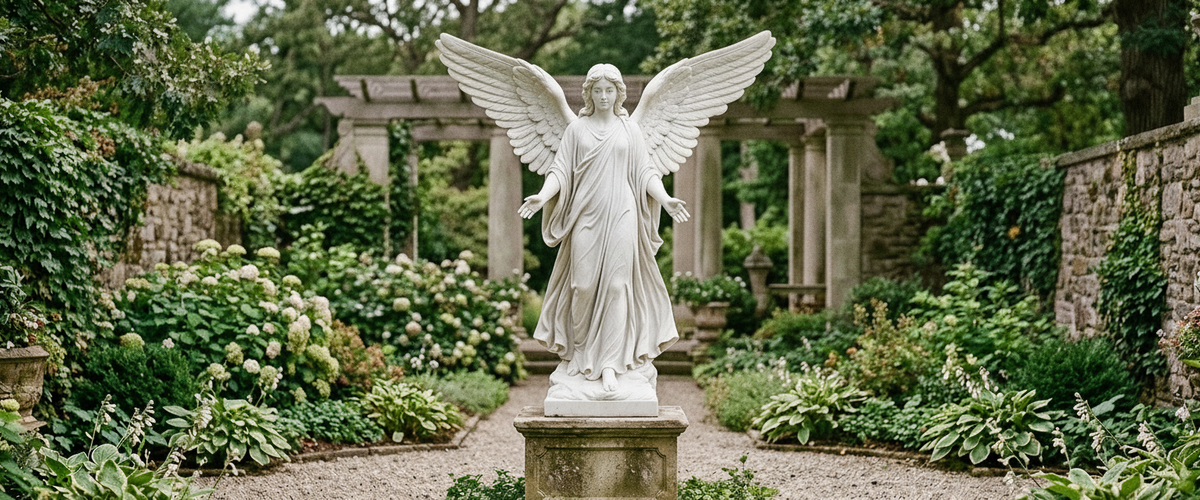

A 5 ft 7 in (170 cm) marble angel looked monumental on our studio floor. Crated, trucked across a Napa lawn and set at the end of a fifty-foot (15 m) mown avenue, the same figure read like a garden ornament. Nothing was wrong with the carving. Everything was wrong with the distance. Large angel statue garden placement, rather than the sculpture itself, is the single most common reason clients call us back a few weeks after delivery.
Distance eats sculpture. So does open sky, a missing backdrop and a plinth chosen by eye. Settle the large angel statue garden decisions before you choose the figure and the piece will hold a garden for decades.

Key Takeaways Before You Choose
Pick the sightline first, then size the figure to the viewing distance.
Roughly, a figure loses visual authority beyond about 30 to 40 feet (9 to 12 m) unless it is at least life-size and raised.
Wings need a solid backdrop. Open sky flattens them into silhouette.
Plinth height is a design decision, not packaging. Too tall and the whole composition goes top-heavy.
Full-height stone and bronze in a large angel statue garden setting need real footings, drainage and crane or gantry access planned in advance.
Large Angel Statue Garden Scale: Why Figures Shrink at Distance
A 6 ft 7 in (200 cm) figure standing at 15 feet (4.5 m) is commanding. Push it out to 50 feet (15 m) and it occupies a fraction of your field of view, competing with a house, a treeline and a lot of empty grass. The eye reads relative size, not absolute size. This is why nineteenth-century cemetery and estate angels were so often set on tall pedestals within enclosed yew or brick surrounds; the enclosure gave the figure something to be big against.
Two fixes work in a large angel statue garden layout. Move the figure closer to the primary viewpoint, or go up in scale. Across a long mown avenue, a 7 ft 3 in (220 cm) upright such as the Standing Angel With Open Arms Marble Garden Statue - 220cm holds the distance far better than a seated composition, because the raised arms and vertical drapery keep both width and height legible at fifty feet. Seated compositions are quieter and want a closer, more intimate setting.
Viewing distance, not carving quality, decides whether a figure holds the lawn.

The Window Test: Pick the Sightline Before You Pick the Angel
Stand at the window you actually use. The kitchen sink, the desk, the head of the dining table. That view is where a large angel statue garden focal point earns its keep, not the drone shot. Send someone out into the garden carrying a bamboo cane or a broom handle while you watch, and mark the exact spot where the figure would stop your eye without blocking the view of something you love.
Then check the second sightline: the approach from the drive or the terrace steps. If the two disagree, favor the interior view. You will look at a large angel statue for a garden far more often from inside the house than from anywhere on the lawn, especially between November and March.
Plinth-to-Figure Ratio and the Point Where It Goes Top-Heavy
For a standing figure viewed at a distance in a large angel statue garden scheme, a plinth of roughly a third of the figure's height is a sensible starting point. It lifts the feet clear of splash-back and wet mulch, and gives the composition a base that reads as architecture. Push much past half the figure height and the plinth starts to dominate; you get a monument on a stalk, and in wind the whole assembly becomes a lever on its footing.
Seated and reclining pieces want less. A composition like the Seated Angel With Roses Marble Garden Statue - 170cm belongs on a low, broad base close to the ground plane, where the viewer looks slightly down onto the shoulders and the roses. Raise a seated figure too high and you spend all your time looking at the underside of the knees.
Wings Need a Backdrop
Wings are the reason angels are difficult, and backdrop is the detail most large angel statue garden plans skip. Carved feathers rely on shadow to read, and against bright open sky they collapse into a dark outline. Clipped yew, a brick or stone wall, a dense holly hedge or a mass of dark evergreen gives the feather work something to sit against, and the reflected light from a warm brick wall in particular does flattering things to white marble.
A dark hedge or masonry wall keeps carved feathers from flattening into silhouette.
If you cannot get a green or masonry backdrop, consider bronze instead. A patinated bronze figure holds form against sky far better than white stone, because the surface carries its own tonal variation. The bronze angel and cherub statues are a useful comparison point for a large angel statue garden on an exposed terrace or a coastal site where salt and glare are in play.

Approach Angles and the Three-Quarter View
Very few figurative sculptures look their best head-on, and a large angel statue garden position is no exception. Turn the piece 20 to 30 degrees off the axis of the path and the drapery starts to work: one leg advances, folds catch raking light, the wings separate rather than reading as one flat plane. We rotate pieces on site for this reason, and clients are often surprised how much a small turn changes the character.
Plan the approach so visitors meet the figure from three-quarters and only square up in the final few steps. If the angel sits at the end of a formal axis where a straight-on view is unavoidable, choose a composition with asymmetry built in, such as a figure with one arm raised or the head inclined.
The February Check
Every garden looks generous in June. Go out in February, when the borders have died back and the perennials are cut to the ground, and look at your chosen position again. That bare month is the honest test. A large angel statue garden focal point that only works when it is surrounded by summer planting is badly sited; a well-placed one becomes the reason the winter garden still holds together.
Also check what is behind it in winter. Deciduous screening that hides a neighbor's shed in August may be transparent in February, and suddenly your figure is framed by a gray fence panel.
Ground Bearing and Footings for a Full-Height Stone or Bronze Angel
Marble and bronze at full height are heavy, and lawns are not foundations. The footing under a large angel statue garden installation should be a poured, reinforced concrete pad wider than the plinth footprint, taken below the local frost line and laid on compacted hardcore. On clay soils, seasonal shrink and swell will tilt an undersized pad within a couple of seasons, and a tilted angel never looks accidental.
Detail the connection too: stainless dowels or pins bedded into the plinth, a mortar bed that lets water escape rather than trapping it, and a slight fall on the pad surface. Trapped moisture and freeze-thaw cycling are the main agents of decay in outdoor stone, a point made repeatedly in technical conservation guidance for stone in exposed conditions. Plan access before delivery day as well. We have had crates that needed a tracked spider crane over a gravel drive, and that is a conversation to have weeks ahead, not on the morning.

Large Angel Statue Garden Placement Checklist
For wider placement ideas, Angel Cherub Garden Statues: Putto, Cherub, or Full-height Angel? is useful companion reading before finalizing the setting and sightlines.
Confirm the primary interior sightline and the viewing distance in feet.
Size the figure to that distance; increase height rather than shrinking the setting.
Test the position with a pole or a cardboard silhouette at full height for at least 48 hours.
Identify a backdrop for the wings, or switch material to bronze.
Set the plinth at roughly a third of figure height for standing works; lower for seated.
Rotate the piece off-axis so the main approach gives a three-quarter view.
Check the position in winter conditions before pouring anything.
Design footings for frost depth, soil type and drainage, with the plinth pinned.
Confirm crane, gantry or tracked access and ground protection for delivery.
Agree a simple annual care routine: rinse, check pointing, inspect the pin bed.
Commissioning a Piece to Fit the Site
When a stock size does not suit the sightline, we scale the figure to the garden rather than the other way around. Most large angel statue garden commissions at Giant Sculptures start with photographs from the actual viewpoint, the viewing distance, and a note on backdrop and light direction. From there we discuss material, carving depth, patina or finish, plinth design, and how the piece will be fixed and lifted. Budget depends on scale, material, carving complexity, engineering, finishing and installation, so we quote each commission individually.
Smaller pieces still have a role in the same scheme. At 20 in (50 cm), the Contemporary Contemplative Angel Bronze Sculpture - 50cm is scaled for a courtyard, a planted alcove or a terrace table where the viewer stands within a few feet, and it reads as a deliberate counterpoint to a full-height figure elsewhere on the property. Compare poses and heights across the wider angel statues collection, then send us the site photos and we will tell you honestly whether your large angel statue garden position works.