



















































































Search for a large gothic angel sculpture and most of what comes back is a Victorian cemetery angel: wings thrown open, chin lifted toward heaven, a lily resting in one hand. Handsome carving, often the right piece for a memorial garden. It is rarely Gothic. The medieval idiom is quieter, heavier and more vertical, and the difference reads from thirty feet away long before anyone gets close enough to study the face.

Key Takeaways
Drapery depth and a downcast gaze carry the Gothic character. The wingspan does not.
Medieval figures are column-like and compressed; Victorian cemetery angels are expansive and sentimental. Neo-Gothic sits between the two.
Limestone and sandstone age into the style. High-polish white marble fights it.
A surface kept spotless looks newer every year, not better.
Eight feet (2.4 m) can read small against a tall gable, a stone wall or mature trees. Measure the backdrop, not just the plinth.
Pressure washing, film-forming sealants and aggressive cleaning do more damage than a decade of weather.
Medieval, Victorian Cemetery and Neo-Gothic: Three Silhouettes People Keep Confusing
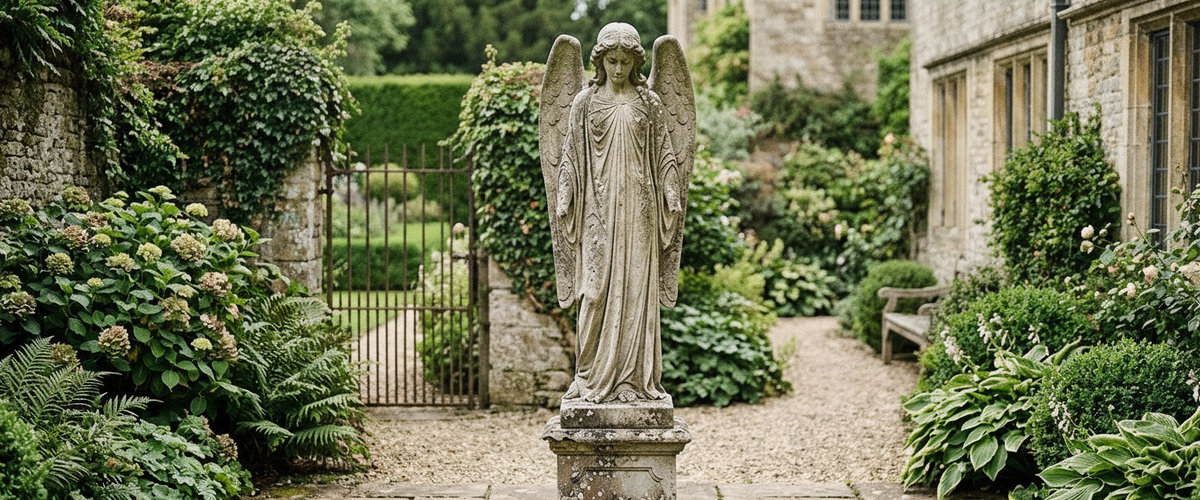
True medieval angels were architecture first and figure second. Carved for jamb, niche and tympanum, they stand almost as columns: narrow shoulders, long vertical folds, wings folded close against the back rather than spread. The proportions are often deliberately stretched because the figure was meant to be seen from below and at distance. Faces are calm, slightly abstract, not expressive in the modern sense.
The Victorian cemetery angel is a different animal entirely. It belongs to roughly 1860 to 1910, carved in soft white marble, full of naturalistic feathering and drapery that flutters rather than hangs. The attributes give it away: hearts, anchors, trumpets, scrolls. The Association for Gravestone Studies documents how quickly this iconography spread through nineteenth-century burial grounds on both sides of the Atlantic.
Neo-Gothic is the middle ground and often the most practical answer for a modern commission. It takes the medieval silhouette and sharpens it, usually paired with tracery, a canopy or a pinnacle base. Most clients who tell us they want a large gothic angel sculpture actually want this: medieval bones with enough carving refinement to survive close inspection in a garden setting.

Drapery Weight and a Downcast Gaze Do Most of the Gothic Work
Ask a carver what makes a large gothic angel sculpture read as medieval and they will point at the cloth. Gothic drapery hangs. It has mass, deep undercuts and long unbroken vertical runs that pull the eye down the figure and hold shadow through the middle of the day. Victorian drapery flutters and catches imaginary wind, which reads as movement and sentiment rather than gravity.
Deep, unbroken folds hold shadow even under high sun, which is what keeps medieval carving legible at distance.
The head does the rest. A downcast gaze, eyes lowered toward the viewer or the ground, produces the introspective quality people associate with cathedral sculpture. Lift the chin and the whole piece switches register to triumph. We have watched a commission change character entirely through a fifteen-degree adjustment to the neck angle at clay stage, which is exactly why we push clients to review maquettes from their actual viewing distance rather than from two feet away in a studio.
Wings are the least important variable, despite being the thing buyers ask about first. Held close and slightly raised, they act as a vertical frame. Spread wide, they flatten the figure into a silhouette that belongs on a monument, not in a garden.
Limestone Weathers into the Style, Polished Marble Argues with It
Material choice decides how the piece looks in year ten, not year one. Limestone and fine sandstone darken unevenly, hold dirt in the undercuts and develop the tonal depth that makes medieval carving legible. That patchy gray is not decay; it is the effect the style was built around.
High-polish white marble does the opposite. It reflects light back out of the folds, erases shadow and reads crisp and modern. Beautiful for memorial work, wrong for Gothic. Where the brief is genuinely a family memorial rather than a Gothic statement, that softer marble vocabulary is the honest answer, and something like the Angel Resting on a Heart Marble Memorial Statue - 170cm uses it without pretending to be medieval. If marble is the requirement on a Gothic commission, for durability or client preference, specify a honed or lightly tooled finish so the surface can hold shade. Our marble sculptures are finished to brief for exactly this reason.
Bronze is the third route and an underrated one for a large gothic angel sculpture in a contemporary setting. A dark brown or near-black patina gives you the mass and shadow of stone with far better resistance to freeze-thaw damage in Aspen or upstate New York. For an interior hall, stair or chapel where the light is already low, a dark metal figure such as the Classical Winged Angel Candelabra Bronze Sculpture - 190cm holds its edges in conditions that would wash a pale stone carving flat.

Why a Spotless Surface Undercuts the Piece
Buyers who spend six figures on carving often want it kept looking new. Resist that instinct. A large gothic angel sculpture depends on tonal contrast between raised cloth and deep fold, and biological growth supplies it for free. Lichen colonization on exposed stone typically takes several years to become visible and considerably longer to look established, so patience is the only route there. Historic England's technical guidance on stone care is consistently blunt about the risk of removing growth that is doing no structural harm.
What you should remove: bird fouling, which is acidic and etches stone; and heavy moss holding standing water in horizontal joints. Everything else can stay.
Siting for the Low-Light Hours
A large gothic angel sculpture performs at dawn, dusk and under overcast skies. Direct midday sun flattens the carving into glare. Dark evergreen backing, yew above all, gives the tonal contrast the style was designed against, and a north-facing wall keeps the folds in constant soft shadow.
A recessed niche frames the figure and shelters the head and shoulders from driving rain.
Wall niches are the historically correct move and the most effective one. A recessed setting frames the figure, protects the head and shoulders from driving rain, and reproduces the architectural logic of the original carvings. A client outside Millbrook, New York set one into a stone barn wall facing a walled kitchen garden, and the piece looks inevitable there in a way a lawn plinth never manages.
Eight Feet Can Still Read Small
Scale errors are the most common and most expensive mistake we see. An 8 ft (2.4 m) figure sounds commanding on a spec sheet. Set it against a 30 ft gable, a run of mature oaks or the long facade of a Texas ranch house and it shrinks to an ornament. The backdrop sets the scale, not the sculpture.
Photograph the site, then have someone stand where the piece will go so you have a human reference at true distance. For architectural backdrops, multi-figure groups solve the problem better than one taller angel: the Angel and Mourner Marble Memorial Monument - 300cm holds a large elevation because it has internal composition to look at, not simply height. Plinth design is part of the calculation too, and a tall base changes sightlines as much as another two feet of carving.

The Maintenance You Should Refuse
Pressure washing. It drives water into the stone, opens micro-fractures and strips the surface skin. Never appropriate on carved detail.
Film-forming sealants. They trap moisture behind an impermeable layer, and when they fail they take surface stone with them.
Wire brushes and abrasive pads. Undercuts are where the shadow lives. Scrub them out and the piece goes mute.
Household bleach or acidic cleaners. Fast results, permanent etching on limestone and marble.
Annual deep cleans by default. Inspect yearly, intervene only when there is a reason.
Winter neglect at the base. Keep drainage clear so the plinth is not standing in water through freeze-thaw cycles.
Commissioning a Large Gothic Angel Sculpture
If you are browsing options for a large gothic angel sculpture for sale and nothing in stock hits the silhouette you have in mind, a commission is usually the shorter route than compromising. Bring three things to a first conversation: photographs of the site with the backdrop visible, one or two reference images that show the period you actually mean, and the viewing distance in feet.
From there we work through material, finish, wing position, gaze angle and base design, with maquette review before any stone is cut. Budget depends on scale, stone selection, carving complexity, engineering for the base and installation access, so we quote each commission individually rather than publishing bands that would mislead. Giant Sculptures has shipped large-format work to private estates, memorial gardens and commercial grounds across the US, and the projects that land best are always the ones where siting was decided before design began.
Start by looking at how different traditions handle the same subject in our angel statues collection, then narrow by material. The silhouette decision comes first. Everything else follows from it.
For wider placement ideas, How to Place a Large Angel Statue in a Garden so It Reads From the House is useful companion reading before finalising the setting and sightlines.