





































































































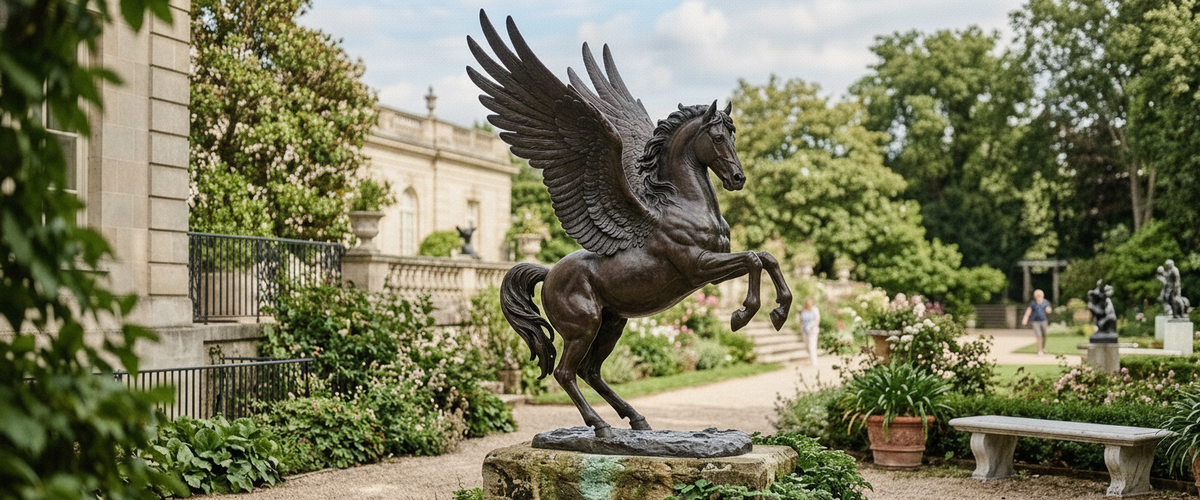

Most winged horses fail on site rather than in the foundry. The casting is clean, the wings are beautifully chased, and then the piece lands on a low lawn plinth where you look straight into its belly and the whole illusion of lift collapses. A bronze Pegasus sculpture is one of the few mythological subjects where pose, height and sight line are structurally linked. Get the relationship right and the horse reads as though it has just left the ground. Get it wrong and you own a very large, very heavy horse standing awkwardly on one leg.

Key Takeaways Before You Choose
Pose dictates site. A rearing figure needs frontal approach; a mid-flight figure needs air and distance around it.
Wings are sails. Span and angle drive wind load, which drives anchoring, not the other way around.
Plinth height sets the myth. Under-elevate a flying horse and it looks stranded.
Patina controls tone. Dark brown reads formal and architectural; green verdigris reads older and softer at distance.
Budget is quote-led. Scale, wing complexity, internal armature, base engineering, finishing and installation all move the number. Ask for a tailored quote rather than assuming a band.
Rearing, Landing or Mid-Flight: Three Poses That Demand Three Different Sites
For wider placement ideas, A Large Bronze Horse Sculpture Needs Room to Move is useful companion reading before finalising the setting and sightlines.
A rearing Pegasus is a frontal sculpture. The drama is in the chest, the raised forelegs and the wing arc behind, and it wants an approach that walks you toward the front three-quarter view. Driveway turning circles, courtyards and gate approaches suit it. Where the drive is long, the silhouette has to survive the distance, and a monumental rearing figure at around 9 feet 10 inches (300 cm), the scale of the Monumental Classical Rearing Pegasus Bronze Sculpture - 300cm, still reads clearly from 150 feet away, where a half-scale version would dissolve into the planting.
A landing pose, with forelegs reaching and wings cupped, is the hardest to place well. It implies a destination, so it needs a defined arrival point: the head of a lawn, a terrace edge, a pool axis. A mid-flight figure, wings extended and legs tucked or trailing, needs sky behind it. Set one against a dense hedge and the wings disappear into shadow. Shift the same figure 30 feet so a ridge line falls below the wing tips instead of sitting behind them, and that repositioning is often the only change the piece needs.
How Foundries Hide an Armature Inside a Single Raised Hoof
Ask any foundry what worries them about a winged horse and they will point at the contact points. A rearing figure may transfer several hundred pounds of bronze through one hind hoof and a tail tip. The answer is an internal stainless steel armature running from the base plate up through the supporting leg into the body core, welded to a hidden mounting flange rather than relying on the bronze wall thickness alone.
Two things separate a serious piece from a decorative one. First, if the tail touches the base it should be doing real structural work, disguised as movement. Second, the anchor bolts should land inside a poured concrete pad sized for the overturning moment, not into paving slabs. When we quote a bronze Pegasus sculpture for an exposed site, the base engineering is discussed before the modeling is signed off, because a change in wing angle changes the loads.

Wing Span Against Wind Load
Wings are the reason this subject behaves differently from a standing horse. A pair of extended wings on a monumental bronze Pegasus sculpture presents a large surface at height, and coastal or ridge-top sites amplify that. Hamptons dune gardens, Aspen slopes and open Texas acreage all deserve a wind check before the pose is finalized. Swept-back wings reduce exposed area and still read as speed. Fully spread wings look magnificent in a rendering, then ask for a deeper footing on site.
There is a design payoff too. Slightly angled wings catch light differently on each surface, so the piece changes through the day instead of presenting one flat plane.
Plinth Height and the Approach Angle
A bronze Pegasus sculpture meant to be read from below needs the modeling adjusted for that view, which is why classical equestrian figures often have exaggerated chests and slightly compressed heads. As a working rule, a flying or rearing horse wants the belly line above eye level for the main viewing position. On a level lawn with a 10 foot (3 m) casting, that usually means a plinth of at least 2 to 3 feet (60 to 90 cm). On a sloping approach, less. Walk the site at the actual viewing distance before you commit; a stack of pallets at the proposed height tells you more than any drawing.
Dark Brown Formality or Verdigris Distance
Patina changes how the myth lands, and the same bronze Pegasus sculpture can read Edwardian or entirely contemporary depending on the finish. A dark chocolate or near-black brown patina reads formal and architectural, and it holds detail crisply in bright sun. Green and blue verdigris tones push the piece backward in time and soften it against planting, which is why they work well in older gardens and near water. Both are chemically induced finishes protected by wax or lacquer, and both continue to shift outdoors. Conservation guidance on outdoor bronze, including work published by the Smithsonian Museum Conservation Institute, consistently points to regular waxing as the single most useful maintenance habit. Plan on a wash and re-wax each year, more often within a mile of salt air.
Gate Piers, Water Features and Open Lawn
Gate piers are the classic home for a matched pair of bronze Pegasus sculptures, and they work because the pier already supplies the height and the frontal approach. The risk is scale: piers usually want a piece smaller than you think, since the horse must sit within the pier footprint without overhanging.
Water is the most forgiving setting. Spray, movement and reflection give a winged horse the context it is asking for, so where a forecourt or large private courtyard can carry plumbing and a basin, a paired fountain group such as the Monumental Classical Pegasus Winged Horses Bronze Fountain - 300cm solves the base problem and the sight line problem at once. Open lawn is where a Pegasus most often looks stranded. Without a plinth, a basin, a hedge backdrop or a change in level, the figure floats in the middle of nothing. If lawn is the only option, build the ground plane: a gravel apron, a stone pad, or a low planted ring.
Interiors and smaller terraces need a different answer. Where the piece will be read from ten feet rather than a hundred, a figure of around 3 feet (90 cm) such as the Large Contemporary Winged Horse Bronze Sculpture - 90cm sits comfortably on a lobby console, a stair landing or a walled courtyard, and its pared-back modeling holds up at close range in a way a monumental classical figure never quite does indoors.
The Tail and Mane Test
Here is the quickest quality check when you compare bronze Pegasus sculpture options online. Look at the mane and tail. If the motion lives in those details, with strands separating, curling and catching light independently, the sculptor modeled movement. If the mane sits as one solid mass and only the legs and wings suggest speed, the motion is faked in the pose and the piece will look static at close range. The same test applies to feather layering: real modeling shows overlapping quills, not a scored surface.

Commissioning Checklist
Confirm the primary viewing distance and eye level, then set plinth height from it.
Ask for the internal armature specification and the base plate or bolt layout.
Check foundation requirements against your site, especially for exposed or coastal locations.
Choose patina against your architecture and light, and request finish samples.
Agree wax maintenance intervals and who performs them.
Plan access for delivery: crane position, gate widths, ground protection.
Request a tailored quote covering casting, finishing, crating, freight and installation.
Giant Sculptures works on bespoke commissions of exactly this kind, adjusting pose, wing angle, scale and patina on each bronze Pegasus sculpture to suit a specific site rather than shipping a catalog figure and hoping. The wider bronze sculptures range and the bronze animal sculptures collection are the easiest way to compare poses at scale, then send us the site photos. The horse is the easy part; the placement is where the commission is won.